
Weekly DAO | Currencies to Watch Next Week (4th week of August 2026)
~Environmental Recognition of Market through DAO~
Good morning.
Thank you for checking out this week's "Weekly DAO".
August is nearing its end, but the hot days continue. Even in Tokyo's August readings by the Meteorological Agency, high temperatures persisted, so it's still a time to watch your health. The market is similar; it's important not to trade frantically in the heat and to stick to your pace.
In this week's financial markets, rising U.S. long-term yields and crude oil prices were on investors’ minds, making the global stock market another volatile week. The Nikkei Average reportedly fell about 4% over the week. On the other hand, gold and Bitcoin rose, showing that different assets behave differently within the same market.
In forex, the environment surrounding the yen continues to draw attention. Even after the July 31 intervention, caution toward the yen remains in the market, and Japan's August inflation indicators support expectations of further BOJ rate hikes.
Looking at these headlines, you’re tempted to wonder, "Will the yen strengthen next week?", "Will stocks go down?", or "Will GOLD rise further?"
However, what I want to confirm with this week's "Weekly DAO" is not the future.
What is the current state of the market right now.
We will organize this in the DAO.
In the DAO, we line up multiple timeframes MN1, W1, D1, H4, H1 and check the direction, slope, and distance from the current price to EMA20.
If you do this first, you won’t make judgments like "since it’s going up somehow, I’ll buy"; instead you’ll view the chart after organizing the relationship between higher and lower timeframes.
As a discretionary trader with over 10 years of trading experience, I actually use DAO in my trades.
This "Weekly DAO" is not intended to predict future price movements.
It is a plan to organize the current environment and share the power relationships observable at that time.
Also, this article is for personal environmental recognition and is not intended as investment advice.
This Week’s DAO One Point
“Procedure for Environmental Recognition using DAO”
The theme this time is less about the DAO’s function itself and more abouthow to view the DAO in what order.
When beginners view charts, they sometimes start by looking for entry points from the beginning.
However, with DAO, you don’t immediately think "buy/sell."
First, you look at,the direction of the higher timeframes.
STEP1 Look at the direction of higher timeframes
Check whether EMA20 on MN1, W1, D1 is rising or falling.
Here you organize the long-term market direction.
STEP2 Look at the relationship with shorter timeframes
Next, check H4 and H1.
Even if higher timeframes are rising, if H1 is falling, not all timeframes are in the same direction.
Conversely, if MN1 to H1 are rising, the directions are aligned.
STEP3 Look at the distance between the current price and EMA20
In addition to direction, confirm how many pips the current price is away from EMA20.
For example, in this GBPUSD, it is only 1.0 pip from H1 EMA20.
Meanwhile, GOLD is 2,378 pips away, BTCUSD is 110,494.8 pips away.
Even with the same “buying advantage,” the current price position can be very different.
STEP4 Organize the power relations among timeframes
Are all timeframes moving in the same direction?
Or are higher timeframes and shorter timeframes pointing in different directions?
By looking here, you can organize whether the direction is currently clear or whether there is still disagreement among the data.
STEP5 Finally look at the chart
After organizing up to this point, actually inspect the candlesticks and support/resistance.
Even this ordered sequence will significantly change how you view the chart.
Direction → Position → Distance → Power Relationships → Chart
This is the basic flow of environmental recognition I use when employing DAO.
Next Week’s Top 3 Currencies to Watch
In this DAO analysis, 12 instruments were compared.
From those, I selected based on the alignment of long- and short-term directions, distance to EMA20 on H1, consistency across multiple timeframes, and overall clarity of environmental recognition.
3rd place NZDJPY
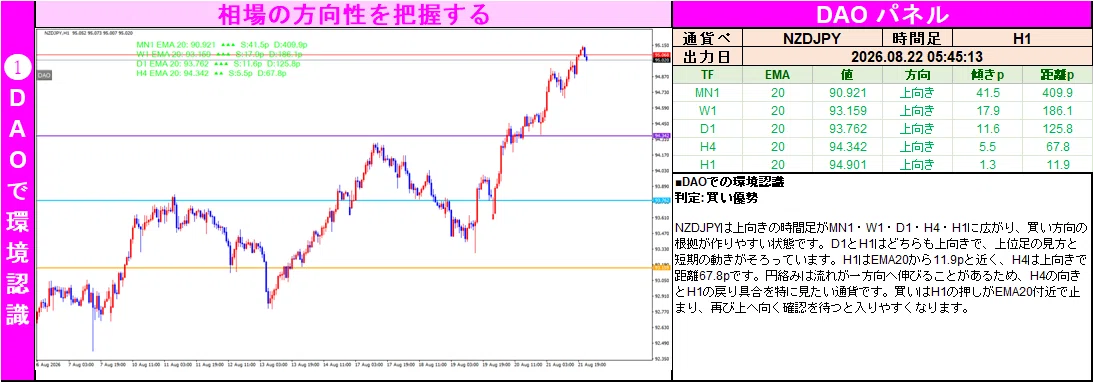
NZDJPY shows EMA20 rising on MN1, W1, D1, H4, and H1.
It is 11.9 pips away from H1 EMA20 and 67.8 pips away from H4 EMA20, making it easy to assess the relationship to EMA20 on shorter timeframes.
With the direction aligned from long to short term, it is one of the currencies where DAO environmental recognition is easy.
2nd place AUDUSD
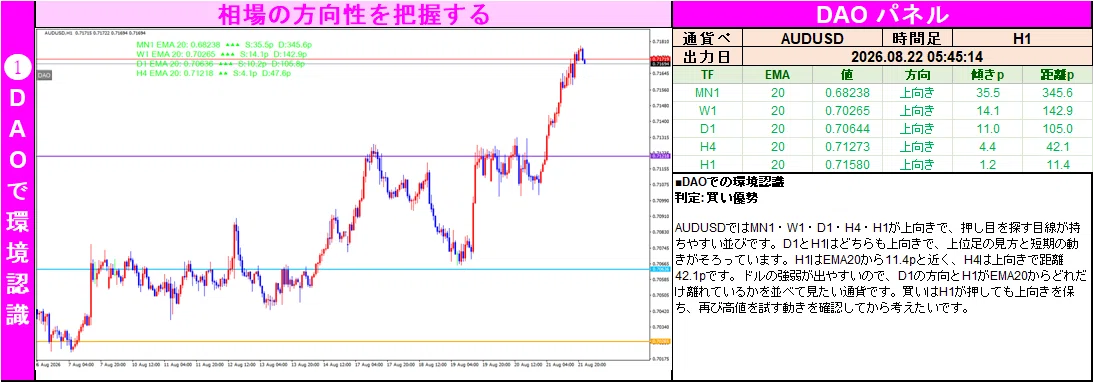
AUDUSD also has EMA20 rising on MN1 through H1.
It is 11.4 pips away from H1 EMA20 and 42.1 pips away from H4 EMA20, a favorable position for assessing the distance to EMA20 in short- to mid-term timeframes.
Because the directions of the long-term and short-term timeframes align, it was evaluated as easy to understand the current power dynamics.
1st place GBPUSD