
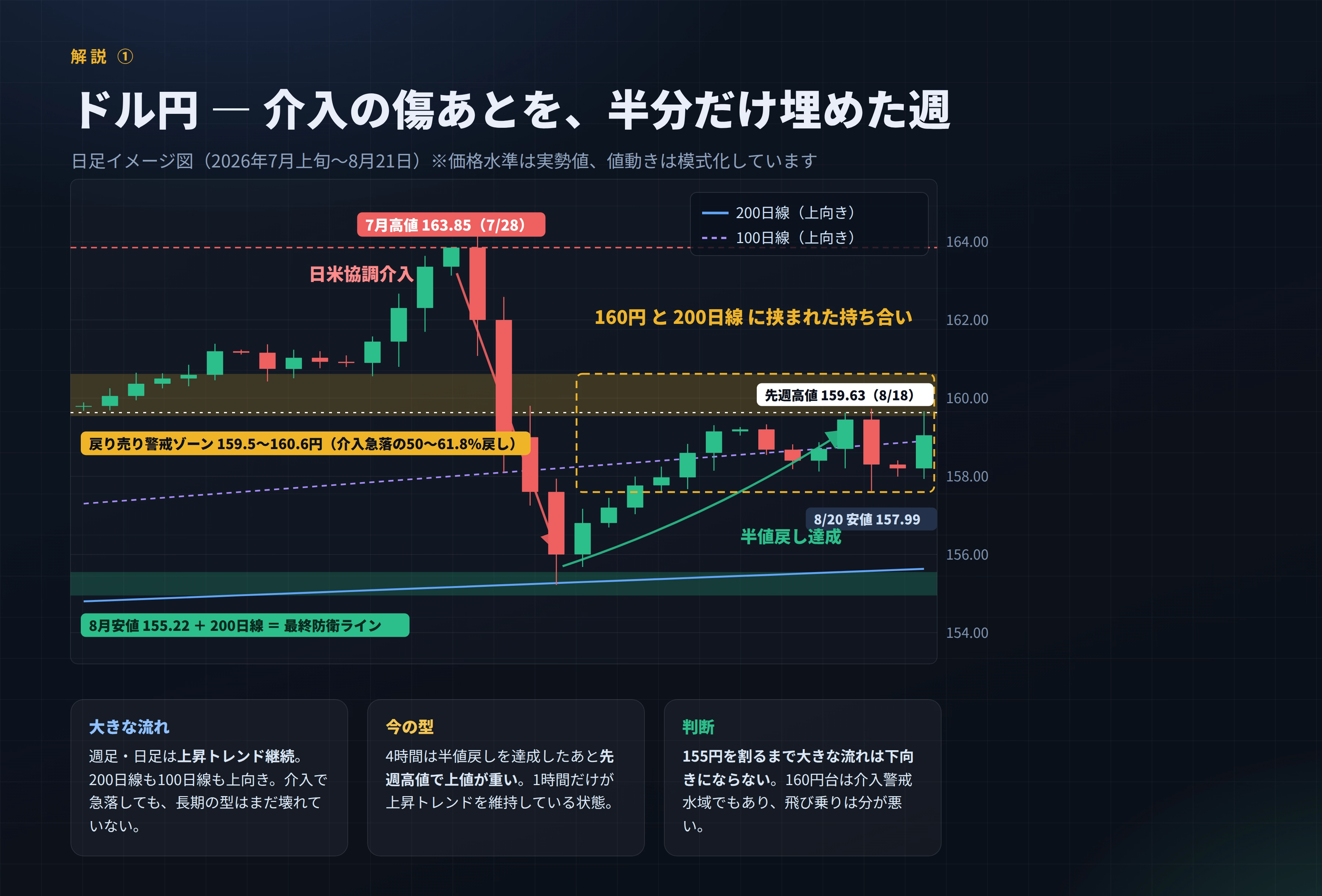
A week in which only half of the scar from intervention was filled
Dollar-Yen Talk — For Beginners
First, a metaphor
If you look at USD/JPY as this summer’s “one story,” it looks like this.
At the end of July, USD/JPY rose sharply to as high as 163.85 yen.
But when both Japan and the United States governments worried that the yen was too weak, they stepped in together in early August (intervention).
USD/JPY was driven down all the way to 155.22 yen in one shot.
After that, it crawled back up slowly, and now sits around 159 yen. It has recovered about half of the drop.
That is the big picture. We’ll break it down from here.
Three terms to know first
① Intervention (かいにゅう)
When the government or central bank determines that the yen is “too weak/too strong,” they directly buy/sell currency in the market to move the rate. This time, Japan and the United States acted together, so it was a “coordinated intervention.” It’s a power that individual investors can’t possibly contend with,so it’s safer not to approach price ranges where intervention seems likely.
② Retracement and “half-way back”
After a sharp drop, when the price rises a bit as buy orders come in, that rebound is called a “retracement.”
The drop this time was163.85 yen → 155.22 yen = about 8.6 yen.
If you pull back the half (50%), you getaround 159.5 yen. If it retraced a little more to 61.8%,around 160.6 yen.
These “50%” and “61.8%” levels arenumbers traders around the world look at as common stopping points, so it’s natural for the price to pause there.
③ 200-day moving average
The average price over the past 200 days, connected by a line. It’s like the “backbone of the long-term trend.” If the line is sloping upward, the big trend is up. In USD/JPY right now, this 200-day line sits approximatelyaround 155 yen.