
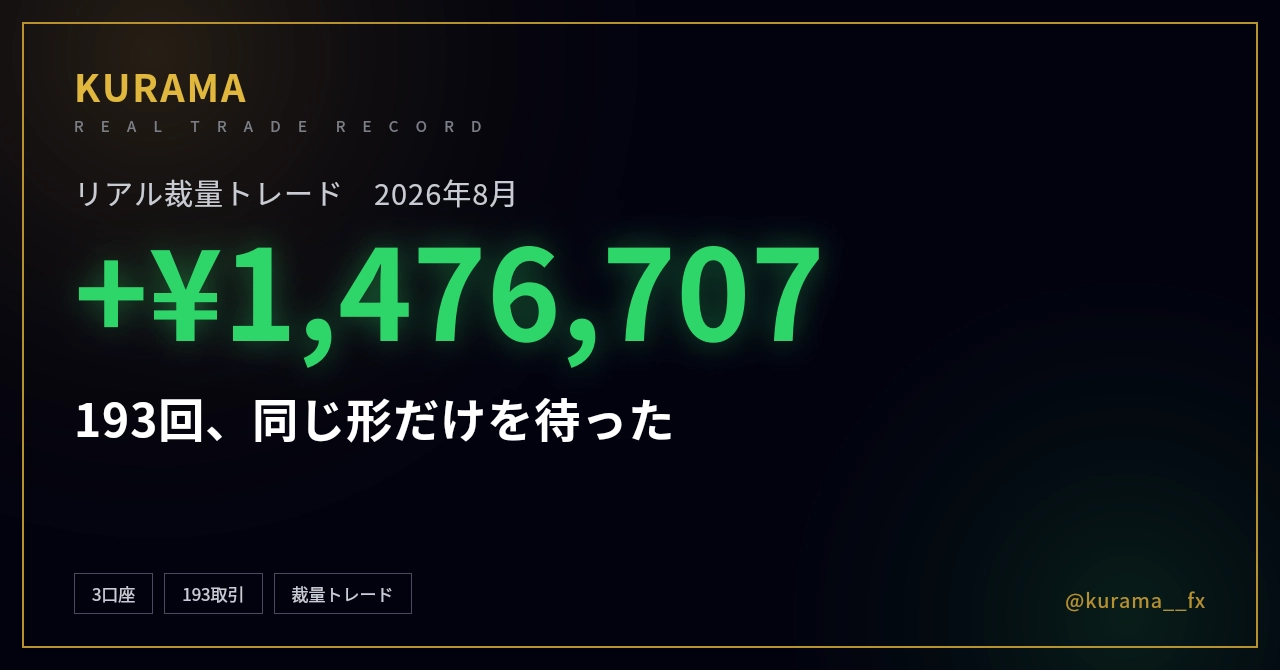
Real discretionary trading earns +1,470,000 yen. 193 times, waited only for the same pattern
Publicizing the performance of discretionary trading for August.
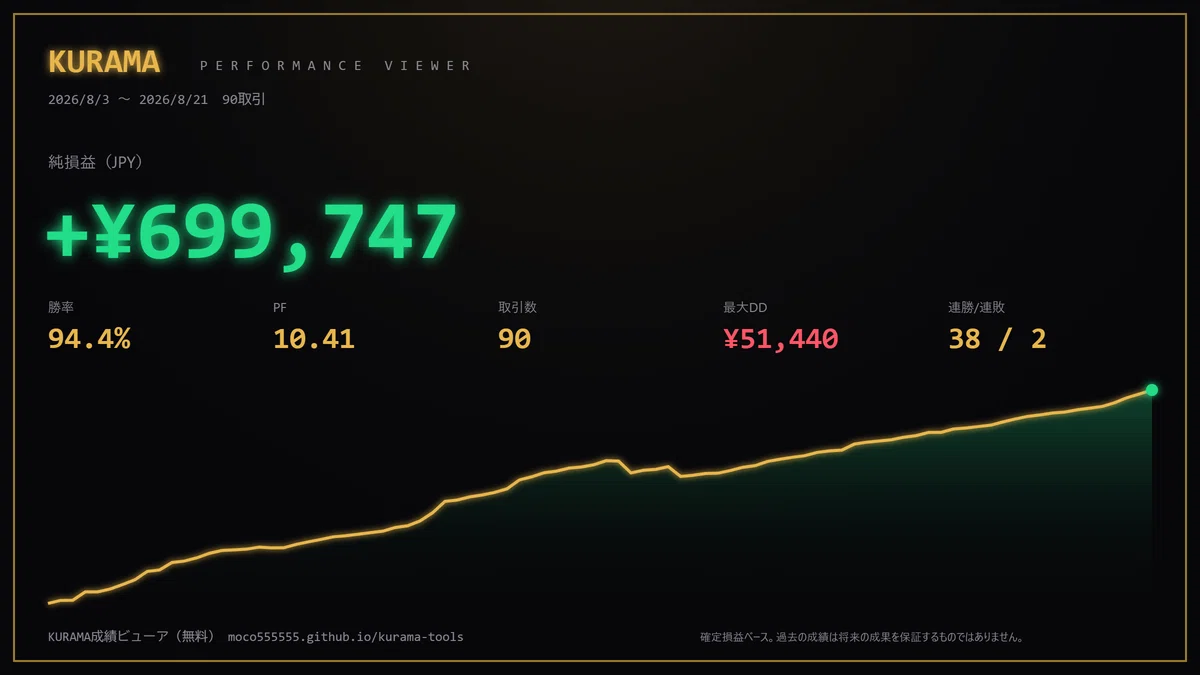
Account ①+699,747 yen (Win rate 94.4% / PF 10.41 / 90 trades)
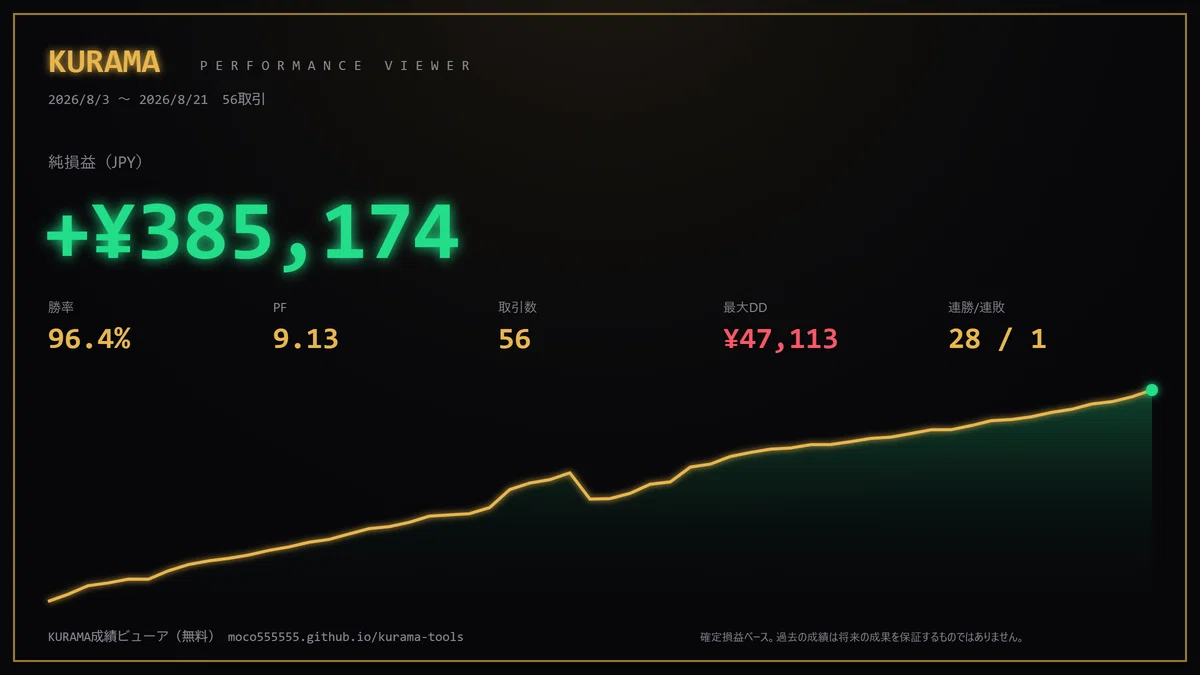
Account ②+385,174 yen (Win rate 96.4% / PF 9.13 / 56 trades)
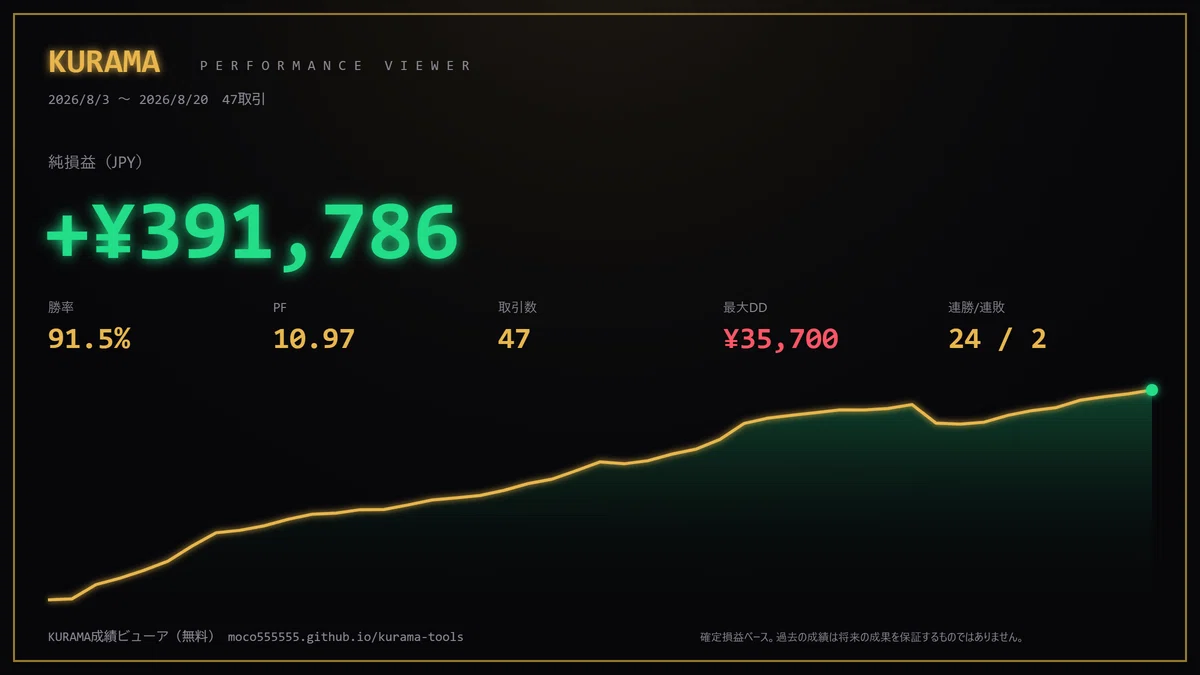
Account ③+391,786 yen (Win rate 91.5% / PF 10.97 / 47 trades)
Total +1,476,707 yen
There were 193 entries, and 11 losses.
Looking only at the numbers, it might seem like I did something special.
But that’s not the case.
Among the 193 occurrences, there wasn’t a single exceptional trade.
I just waited for the same pattern to appear 193 times.
After all, I still enjoy discretionary trading.
Why I trade discretionary while building tools
First, there is one thing I want to note.
I create indicators and EAs. Yet my main trading remains discretionary.
It may seem contradictory.
But I think the roles are different.
Machines are good at consistently enforcing the set conditions.
Humans fatigue. “I haven’t entered yet today,” or “This should be fine, so I’ll ease up on the conditions.” I do that too. Therefore, it’s faster to delegate judgment to the machine.
Humans are good at noticing exceptions.
Prices move unusually. It’s better to stop today. This feeling can’t be fully captured by a formula.
That’s why I handle the judging mechanically, while keeping the final move in my own hands.
And to be honest, that’s more interesting.
193 times, waiting for the same shape
So, what am I waiting for?
Overextension and its pullback.
When the market gains momentum, price temporarily overshoots the reference level. It doesn’t stop where it should, it runs a bit further.
And the excess rally returns.
What I’m aiming for is that return alone.
I don’t try to predict the initial move of a trend. I don’t try to top or bottom. I don’t hold on hoping for a big extension.
Overextension and pullback. I take just one round trip and then exit.
It may seem dull. In fact, it is dull.
But this one round trip appears repeatedly. It happens today, and tomorrow as well. That’s why I can accumulate the count.
“193” means I repeated this one round trip 193 times.
It’s better to take multiple copies of something that comes repeatedly than to chase something that comes only once.
Why do overshoots return?
Why does the overrun return in the first place?
Because buyers and sellers flood in at the same time.
The moment prices move, those who missed out rush in. At the same time, those who held the opposite position dump with a loss. Opposing orders flood in at once.
Therefore, price goes beyond the level where it should stop.
But that doesn’t last long.
The overwhelming orders exhaust themselves, and those who rushed in let go after a slight pullback.
When the force driving the price wanes, the overrun returns.
This isn’t market intuition. It’s about the actions of participants.
So it can happen repeatedly. Whether the forecast is right or not is a different dimension.
How I view USD/JPY from here
I’ve talked about numbers, so I’ll now describe what I expect.
Current situation
After the intervention, USD/JPY has continued its rebound.
It has formed a pattern of higher lows, and the bottom has been gradually rising. The upward trendline is effective.
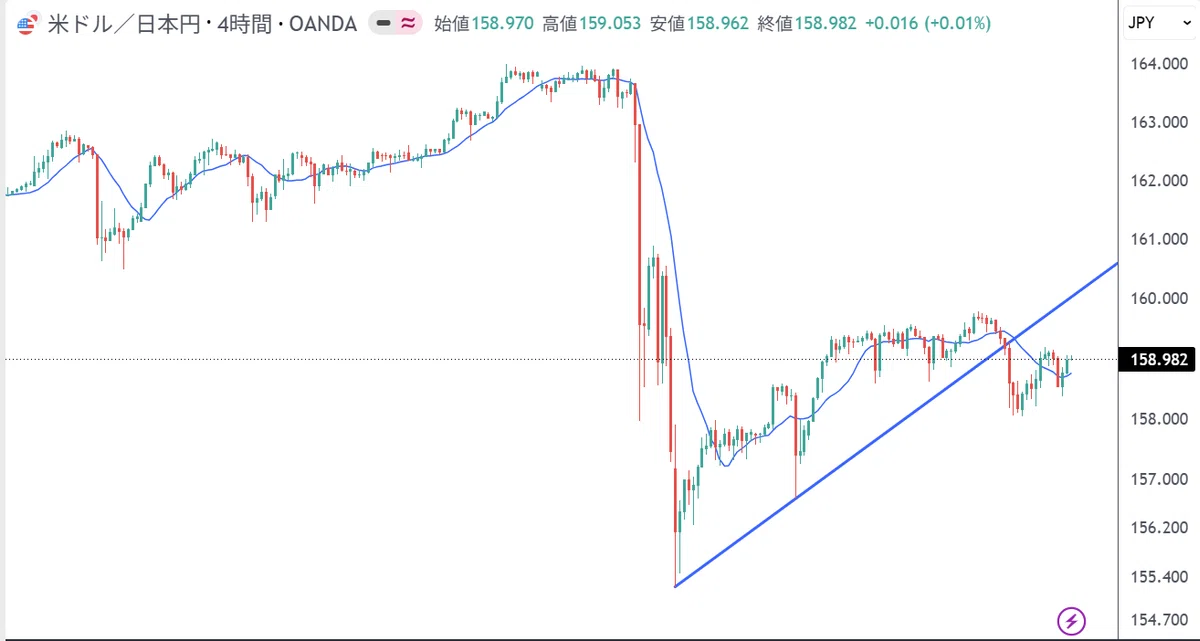
From the temporary sharp fall, it has recovered quite a bit.
Big picture
I expect it will eventually test lower prices.
Movements forced by intervention often try the same direction again at some point. I don’t think this drop is over for good.
Therefore, I see the overall direction as bearish.
But this month, I think it will range trade
However, I don’t think this range will resolve within this month.
This month will be a rangeas I see it.
The reason is simple: after a big move, it fell, retraced, and is now within a range. It’s not common to move strongly in the next direction right away from this state.
It should spend some time moving back and forth, rebuilding energy.
Chasing higher or pulling lower both tilt the odds unfavorably.
Conditions for this scenario to break
If the current uptrend line is clearly breached and it stops returning from there.
I decide in advance how I would admit I’m wrong.
Even in a range, the approach doesn’t change
If you write “range expectation,” you might think I’ll pause this month.
That’s not the case.
Even in a range, I trade normally.
Just because there isn’t a strong direction doesn’t mean price movement stops. When it swings up and down, there will be moments of overextension.
What I’m aiming for isn’t a big trend. It’s one round trip of overextension and pullback.
So, it doesn’t matter if the overall market direction isn’t decided.
Rather, range is the movement of going and returning itself.
What changes is the target and the range width estimates; the actions are exactly the same as in August.
The number 193 just means it was a month with many patterns to target. It may not repeat next month.
But, wait for the pattern to appear, enter, and exit at the predetermined point. That order won’t change.
Don’t change the method to fit the market. Just choose the situations where the method fits.
Clear boundaries, so it’s usable
This method isn’t usable everywhere, at any time.
There are suitable timeframes. There are shapes that can be targeted and shapes that cannot.
It isn’t universal.
But I think that’s fine.
Having clear conditions meansthere are clearly allowed and disallowed entry momentsbecause of that.
Methods with vague boundaries are far more dangerous.
Any system that claims to work all the time leaves you uncertain when to use it.
Summary
・In August, across 3 accounts, +1,476,707 yen, 193 trades, 11 losses
・There wasn’t a single special trade. I repeated one round trip of overextension and pullback 193 times
・Overextensions returning are caused by participant actions, so they happen repeatedly
・Dollar/Yen is bearish overall, but this month is a range
・In a range, I trade normally. What I’m aiming for is one round trip, not a big trend
・I don’t change the method to market conditions. I just choose the scenes where the method fits
More important than the number 193 is the order I value.
Wait. Enter when the pattern appears. Exit at the decided place.
This week, the trade you entered.
Was it entered by waiting? Or was it entered because the price moved?
I think that point is the dividing line.
The criteria for judging whether “this is an entryable overextension” have been compiled into materials.