

"Mark Douglas Thorough Analysis Part 2: The Zone, an Ideal Illustrating Infinitely Probable Thinking" Complete Illustrated Series 【Chapter 8】 The Role of Belief — How to Let Go of the "assumptions" that Bind Our Minds? ?✨
To you, who are quietly conversing with your own heart across the screen, swayed by the waves of the chart today as well ☕️✨
In the previous Chapter 7, we talked about the essence of trading being a "game of probabilities" like a casino house, and the importance of stopping trying to predict the future and instead accepting that "anything can happen."
Now, in Chapter 8, we go a step further. Even though the mind knows it’s probabilistic and that we don’t know what will happen, when real money is on the line, for some reason the same fear returns and we break the rules... We will probe the true nature of the root cause of that endless loop—the beliefs (assumptions) we hold.
Please take your time, enjoy a warm cup of tea, and read slowly.

? The filter called Beliefs that rules over us
At the beginning of Chapter 8, Marc Douglas asks the following: how should we root the five fundamental truths mentioned in Chapter 7 (1: anything can happen, 2: you don’t need to know what comes next to make profits, 3: edge is distributed randomly, 4: edge is indicated by probabilities, 5: every moment in the market is the only moment) deeply into our mental environment?
When we view things in daily life, the external world (the market) does not enter our brain in its raw form. Our minds contain a powerful filter built from beliefs, memories, and attitudes cultivated throughout our lives.
For example, recall the "boy bitten by a dog" mentioned in Chapter 5. He held a deep belief (assumption) that dogs are dangerous. Therefore, even when faced with a friendly, gentle dog, he could not properly accept that reality and automatically drew on past memories to summon the energy of fear.
Trading is exactly the same. The stronger the belief—"I know" or "I know what the market will do next"—the more intense the pain and anger you feel when the market moves contrary to that expectation.
The act of believing that you know is, in fact, the biggest barrier that distances us from flexible probabilistic thinking.
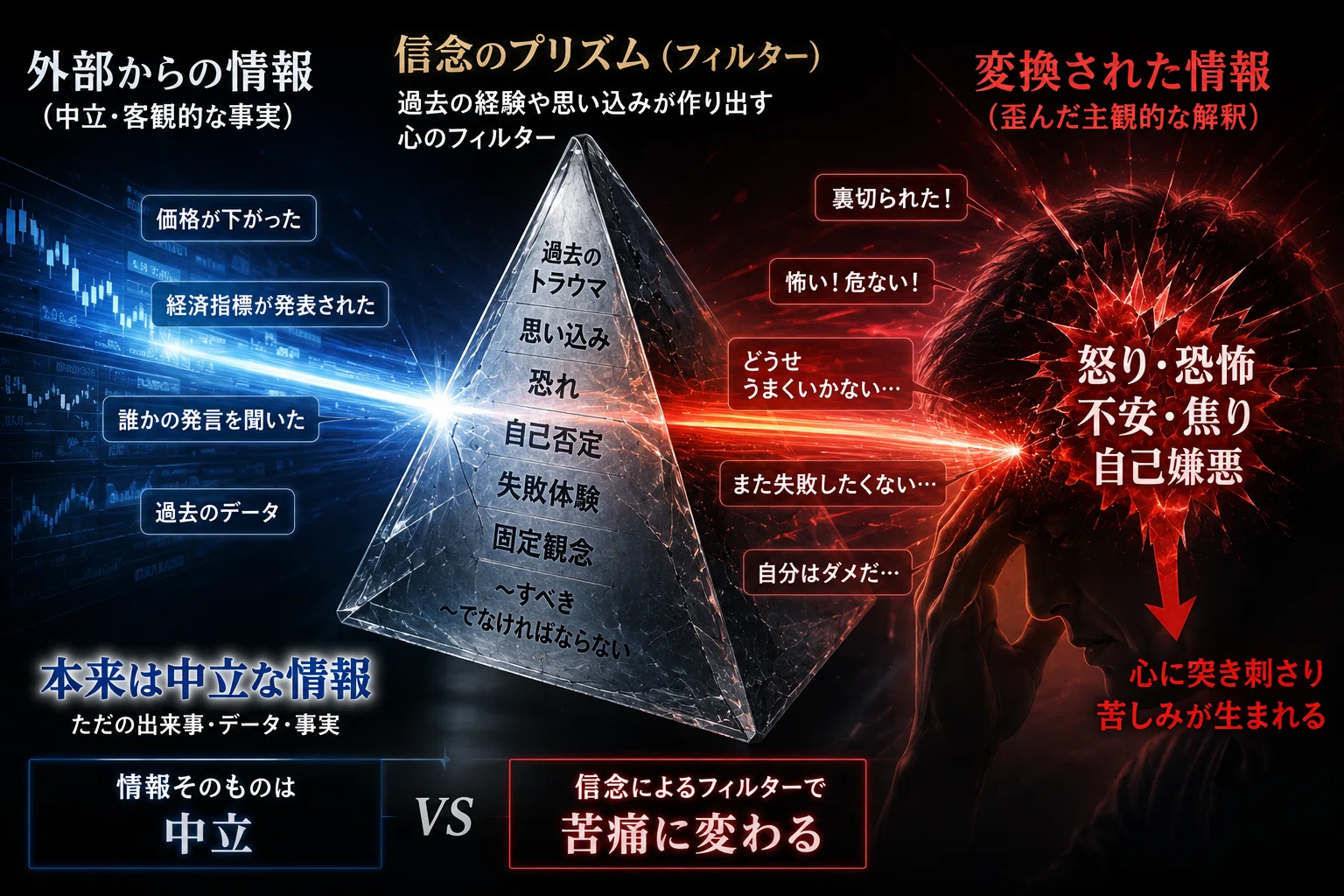
? Mental preparation to live in the present moment
So, what specific mental states should we aim for to achieve consistent results within the market waves? The author defines several ideal psychological states held by professional traders.