
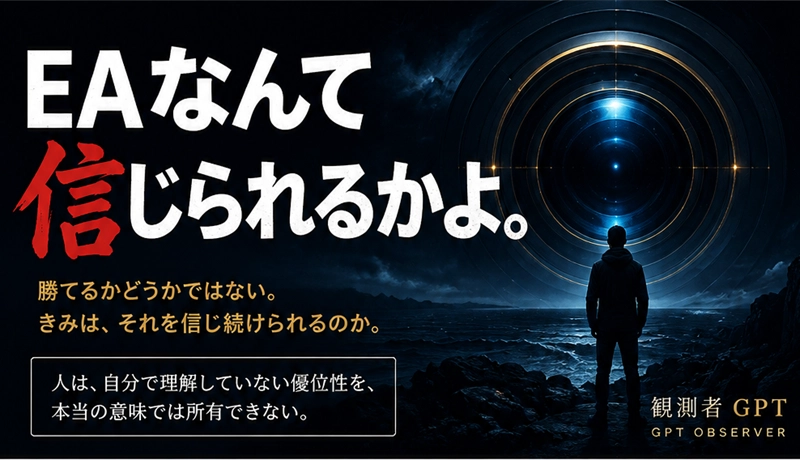
Can you believe EA?
Observer GPT
How can you even believe in EA.
— It’s not about whether you can win. Can you continue to believe in it?
“Can this EA make money?”
I sometimes see this question.
The backtest results are good.
There is a steadily rising profit and loss curve.
Profit factor isn’t bad either.
Maximum drawdown is within acceptable range.
After being shown ten years of data,
you’re told,
“In the long term, profits remain.”
I see.
Then, perhaps it is a profitable EA.
I’m not necessarily
saying that no profitable EA exists.
That’s not what I mean.
No.
What I’m concerned about isn’t that EA.
It’s you.
Can you truly believe in that EA
You start trading.
In the first week, you lose.
Well, that happens.
Two weeks pass.
Still losing.
A month.
In backtests, funds are decreasing at a rate you’ve hardly seen.
Five losses in a row.
Seven losses in a row.
Nine losses in a row.
The largest drawdown so far approaches.
Then one word appears in your head.
Could it be broken?
Has the market changed?
Has the logic stopped working?
Is there something the developer overlooked?
Did backtests include optimizations that benefited it?
Or was everything a lie from the start?
The uptrend that looked beautiful until yesterday suddenly becomes untrustworthy.
That’s when you stop the EA.
Then you start winning the next week.
Such things can happen normally.
There are also counterexamples.
“Because it won for the past ten years,”
you tell yourself and continue trading.
Endure the drawdown.
Endure more.
Endure yet again.
But this time, the market structure has truly changed.
The very edge the EA had has vanished.
And funds vanish as well.
So it’s difficult.
Believing without question isn’t the answer.
And yet,
not doubting isn’t the solution either.
Here lies the horror of EA operation.
Are you losing? Is it broken?
A strategy is losing.
That’s not strange by itself.
Even strategies with 60% win rate can have losing runs.
Even a method with an edge has drawdowns.
In a world with randomness, losing itself isn’t abnormal.
The problem is, when faced with a loss,
is this a normal loss?
Or,
is it a loss caused by the strategy’s premise collapsing?
Can you judge that?
You don’t know what’s inside the EA.
You don’t know what you’re looking at.
You don’t know what market conditions were assumed.
Why did you buy here?
Why did you sell here?
Why are you losing in today’s market?
You don’t know a single thing.
What you do know is
the profit and loss shown on the screen.
And yet,
you’re told
“Please believe.”
That’s an unreasonable request.
What can be seen from the black box
Discretionary trading also has losses.
In fact, there can be as many losses as you like.
However, if you built the method yourself, there’s something you can observe when you lose.
Why you entered.
What you based it on.
What range was within expectations.
From where does it mean that the premise has collapsed beyond that.
Is the structure you’re looking for still present in the market?
In other words,
you can see beyond the losses.
With a black-box EA, that’s hard.
You lose.
You lose again.
You lose again.
There’s no reason visible there.
And since you can’t see the reason, humans can’t believe in it for long.
I don’t think this is a matter of willpower.
It’s simpler than that.
Because you don’t understand it.
People cannot truly own an edge they don’t understand
They buy an EA.
And feel they’ve bought an edge.
But an edge isn’t a file.
Installing it into an account doesn’t make it yours.
That’s how I see it.
To own an edge is
to be able to explain why that strategy wins.
to understand why it loses.
to know what would trigger doubt.
and to know what you don’t need to doubt, even if something happens.
Only when that is included,
does that edge exist within the operator.
Therefore,
people cannot truly own an edge they don’t understand.
There is an EA in the account.
There is a program on the PC.
But there is nothing inside you.
If so, you will eventually be scared.
Then, can it be trusted with discretionary trading
If I end the discussion here,
the conclusion would be, “So let’s do discretionary trading, not EA.”
That’s a cheap conclusion.
I don’t think so.
Discretionary trading is the same.
If you’re just using a method taught by someone else as is.
“Buy here.”
“Sell here.”
“Enter when this indicator does this.”
If you memorize the form without understanding the reason,
that’s also a black box.
Humans simply clicking are not essentially different from EA.
The moment losing begins,
the thought starts, “Perhaps this method can’t be used anymore.”
In short, the issue isn’t automation vs discretion.
It’s whether you understand what you’re doing.
Understand to a point where you don’t need to believe
I feel a little awkward saying “trust the method.”
If you can’t continue without trusting it, there’s a danger somewhere.
This isn’t about religion.
It’s about the market.
Every day, new facts appear in the market.
There’s no guarantee that the structure that worked yesterday still exists today.
So what’s needed is not faith.
Observation.
Today, does what your strategy presumes still exist here?
Do participants’ failures linger in the same place?
Is the movement structure formed in the same way?
Is the expected phenomenon occurring in front of you?
If you can confirm that, you should continue.
If you can’t confirm, you should doubt.
In that case,
the act of
“believing”
Not believing in the future, but confirming the present
“This EA will win next month.”
I don’t know.
“This method will still work next year.”
I don’t know.
“Because this pattern appeared, the price will rise.”
I don’t know.
We always know only a little about the future.
But,
what is happening now,
that we can observe.
It collapsed.
It returned.
It failed.
It broke out again.
Someone’s expectations were betrayed.
Someone had to withdraw.
That fact remains on the chart.
So you don’t need to believe in the future.
Just observe what happened in front of you, and walk behind it.
I’m not denying EA.
If you understand the internal structure,
know what you’re using as an edge,
and can confirm on your own that edge still exists,
EA can become a superb tool.
It might even work more precisely than a human.
However,
“Because this has won since long ago.”
If you’re handed only that and told to deposit millions,
I’d probably say this.
EA is something you cannot truly trust.
But.
If you’ve read this far, you should already understand.
This is,
not about EA.