
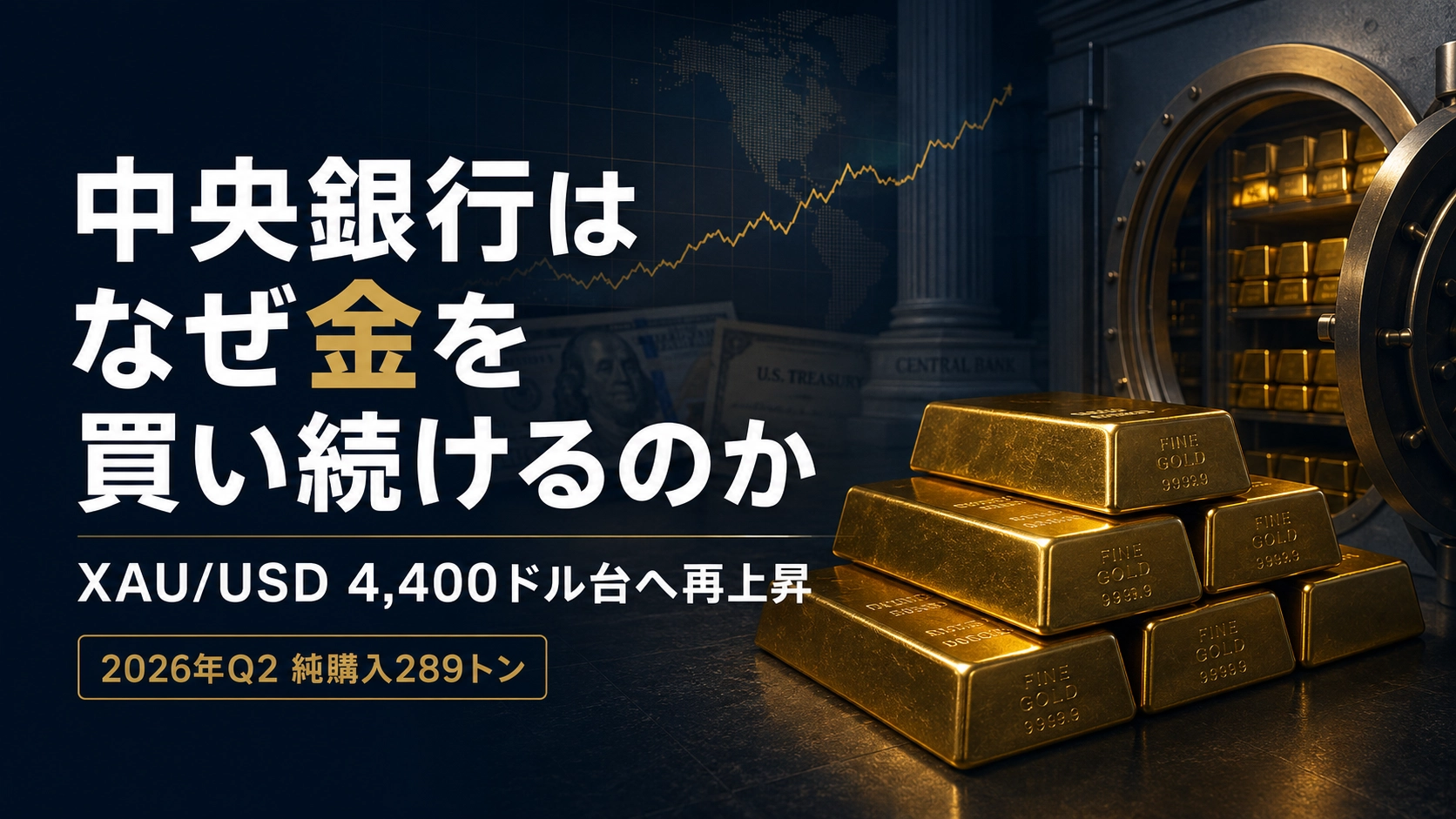
Why do central banks keep buying gold? Background for XAU/USD rising back into the 4,400s
In August 2026, gold (XAU/USD) rose from around $4,000 to briefly the $4,400 range.
In short, the current rally cannot be explained by a single reason such as “there is a war” or “central banks are buying.”
In the short term, a convergence of weaker US employment and consumer indicators, a retreat in expectations for additional Fed rate hikes, dollar weakness, and geopolitical risks surrounding the US and Iran contributed to the move.
In the medium to long term, however, central banks around the world continuing to buy gold to diversify their foreign exchange reserves provides a structural underpinning for the gold market.
That said, just because central banks are buying gold does not mean gold prices will not fall.
This time, we will categorize the factors driving the current gold market into two:
Factors that trigger short-term price fluctuations
Factors that support medium- to long-term demand
Gold rose by about 10% in August
Gold traded around $4,000 per ounce through early August 2026.
Subsequently, views on US economic indicators and monetary policy shifted, and on August 13, spot prices briefly rose toward around $4,449. The gain from early August reached roughly 10% at one point.
As of August 14, some profits were taken, and spot prices hovered around $4,380. US gold futures closed around $4,437.
In other words, gold did not rise in a straight line.
After moving into the $4,400s, there was some short-term profit-taking.
To understand the price movement, we first need to consider the relationship between US economic indicators and interest rates.
US economic data reduced expectations for additional Fed rate hikes
In July 2026, US nonfarm payrolls fell by 23,000, an unexpected decrease since markets had anticipated about an 80,000 gain.
Additionally, July US retail sales fell 0.6% month over month, versus expectations of about a 0.1% gain, suggesting weaker consumer spending than anticipated.
On the price front, July producer prices were flat month over month, though up 4.7% year over year, indicating inflation has not vanished but that price increases did not accelerate from the prior month.
As a result, the probability of the Fed delivering another rate hike by the September FOMC meeting fell from around 55% to roughly 30%.
It is important to note that the market is not expecting cuts in earnest.
The focus is whether the Fed will raise again or hold the policy rate at 3.50–3.75%.
For gold, the mere possibility of fewer rate hikes is supportive.
Gold itself does not yield interest. When rates rise, the attractiveness of government bonds and deposits that pay interest increases, reducing the relative appeal of holding gold.
Conversely, if expectations for further rate hikes retreat, the opportunity cost of holding gold falls, making it easier for prices to rise.
A weaker dollar also lifted gold
Gold is primarily traded in US dollars on international markets.
Therefore, when the dollar falls, investors using currencies other than the dollar find gold comparatively cheaper to purchase.
On August 14, the dollar index fell about 0.3%, supporting gold prices.
However, “a weaker dollar always means higher gold” is not a guaranteed relationship.
In reality, gold prices are influenced by multiple factors beyond the dollar.
US real interest rates
Federal Reserve policy
Capital flows into ETFs and funds
Central bank purchases
Geopolitical risk
Physical demand from China and India
The dollar is an important factor, but it does not solely determine gold’s direction.
Geopolitical risk around the US and Iran
In today’s gold market, tensions surrounding the US and Iran cannot be ignored.
Attacks in the Strait of Hormuz have reduced shipping activity, and there are reports the US may extend its naval blockade against Iran.
With stock, bond, and currency markets’ outlooks cloudy, some funds may move into gold.
However, higher geopolitical risk does not automatically mean higher gold prices.
For example, if conflicts push crude oil prices higher, inflation could reaccelerate. If the Fed raises rates to curb inflation, rising rates would be a negative for gold.
Geopolitical risk has two effects:
Boosts safe-haven demand and lifts gold
Rises in oil and inflation lead to higher rates, which can push gold down
Rather than assuming “war means buy gold,” it is essential to see how geopolitics reverberates through oil, inflation, and interest rates.
Central banks worldwide purchased 289 tons in Q2
Beyond short-term price moves, central bank purchases provide medium- to long-term support for gold.
According to the World Gold Council, global central banks and official institutions bought a net 288.9 tons of gold in Q2 2026.
That is a 62% year-on-year increase and the highest quarterly purchase on record. It compares with about 57 tons in the revised Q1, a roughly fivefold rise.
Major buyers include:
Poland: 51 tons
China: 33 tons
Uzbekistan: 16 tons
Kazakhstan: 15 tons
Jordan: 6 tons
Czech Republic: 6 tons
However, not all central banks are buyers.
In Q2, Russia sold 22 tons and Turkey sold 4 tons.
Moreover, total central bank net purchases for the first half of 2026 were 345 tons, the lowest half-year level since 2022.
While the second quarter’s figure looks like a record high, the reality is that the first quarter saw more selling and the second quarter a rebound in buying.
Central bank demand remains strong, but quarterly purchase volumes can vary significantly.
Why do central banks buy gold?
Central banks hold assets as foreign exchange reserves to support the credibility of their currency and resilience in financial crises.
FX reserves include USD, EUR, government bonds, deposits, and gold.
There are four main reasons central banks increase gold holdings:
1. Low credit risk to specific countries or institutions
Government bonds have issuing countries; bank deposits have custodians. Physical gold, however, is an asset that does not require a counterparty and has inherent value.
As financial markets and international relations become unsettled, holding gold becomes more meaningful for central banks.
2. Diversification away from reliance on the dollar and US Treasuries
The dollar remains central in reserve assets, but concerns about US fiscal deficits, debt, long-term yields, and Fed independence look to diversify reserve holdings beyond the dollar.
World Gold Council surveys show 74% of central banks anticipate the share of USD in global reserves will decline over the next five years.
This does not mean the dollar loses its status as a reserve currency immediately.
It is more appropriate to think central banks will hold dollars while also increasing gold to diversify reserves.
3. A hedge against geopolitical risk
Sanctions or asset freezes can restrict access to foreign-currency assets abroad. While gold storage and liquidity are not without constraints, holding gold domestically can reduce dependence on other countries’ financial systems.
For central banks, gold is not only about price appreciation but also a defensive asset when financial systems come under stress.
4. A long-term store of value
Currency purchasing power may decline over the long term due to inflation. Gold has high price volatility but remains an asset independent of any single currency, used for long-term value preservation and inflation hedging.
World Gold Council’s 2026 survey shows 89% of responding central banks expect higher gold holdings over the next 12 months, and 45% plan to increase their own gold holdings over the same period.
Will central bank purchases support gold prices?
Central bank purchases can underpin gold’s medium- to long-term demand.
Central banks differ from typical speculators who trade for short-term gains; they tend to buy with a long-term holding horizon to diversify FX reserves and prepare for financial crises.
Thus, continued central bank purchases can provide ongoing demand for gold.
However, assuming “central banks buy, so prices cannot fall” is dangerous.
In Q2 2026, about 45 tons of money flowed out of gold ETFs. Jewelry demand has also declined to its lowest level since the COVID era due to high prices.
Even with central bank buying, if ETF/investment fund and jewelry demand weakens, prices can fall.
Additionally, IMF notes in its June 2026 report:
Prices are highly volatile
Diversification benefits and safe-haven effects vary with market conditions
Gold does not yield interest
Among FX reserves, it is not ideal for highly liquid assets ready for immediate use
Central banks should also manage it as a high-risk asset
The fact that central banks buy gold does not mean gold is always a safe asset.
What currently drives gold
Today’s gold market should be considered as a combination of the following factors.
| Confirmation factor | Gold’s upside factors | Gold’s downside factors |
|---|---|---|
| Fed policy | Softening expectations for rate hikes, possible rate cuts | Further hikes, higher-for-longer rates |
| US dollar | Dollar weakness | Dollar strength |
| US real interest rate | Decline in real rates | Rise in real rates |
| Geopolitical risk | Increased safe-haven demand | Tension easing, profit-taking |
| Oil price | Rising risk sentiment | Inflation re-acceleration and rate hike expectations |
| Central banks | Ongoing purchases | Pace of purchases slows, selling |
| ETF and investment funds | Inflow to ETFs | Outflow from ETFs |
It is important to look at multiple factors together and not rely on any single indicator pointing in one direction.
Three possible scenarios for future gold
Scenario likely to see continued gains
US employment and consumption weaken further
Expectations for additional Fed rate hikes retreat further
US dollar and US real rates decline
Tensions around the US and Iran persist longer
Central banks and ETFs keep buying
If these converge, gold could see ongoing capital inflows.
Scenario where gains are likely to pause
Fed keeps policy rate steady
US economy does not deteriorate sharply
Dollar and interest rates remain within a range
Geopolitical risks do not worsen beyond current levels
In this case, gold may struggle to find a clear direction and could trade sideways in a high range.
Scenario likely to see declines
Inflation accelerates again
Expectations for further Fed rate hikes rise again
Dollar and US real rates rise
Tensions around US and Iran ease
ETF outflows and profit-taking increase
Pace of central bank purchases slows
In particular, after gold has risen sharply in a short period, profit-taking adjustments can occur even if the underlying factors have not worsened.
Points individual traders should check
Central bank purchase data is useful for understanding the medium- to long-term backdrop for gold.
However, central bank purchases are reported monthly or quarterly, so they are a lagging signal for short-term trading entries.
When trading XAU/USD on a short-term basis, do not rely on central bank purchases alone; verify in the following order:
US employment, consumption, and price indicators
Probability of Fed rate hikes or hold
US dollar index
US real interest rates
Geopolitical risk and oil prices
ETF and central bank capital flows
Central bank purchases do not indicate a simple “buy timing.”
Use them as information on the macro environment for gauging long-run demand for gold.
Summary
There were multiple factors behind gold’s rebound to the $4,400 range in August 2026.
The short-term rise was driven by weaker US employment and consumption data, retreat in expectations for additional Fed rate hikes, dollar weakness, and geopolitical risk surrounding the US and Iran.
Meanwhile, medium- to long-term demand is supported by central banks diversifying their reserve assets into gold.
In Q2 2026, central bank gold purchases reached 289 tons, a quarterly record, and 45% of central banks expect to increase their own gold holdings in the next 12 months.
However, central bank purchases do not guarantee gold price increases.
Short-term gold direction remains influenced by US rates, the dollar, real rates, geopolitical risk, and ETF flows.
Today’s gold market can be viewed from two perspectives:
Short term: US monetary policy and the dollar; Medium to long term: central bank reserve diversification
It is important to consider both viewpoints.
References
Reuters: Gold rises on weaker dollar as inflation data cements rate-hold bets
US Bureau of Labor Statistics: Producer Price Indexes – July 2026
※This article is for information purposes only and does not constitute a recommendation to buy or sell any specific financial instrument. FX and CFD trading involves the risk of loss of capital. Please make your own final investment decisions.