

Chapter 1: The Impulse of the Market and the Baptism of N-Value and E-Value [Part 1]
I. The rooftop of the building and the small universe inside the screen

In 2018, early summer afternoon.
The blazing sun pushed up the heat of the asphalt, and the faintly sweating air from the company car's air conditioner brushed the skin.
I—Komugi—stood in a coin parking lot in a building district in Tokyo between client visits, resting my elbows on the steering wheel and staring at my smartphone.
As a company employee, my job involved cold calling clients, preparing proposals, and above all fighting the monthly “sales quota.” I often lowered my head and chased numbers, feeling a vague sense of stagnation.
“FX… foreign exchange margin trading, is it.”
The trigger was a trivial phrase I saw in an online ad.
Twenty-four hours a day, currencies around the world are bought and sold, and with a single order my account balance would change in real time. The green and red candlesticks on the smartphone screen writhed as if they were living creatures.
(If I could capture this wave with my own power… wouldn’t there be another free pillar of wealth besides my salary from the company?)
My chest gave a throb.
I carefully opened an FX account and deposited a small amount of surplus funds, only a few tens of thousands of yen.
The moment I pressed the “buy” button, the heart-pounding tension rose as if my heart would leap out of my chest.
The price rose a few pips, and the account balance turned positive by 1,200 yen.
“Amazing...! My money really increased with just my own finger...!”
I was instantly captivated by this small universe of market prices that I had never known before.
In the days of chasing numbers as a sales person, that blue-lit screen alone seemed like a magical door, leading me to a new future.
However, it didn’t take long to realize it was a sweet trap.
The beginner’s luck didn’t last a week. Trades based on nothing but intuition began to go wrong, and after a few consecutive losses, profits vanished in an instant.
“If you just buy and sell at random, that won’t work. The market must have ‘rules.’”
With that in mind, I threw away all time I had for meetings and night hours, and stepped into the world of market analysis—so-called “technical analysis.”
II. N-values and E-values — The illusion of the “Holy Grail” gifted by geometry —
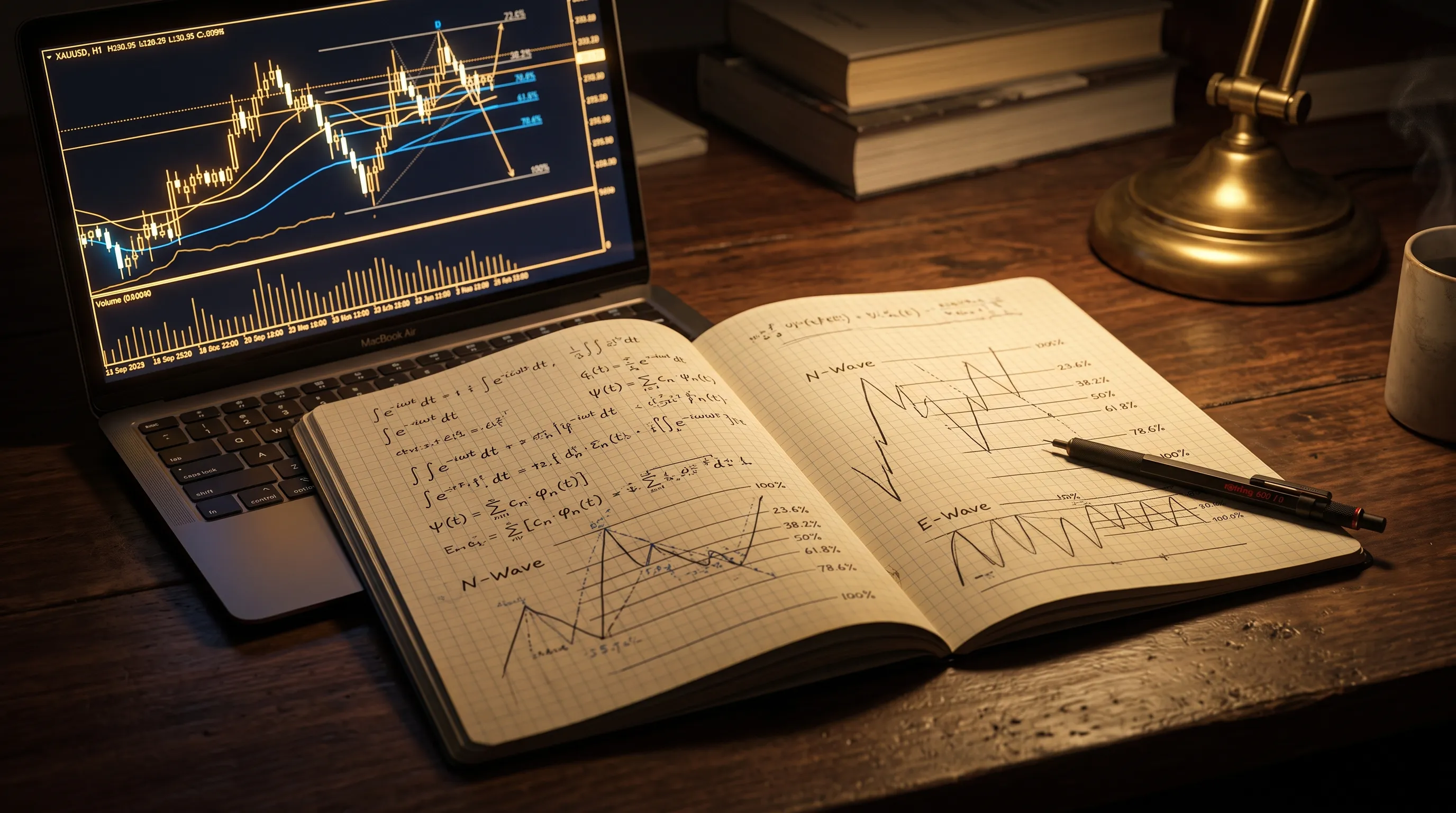
When I began studying technical analysis on my own, I was most strongly drawn to the wave theory’s “range observation theory (N-values and E-values).”
The market seems to move randomly, yet apparently it traces and moves along beautiful geometric “waves.”
In rising and falling trends, there was a theory that you could predict the next target value in pips based on the heights and widths of past waves.
I drew beautiful figures in my notebook and pounded the formulas again and again.
[Basic structure of range observation theory in waves]
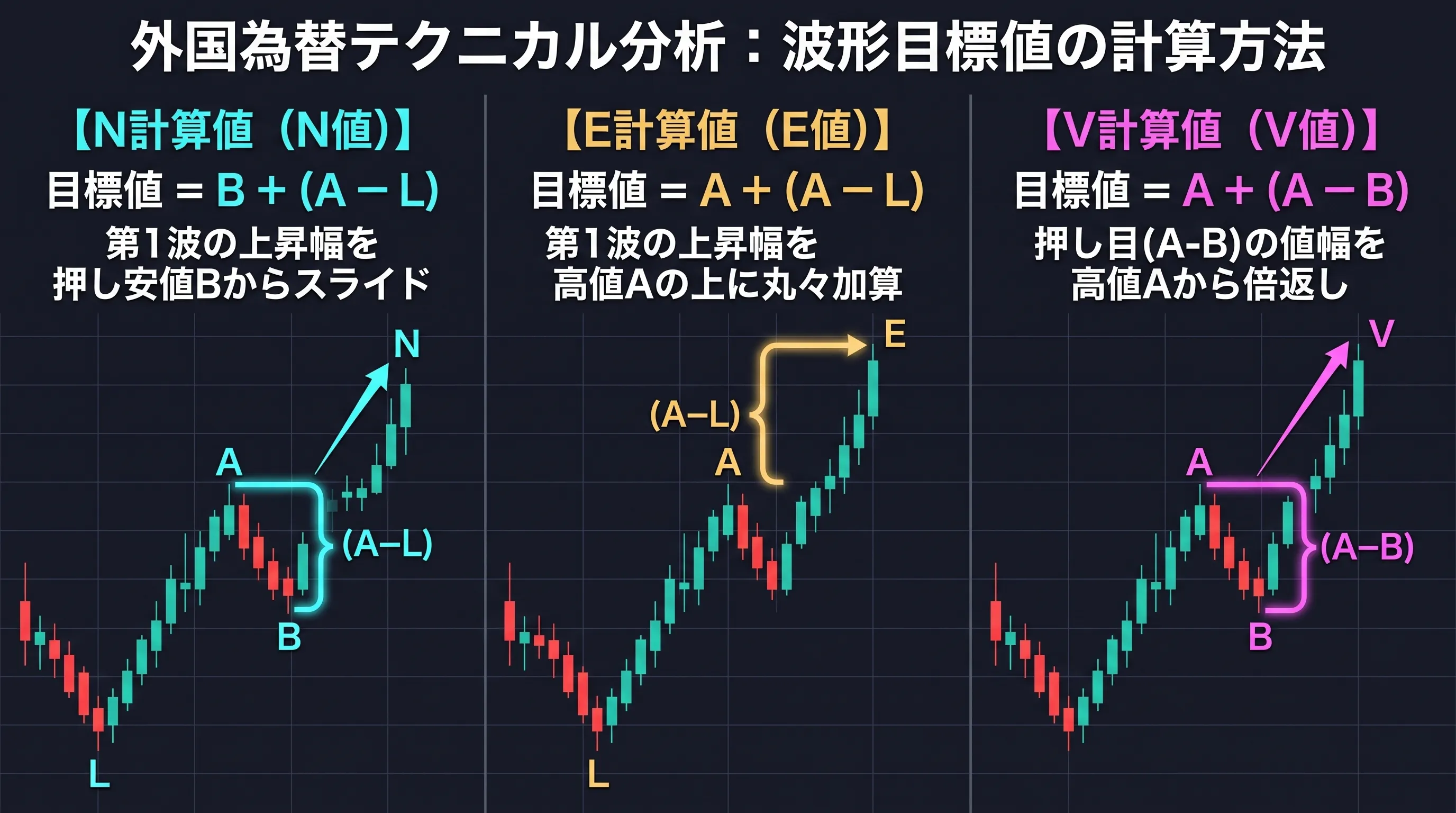
・N-calculation value (N-value): Predict the first wave’s range by sliding it from the starting point of the pullback (retracement).
Formula: Target Price = B + ( A - L )
(The rise from the low L to the high A added exactly to the retracement price B to obtain the target point)
・E-calculation value (E-value): Predict the first wave’s range by extending the same amount beyond the most recent high as the maximum wave length.
Formula: Target Price = A + ( A - L )
(The rise from low L to high A then added again above the high A for the ultimate target)
When you apply this to past charts, there were many moments where the wave perfectly reversed.
“...What is this? It’s perfect!”
I trembled as I stared at the candlesticks overlapping the chart.
If a wave extended 100 pips from a low to a high, then at the moment of reaching that limit point according to E-values, the buyer’s energy would be exhausted. If you placed a precise reversal short right there, you should be able to extract massive pips as the price plunged from the top.
The theory was perfect.
When the market had risen completely and reached the geometric limit point of the E-value, the buyer’s energy would be exhausted and sellers would flood in.
If you hit that exact reversal at the “limit point,” that would become the ceiling, and the price would slide down, allowing you to take enormous pips all at once.
I drew multiple horizontal lines on the chart and, using indicators that could calculate N-values and E-values, set up limit orders.
“I have become a ‘smart trader’ who can pinpoint the market’s peaks and troughs with precision!”
That sense of omnipotence, or something like it, began to control my mind.
Back then, I never imagined nights like that would come...