
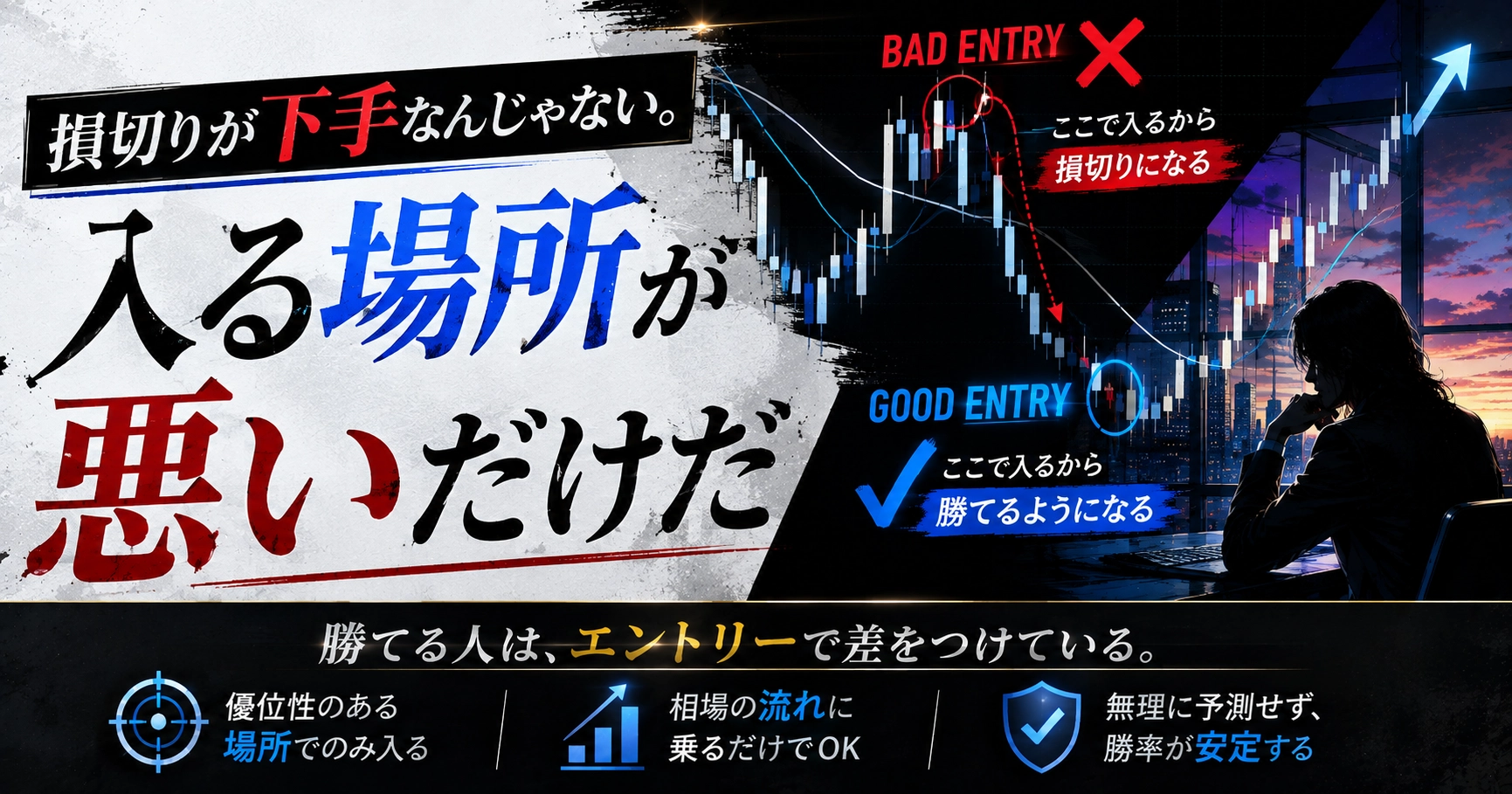
It’s not that I’m bad at cutting losses. It’s just that I’m entering at the wrong place.
"I can't cut losses"
It's the issue I hear most often. And I believe it's also the most misaligned concern.
Not being able to cut losses isn't because your willpower is weak.
It's because you're entering at a place you can't exit.
The order is reversed.
Today, I'll talk about that.
There are common traits in losses you couldn't cut
Please recall your own trades.
Those losses you couldn't cut. Dragged on, and then you got hit hard at the end.
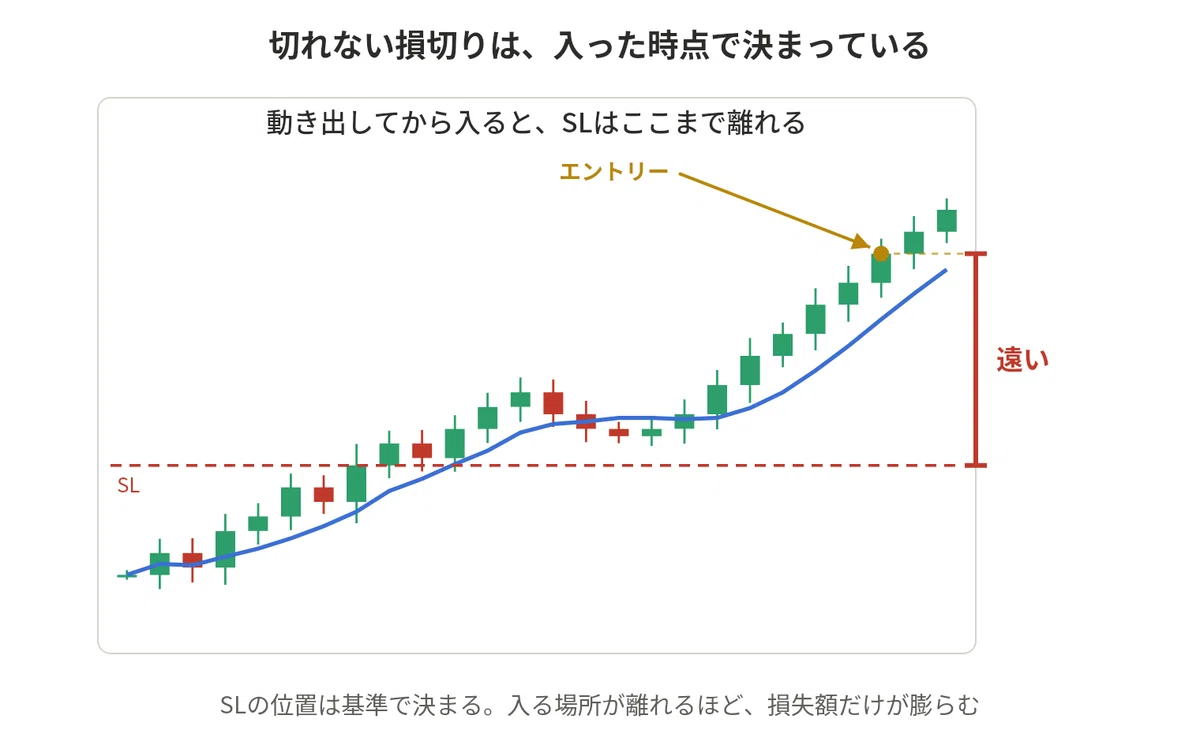
Huh,Wasn’t the SL far away?
Because the amount of loss is large, you’re afraid to cut. Because you’re afraid, you wait. While you wait, it opens more. You become less able to cut.
Conversely, trades with a near SL are surprisingly easy to cut.
Because you think, "Well, this much is fine."
In short, it comes down to this.
Whether you can cut losses is almost determined at the moment you enter the trade.
It's not a matter of mindset. It's a distance issue.
Why does the SL become far away
Then why does the SL become far away?
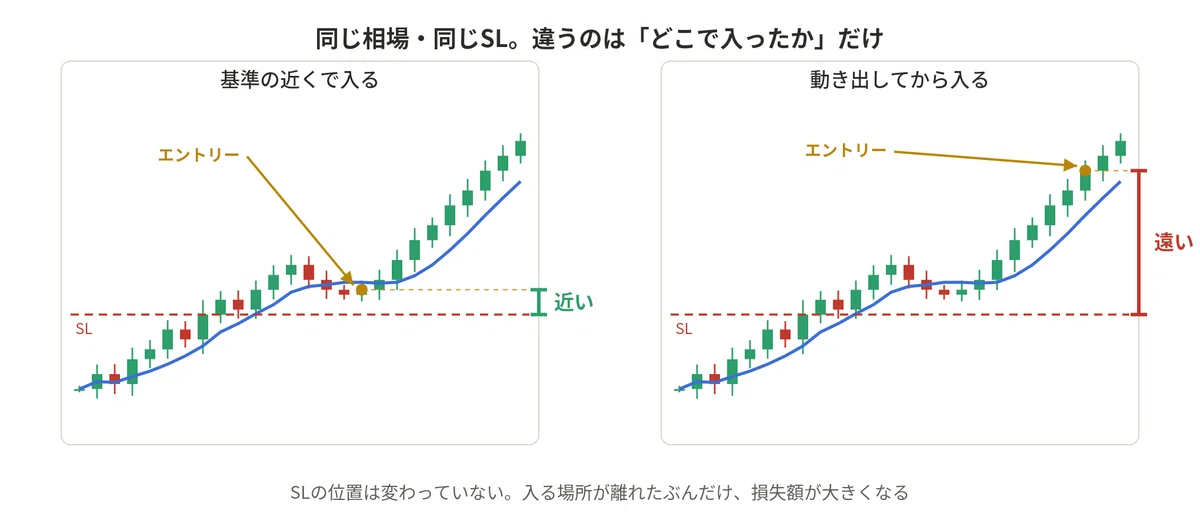
Because you entered from a place far from a benchmark.
A loss-cutting point is originally placed where, if you break through this point, your expectation collapses.
That place is above the chart: recent highs and lows, levels that are watched, the position of lines.
Therefore, if you enter near that benchmark, the SL naturally comes near.
If you are farther, you become farther proportionally.
And people generally enter from distant places.
The reason is simple.
Because you enter after it starts moving.
You buy after it starts rising. You sell after it starts falling. You enter so you don't miss the move by watching it go.
At that moment, you are away from the benchmark.
The positions you entered thinking "there is momentum" have SL farther away.
And you cannot cut the far SL.
"It might come back" is problematic because it’s correct sometimes
This is the tricky part.
When you are holding a drawdown, you think, "It might come back."
And indeed,it does come back with a decent probability.
So you develop a habit of not cutting. After surviving several times, you learn, "If I wait, it will return."
But this learning is terrible.
There are lots of times you’re saved. But in that one time you’re not saved, you lose everything you had been saved up to that point.
This is correct in a majority vote, but wrong in terms of profit and loss.
This kind of habit won't be fixed by will.
The only fix is to enter in a place where you don't have to wait for it to come back.
Trades that never become profitable are dead from the start
While reviewing my own trades, I noticed something.
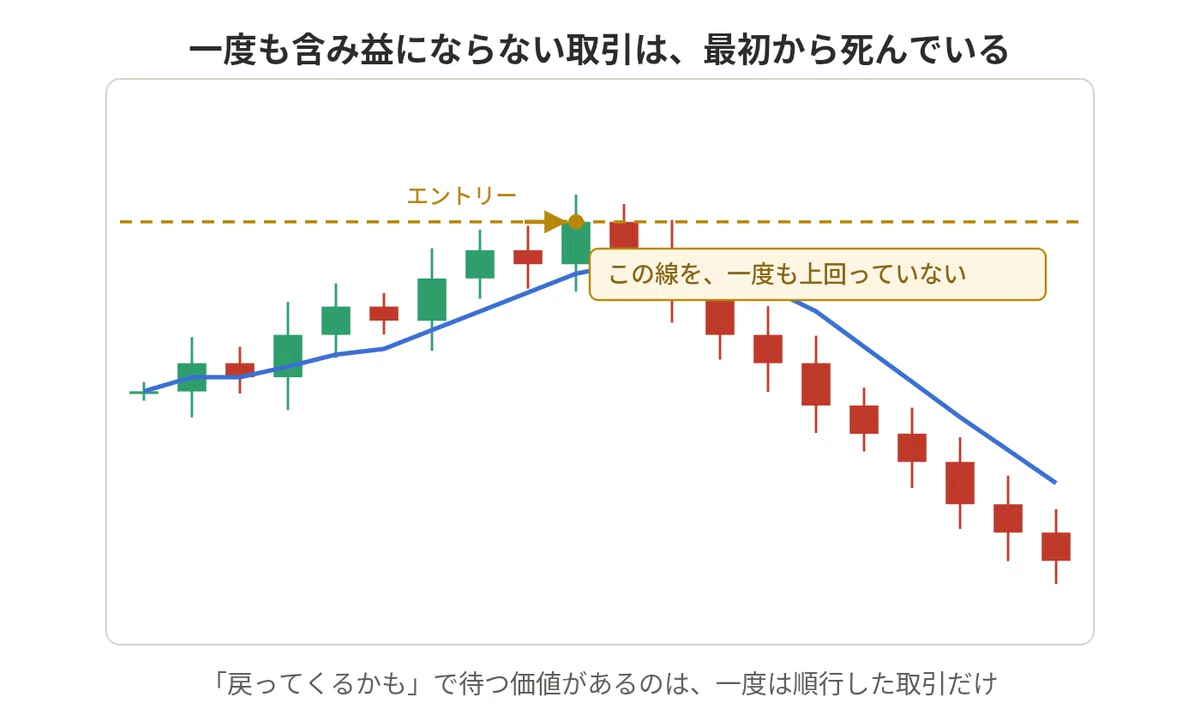
Many losing trades never become profitable at any point.
They move against you the moment you enter and never come back.
Conversely, trades that move even a little in the right direction, even if they end up losing, don't get hurt as badly.
This is quite useful.
If, after entering, a certain amount of time passes without ever being in profit, that trade is already a bad setup.
The value in waiting to see if it comes back is weak.
What you should wait for is a trade that at least moved in the right direction once.
Trades that have never moved in the right direction at all are likely misaligned with the setup itself.
You can step off before the loss-cutting line is touched.
It's quicker to choose the entry place than to train yourself to cut
To summarize up to here:
Practicing cut losses doesn't help much.
Because as long as you keep entering trades that are hard to cut, the same suffering comes every time.
Instead,it's faster to select trades that are easy to cut.
Enter near the benchmark. The SL becomes naturally near. Therefore you can cut. Because you cut, you can bet again next time.
The order is this:
・Decide where to enter
・From that place, determine the position of the SL
・From the distance to the SL, determine the lot size
・Therefore, even if you lose, it won't hurt
The mental aspect never comes up.
As long as you treat cut losses as a mental problem, you probably won't solve it.
It took me years to realize this.
The period I spent blaming myself for "not being able to cut losses" was long. There was no need to blame myself. I was simply entering at places where I couldn't cut.
Instead of suppressing the desire to enter, remove it
That said, when I see movement, I want to enter.
This sounds like a restraint, but it's a bit different.
If the places where you can enter are fixed, everything else automatically becomes excluded.
You're not forcing yourself. It's outside of judgment.
Conversely, if the places where you can enter are not fixed, all price movements become candidates.
Because they become candidates, you must restrain yourself. And humans cannot restrain themselves forever.
Therefore, decide the benchmark first.
Deciding "where to enter" is actually deciding "where not to enter."
I think that's the more fundamental issue.
So how do you decide that “benchmark”
This is the hardest part.
When told to "enter near the benchmark," you then ask what to use as that benchmark.
Should it be highs and lows, lines, levels? Which should be prioritized?
And you shoulddetermine whether your tomorrow self can judge it in the same way.
If this is not decided, you end up deciding "today's benchmark" based on the mood of the moment, which changes nothing.
I base my benchmarks on things watched by people all over the world. The more participants, the more likely they react there in reality.
Therefore, I don't use lines that only I see or lines I draw alone.
I won't detail exactly how I look at things in this article. This is the part I've refined over 12 years, and honestly, this is everything.
But I can say this in terms of direction.
Benchmarks are not decided by you. Use what the market majority watches.
Summary
・The inability to cut losses is not a matter of will but a distance issue
・Trades with distant SLs cannot be cut easily. Trades with near SLs cut easily
・SL becomes distant because you enter from places far from the benchmark
・If you enter after movement starts, you will always move away from the benchmark
・"It might come back" is somewhat accurate, which breeds a bad habit
・Trades that never become profitable are based on incorrect assumptions
・Training cut losses is faster by choosing only easy-to-cut places
・Deciding "where to enter" is deciding "where not to enter"
Please recall the recent loss that you couldn't cut earlier.
Back then, how far away was the SL?
And why did you enter at that place?
I think you entered after you saw it start moving.
The method to create the benchmarks for "where to enter" is summarized in the教材.
【This is all you need now】
▼ KURAMA Complete Set (¥64,800) Two indicators +教材 + one-on-one guidance + videos. The strongest set containing everything a trader needs
https://www.gogojungle.co.jp/tools/rooms/78023?via=users_products