
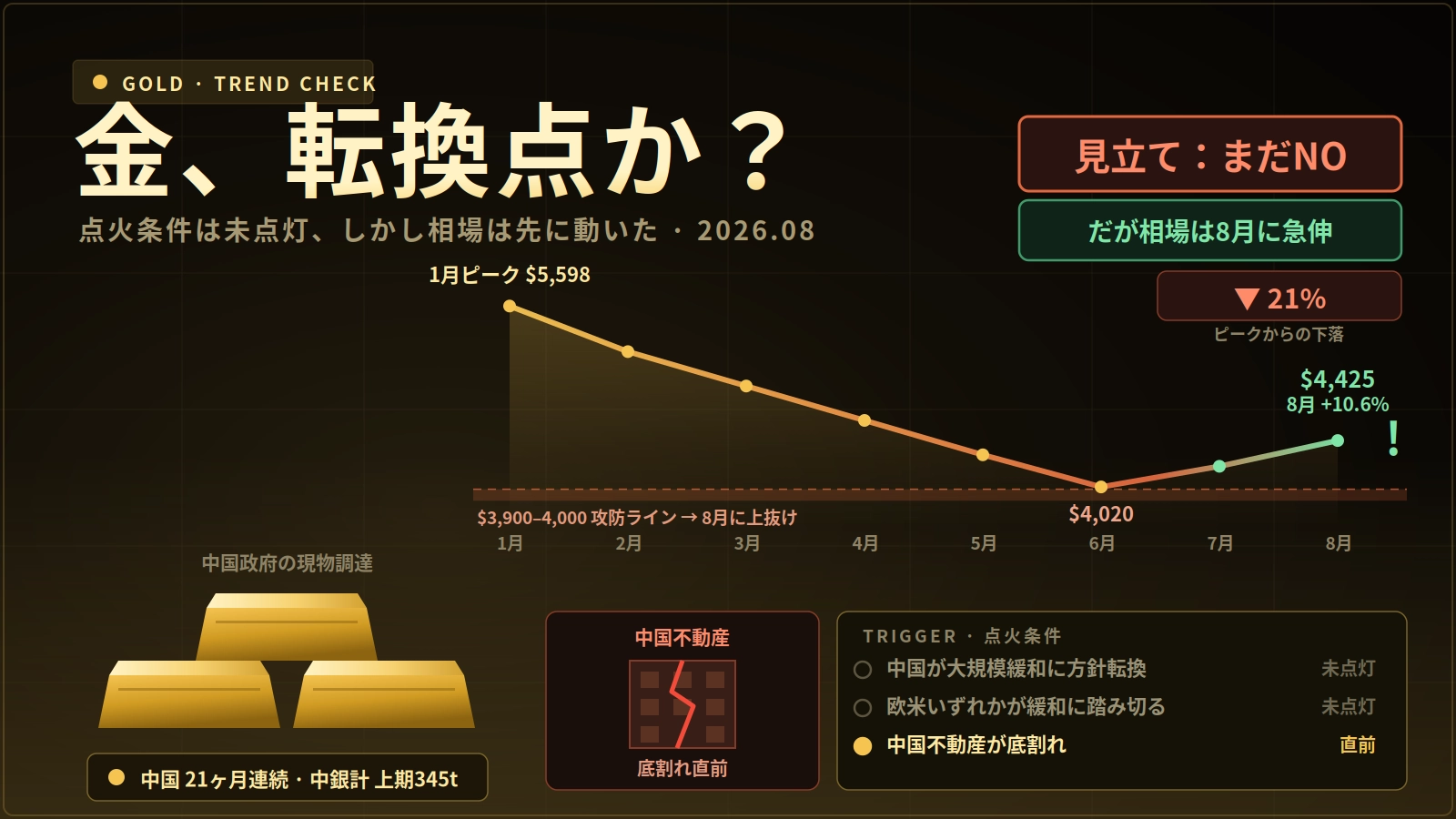
Gold, a turning point? — “China's temporary procurement”
Gold, a Turning Point? — Verifying the claim that it is only a temporary purchase by the Chinese government with data
Introduction (Important premise)This article is① facts that can be verified from public informationand,② market interpretations (speculation) of how one should read itclearly separated.To state the conclusion upfront――“the conclusion that it is not yet a trend reversal is currently wavering.”Because the market moved in August. I will treat its contents in Chapter 7. This is not investment advice.
0. To put it simply, first
The following hypothesis was tested.
“What is happening now is that gold is being bought because the Chinese government is purchasing physical gold. The market trend has not changed. If China or the West begins monetary easing, that will be the turning point.”
“Being bought” and “the trend changing” are different things――Separating these two is a very effective way of thinking. Chapter 2 explains this in detail.
However,this hypothesis has two problemsthat were found.
- Facts cited as evidence that conflict with the data(Chapter 7①②)
- In August, the market moved even though there was no switch activated(Chapter 7③)
We will look at them in order.
1. First, the “Facts” part — What is happening
In this chapter, only verified facts are listed.
Gold fell sharply and then rebounded in August
If you don’t know this, the story can look completely reversed.
- Gold peaked at about$5,600/oz at the end of January 2026.
- Then it declined,the second quarter (Q2, Apr–Jun) fell about 16%, the worst quarter since 2013.
- After dropping to about$4,020 in June, July continued to fall by about 1–2% for consecutive losses.
- Andrecovered to the $4,400s on Aug 10–11.The highest in about 10 weeks,the August rise was about +10.6%.
- As of August 12, the current price is$4,425approx. from the January peak is about −21%
The trigger was the U.S. CPI on August 11. Because inflation growth was mild,the fear that the Fed would hike faded, and gold was bought.
⚠️Important: The reason gold rose is not because monetary easing actually occurred.It’s only that the expectation changed that “they might not raise rates.”This difference is the point of Chapter 7③.
China continues buying
- People’s Bank of China (PBOC) hasbeen increasing gold purchases for 21 consecutive months.
- In July 2026, it bought **19.9 tons (64k ounces)**.The largest since autumn 2023.
- As of end-July, gold holdings stood at7,608万 ounces (about 2,366 tons).
Total central bank purchases are accelerating
- Q1 2026: 57 tons
- Q2 2026: 289 tons. This isthe highest quarterly total on record,up 62% YoY.
- H1 total: 345 tons. Led byPoland 51 tons, China 33 tons.
In July, gold ETFs saw inflows again
- In July 2026, global gold ETFs saw inflows ofabout $2.96 billion (23.5 tons).Two months of outflows stopped.
- Year-to-date, inflows wereabout $11 billion (39 tons).
Regional breakdown is as follows. The World Gold Council (WGC) divides regions into “North America, Europe, Asia, Other,”with India counted within Asia.
| Region | July Inflows |
|---|---|
| Europe | 17.3 tons ($2.0B) — the largest. UK about $0.875B, Switzerland about $0.657B |
| Asia | 4.8 tons ($6.16B) — of whichIndia about $0.157B. Japan outflows |
| North America | 0.3 tons ($0.71B) — the weakest.Only region with a year-to-date negative |
| Other |
China has not yet embarked on monetary easing
This is a central point of the hypothesis.
- The LPR has been held for 14 months through July 2026.
- The PBOC has signaled that it will cut reserve requirement ratio (RRR) and/or cut rates,but has not done so yet.
Europe and the US also have not turned to easing
- ECB raised rates on June 11, 2026 (since 2023). Reason: inflation pressure from Middle East wars.
- US Fed held rates on July 29 FOMC (policy rate 3.50–3.75%). Voting: 9–3, the three dissenters favored a rate hike. Chair Powell cited uncertainty for the hold.
China’s real estate sector continues to deteriorate
- Prices of second-hand homes in 100 major cities in June fell month-on-month by−0.42%. Year-on-year: first-tier cities −6.95%, second-tier −8.21%, third/fourth-tier −7.48%.
- From Jan–May 2026, new home sales fell in floor space by−10.8%, value by −13.5%. Real estate investment −16.2%, commencements −22.6%, completions −23.4%
- Population has been shrinking since 2022, pointing to structural factors
- Fitch downgraded 2026 new home sales forecast to −13%.
- On the other hand,new home prices slowed their decline in June,. There are reports that the picture is mixed.first-tier cities rose for four consecutive monthsViews diverge.
Digital Gold infrastructure development
- World Gold Council (WGC) announced on March 19, 2026 a concept for “Gold as a Service (GaaS).”This is a proposal for shared infrastructure for digital gold products.Currently it is only a proposal, not an active service.
- WGC, with law firm Linklaters, proposed a new share mechanism for the London market, “Pooled Gold Interest (PGI).”It would allow digital transactions with gold used as collateral,planned to start in Q1 2026 (announced Sept 2025).But as of August, no start confirmed.
- UK FCA is discussing standards with major banks for tokenized gold for large markets.Independent rulebook not yet in place, overall roadmap expected in late 2026.
- London accounts for about 70% of world gold trading, with holdings of9,339 tons (about $1.384 trillion as of March 2026).
Transparency of procurement routes and rules for on-site purchases
- LBMA’s Responsible Gold Guidance, RGg v10 is being prepared for release within 2026.
- EU’s Corporate Sustainability Due Diligence Directive (CSDDD) becomes applicable in 2027,with 2026 a regulatory milestone for member states.
- EU AML Regulation (AMLR) applies from July 10, 2027, 2026 is a preparation year.
- EU Conflict Minerals Regulation enforcement tightens. Global Precious Metals Market Code of Conduct (GPMC) Version 3 due end-2026.
- In Japan, under the Act on Prevention of Transfer of Criminal Proceeds, traders of gems and precious metals must perform customer due diligence (CDD) at transaction time. Payments exceeding ¥2 million in cash are subject to the rule (card or bank transfer rules differ).
2. Core — How is “being bought” different from “trend reversal”
This is the best part of this hypothesis.
Who is buying matters entirely
Gold buyers can be divided into three main groups.
① Central banks (governments) = “stockpile”Nations hold gold as part of foreign exchange reserves to reduce risk of dollar concentration and to hold assets less prone to sanctions. They tend to buy in fixed quantities as policy, not based on price movements.
② Investors (ETFs) = “price appreciation expectation”They buy because it seems profitable. They buy when prices are rising and sell when they think they will fall. This group drives market trends.
③ Jewelry/industry = “consumption”Rings, electronic components. When prices rise too much, demand may fall (hesitation to buy).
If you compare it, it’s like “stockpiled rice” and a “new rice boom”
Suppose the government buys a fixed amount of stockpiled rice every month. Inventory piles up and the news reports the buying. But that does not necessarily mean the price of rice is in an upward trend.Because the government buys regardless of price as a policy.
On the other hand, if people in town all rushed to buy rice because they expect prices to rise, that could indicate a turning point in the market.When people who move with price changes change their direction, that signals a trend reversal.
A trend reversal is when “② investment money really changes direction.”――This is the central idea of this hypothesis and a coherent framework.
Compare the scale
When you lay out the numbers, the picture becomes clear.
- Central bank purchases (H1): 345 tons
- Gold ETF purchases (since start of year): 39 tons
About nine times larger. In other words, the gold market is currently overwhelmingly supported by the central banks (group ①), and investment money (group ②) is still small.The view that it is “being bought, but not a trend reversal” is best supported by this comparison.
3. Why would monetary easing be the switch?
Gold and interest rates
Monetary easing means central banks lower rates or flood the market with money, increasing the amount of money in circulation.And gold —
is an asset that benefits when money itself becomes less valuable because it does not earn interest
- The handicap of not earning interest becomes smaller. Gold itself does not yield interest. So when rates are high, cash deposits or bonds look better, and gold is disadvantaged. When rates fall, that handicap diminishes.
- When money increases, the relative value of goods rises: more money dilutes value per unit. Gold cannot be produced easily, so its relative value tends to rise.
To illustrate— if class size doubles, each person’s speaking time halves. When money increases, that is the meaning.The scarcity of gold makes its value rise relatively.
Therefore,when China not only buys gold but also becomes a creator of money (i.e., engages in large-scale easing)— that is, when large-scale easing is undertaken—the investment money in group ② has a reason to move. This is the logic for the “turning point” condition.By the same logic, if either Europe or the US eases, the same could be expected.
And as Chapter 1 states,China has kept LPR for 14 months, the ECB raised rates in June, and the Fed held (vote: opposed to hike).The switch has not happened yet.
4. Chinese real estate is at the “last step before bottom”
Why real estate could trigger easing
China’s real estate is at the center of household assets and a main source of local government revenue (selling land rights for financing). If this collapses, pain will hit households, local governments, and banks simultaneously.
Therefore, if real estate truly bottoms out, the government would be forced to undertake large-scale easing.
China real estate bottoming → turning to large easing → more money in the economy → gold trend reversal
“Bottoming out triggers easing.”The People’s Bank has signaled RRR cuts and rate cuts but has not yet implemented them
What the data show
As Chapter 1 shows,investment −16.2%, starts −22.6%, completions −23.4%, prices down 7–8% YoY.Fitch also lowered forecasts to −13%.
However,the pace of decline in new home prices slowed in June, and first-tier cities rose for four months in a row.Whether this is a sign of a bottom or just a near-bottom is not yet settled.
5. Digital Gold (GaaS) and the transparency of procurement routes
This is more about the system than the market. But it will matter in the medium to long term.
What is GaaS?
To illustrate— In the old days, each shop had its own loyalty cards; you could not use A-store points at B-store. The same is true for digital gold being developed by various companies: if issuers differ, there is no interchangeability. GaaS aims to create a common platform where digital gold from any issuer can be treated the same.GaaS would provide a common base for handling digital gold from any issuer.
Current status:The WGC published a proposal in March 2026,but it is not an active service yet.
Relatedly, for the London market,PGI (Pooled Gold Interest) has been proposed.A mechanism to use gold as collateral in digital transfers,intended to start in Q1 2026 (announced Sept 2025).However, as of August, no start confirmed.UK FCA is actively discussing standards with major banks.
Why is it paired with transparency of procurement routes?
For digital gold to be trusted, it must be guaranteed that the backing bullion truly exists and comes from legitimate sources.Just increasing tokens without backing serves no purpose.
Hence,promoting tokenization and ensuring transparency of origin and supply chains move in the same direction. In practice, what is already moving is —
- LBMA’s Responsible Gold Guidance v10 (to be published within 2026)
- EU’s CSDDD (2027 applicability, 2026 is a regulatory milestone)
- EU’s AML Regulation enforcement tightened
- GPMC v3 (to be published by end-2026)
Relation to over-the-counter purchase regulations
The view that“OTC Gold purchase regulations are part of this”is broadly coherent with the overall direction.
Gold has always been used for anonymous value transfer,and thus is prone to money laundering concerns. When untraceable gold enters circulation, transparency efforts are undermined. Thereforethe idea is to perform customer verification at the point of purchase.
⚠️Note: Japan’s customer verification obligation is based on the existing framework under the Act on Prevention of Transfer of Criminal Proceeds, Strengthening anti-money laundering measures and improving gold transparency are moving in the same direction, which is accurate. Also,there is no single international treaty; rather, a bundle of regulations and guidelines exists.
6. How to view retail ETF buying
In July, funds flowed back into gold ETFs (about $2.96 billion, 23.5 tons) — the first increase in two months.
There is a basis for not viewing this as the start of a large trend:there are grounds to be cautious.
- It was only a one-month reversal, after two consecutive months of outflows prior.
- Year-to-date inflows total 39 tons, about one-ninth of the 345 tons that central banks bought in Q1–Q2.
- North America is the only region with a YoY negative. The world’s largest investment money has not yet fully returned.
In terms of scale, this is not yet a complete “rotation of investment money.”— I think this is a fair assessment.
7. [Most important] Weaknesses of this hypothesis
① The claim that India and China are central does not align with the data
July ETF inflows were led by Europe. 17.3 tons (about $2.0B), far surpassing Asia’s 4.8 tons (about $6.16B). India about $0.157B.
Thus, the notion that retail buying is driven by India/China in July is not supported by the WGC data; the leaders wereUK and Switzerland.
This is not a minor point. Europe’s buyers are likely influenced more by expectations about interest rates and currencies than by Asia’s physical demand.If the buyers differ, the triggers differ too.
② It is inconsistent to label central bank purchases as merely China’s temporary procurement
When numbers are lined up, this expression is hard to defend.
- PBOC purchases have been21 months straight,a natural part of structural policy.
- Q2 central bank total was 289 tons, a quarterly record,, acceleration.
- First-half drivers were Poland (51t) and China (33t), not China alone. So it’s not China-only.
Moreover,some analyses argue central bank buying supports prices. One view is that ongoing PBOC purchases helped support gold above $4,000,China may be leading about one-third of global demand flows.
This is a direct rebuttal to the core argument in Chapter 2 (central bank buys do not create a trend).Whether they do not create a trend or whether they actually support prices is a debated point to be understood.
③ [Most important] The market moved before the switch happened
This is the biggest problem.
The framework was “no movement until actual easing comes.” But—
- On Aug 10–11, gold leapt to the $4,400s.Ten-week high,monthly +10.6%.
- $3,900–$4,000 support/ resistance line has already broken upward.
- Both China and the West have not eased
The trigger was the U.S. CPI on August 11.Inflation growth was mild,and the fear of rate hikes faded. In other words—
The move to +10% was caused not by actual easing but by a change in expectations—just the possibility that rates would not be hiked.
The lesson is important.Markets move when expectations change, not when actual easing is implemented.Waiting for actual easing to buy may result in a late entry.
Of course, it is still unclear whether this rise is a genuine turning point or a rally within a downtrend (a so-called “false breakout”). It is still about 21% below the January peak.
④ “Just because easing hasn’t happened, doesn’t mean prices won’t rise”
Prices can rise for reasons beyond easing: geopolitical risk, dollar weakness, inflation resurgence, fiscal concerns.If you focus only on easing as a switch, you may miss alternative routes for price rises. August’s gains are an example.
⑤ The claim that GaaS “has made substantial progress” is a bit premature
GaaS itself remains at the proposal stage announced in March 2026 and is not yet active.PGI was announced in September 2025, with a start targeted for Q1 2026,It is necessary to separate concept, plan, and actual progress.
⑥ China real estate is neither bottomed out nor broken through
The pace of decline in new-home prices has slowed, and reports say first-tier cities rose for four consecutive months.“Bottoming out just before bottoming” is one reading, not a confirmed fact.
8. Mini glossary of terms
Market terms
- Trend reversal: The direction of the market’s major trend (up or down) changes. Distinct from a temporary rebound.
- Bear market: A drop of more than 20% from the peak.
- Ounce (troy ounce): Unit of weight for precious metals. About 31.1 grams.
- Attack/defense lines (support/resistance): Price levels that many traders watch. Support is a floor; resistance is a ceiling.
- Daily/Weekly: Price charts by day or by week; weekly provides a longer-term view.
- Technical analysis: A method of predicting future price movements from past patterns.
- Retail: Individual investors and small buyers.
- Geopolitical risk: Impacts of war and international tensions on the economy.
Gold/Market terms
- Gold ETF: Investment funds that track the price of gold; tradeable in brokerage accounts, backed by physical gold.
- Physical gold / bullion: Actual physical gold bars or coins, not paper or data.
- Foreign exchange reserves: Assets held by a country for external payments and currency intervention. Gold is a component.
- Central bank: The national monetary authority. China’s is PBOC, the US is the Fed, the Eurozone is the ECB.
- LBMA: London Bullion Market Association. Sets standards for global gold trading.
- WGC (World Gold Council): Industry body centered on gold miners; source of supply/demand statistics.
Policy/Regulatory terms
- Monetary easing: Lower interest rates or increase money supply to expand the economy.
- LPR (Loan Prime Rate): China’s actual policy rate, the rate for the best borrowers.
- RRR (reserve requirement ratio): The portion of deposits that banks must hold with the central bank; lowering it increases bank lending, i.e., easing.
- FOMC: U.S. Federal Open Market Committee, decides monetary policy.
- CPI (Consumer Price Index): A key statistic for inflation.
- Hawkish/Dovish: Hawkish = inclined toward tightening; dovish = inclined toward easing.
- Digital Gold: Gold with a digital claim against it, enabling digital transfer of ownership.
- GaaS (Gold as a Service): The shared infrastructure concept for digital gold (WGC, March 2026 proposal).
- PGI (Pooled Gold Interest): A proposed share-based mechanism to use gold as collateral for digital transfers in London (planning stage).
- Tokenization: Converting asset rights into digital units.
- Money laundering: Concealing the origin of illicit funds. Gold’s anonymity makes it a common target.
- Act on Prevention of Transfer of Criminal Proceeds: Japan’s law on anti-money laundering; requires customer verification for precious metals businesses.
- Due diligence: Pre-checking suppliers and procurement paths for issues.
- Responsible sourcing: Procuring materials from sources without conflict or human rights abuses.
9. Summary
Facts
- Gold peaked at about$5,600 in late January,Q2 fell −16% (worst since 2013),$4,020 in June. Since then7月 +1–2%, 8月 surged to $4,425 (monthly +10.6%, 10-week high). From the peak, about−21%.
- August rise triggered by the August 11 U.S. CPI,“hike caution faded.”This is not actual easing.
- PBOC has purchased for 21 consecutive months, July:19.9 tons.Central banks total in Q2: 289 tons (record for Q2), H1 total 345 tons. Led byPoland 51t, China 33t.
- In July, gold ETF inflows were about$2.96B, 23.5 tonsEurope led (17.3 tons). North America YTD is negative, with.
- China has kept LPR at 14 months, RRR cuts and rate cuts announced but not implemented.ECB raised rates in June, Fed held in July (three dissents favored a hike).
- China’s real estate continues to worsen (investment −16.2%, starts −22.6%, Fitch forecast −13%): but.
- GaaS is at proposal stage, PGI at planning stage. The UK FCA standards are making progress.
Assessment of this hypothesis
- ✅ Strong points: The idea to separate “being bought” from “trend reversal.” A scale comparison—Central bank 345 tons vs ETF 39 tons (about 9x)—best supports this hypothesis. It is also accurate to recognize that China and the West have not yet eased.
- ⚠️ Points needing revision: ① Retail buying was led by Europe, not India/China. ② Central bank buys are 21 months straight, with Q2 the record and Poland as the lead; China alone cannot explain it. ③ GaaS is still at the proposal stage.
- ❗ The most serious issue: In August the market moved more than 10% before the switch happened. Waiting for actual easing can cause missing a market move that occurs when expectations change.
The conclusion that “it is not yet a trend reversal” was reasonable based on data up to late July.
— This perspective applies to all markets, not just gold. In this case, the perspective is correct, and the scale comparison (345 tons vs 39 tons) was able to be corroborated.
However,markets move not when policy is actually implemented but when expectations change. If you set the trigger to “actual easing,” you may judge correctly but move late. August’s 10% rise seems to illustrate this well.