
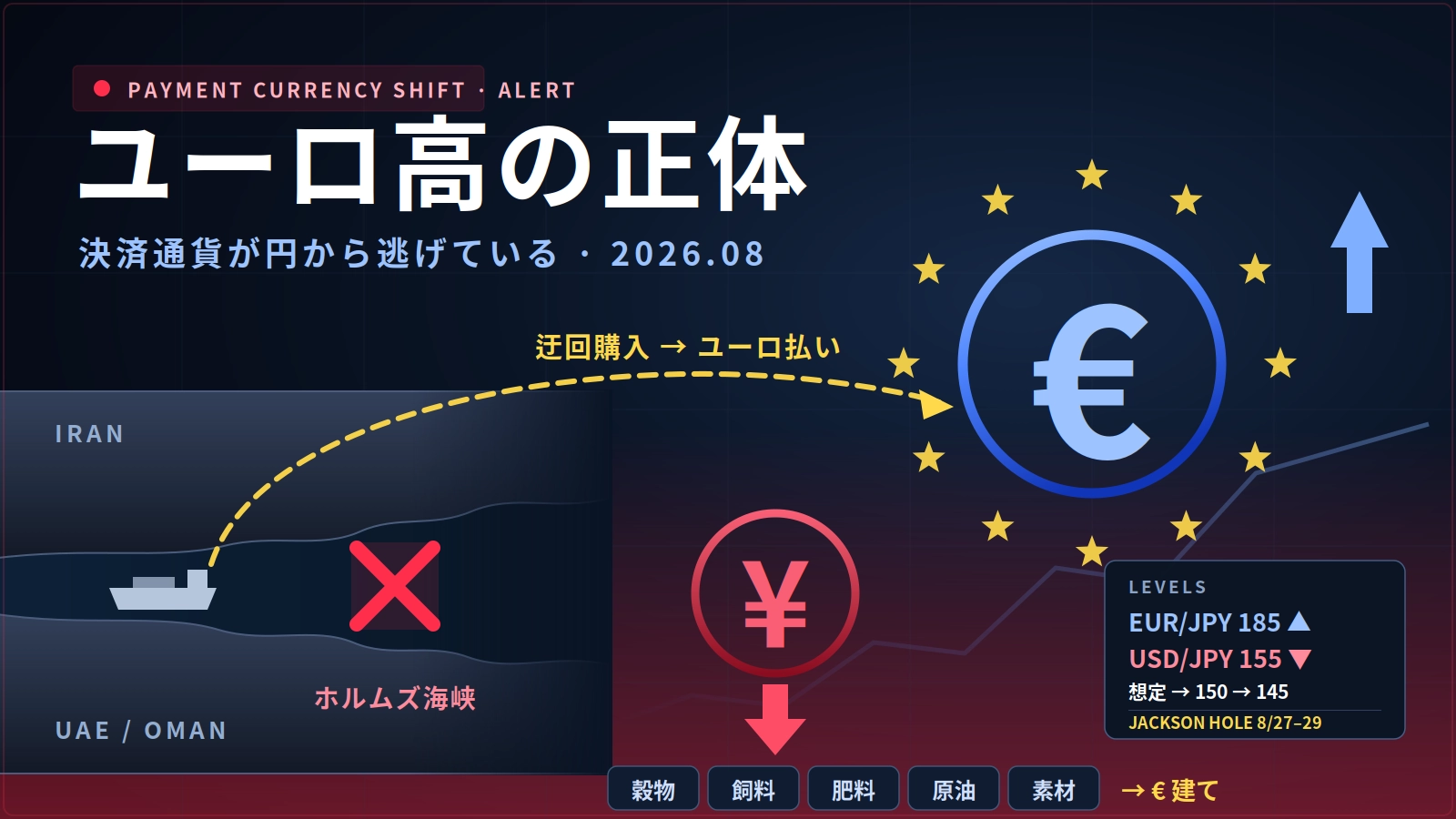
The Real Reason for the Euro’s Strength — “Why is the Euro Too Strong Against the Yen”
The True Face of the Euro Rally — Reading “Why is the Euro So Strong Against the Yen?” for Beginners
Introduction (Important Premise)This article blends three themes: ① public facts,② conjectures (hypotheses) like “could it be explained this way?”,③ individual trading scenarios. For readability, we will clearly distinguish at every turn between what is fact and what is conjecture.we will summarize materials that disadvantage this view. Interestingly, there is another simpler hypothesis that explains the same events through a completely different route. Reading up to that point is the main aim of this article. This is not financial advice.
0. In short, the core idea
It is not that the euro is “strong”; instead, the world’s payments are increasingly settled in euros, which in turn is selling the yen—this is the backbone of the view we examine here.
Usually, forex moves are explained by “interest rates” or “the economy.” But this time we focus on a quieter factor —“Which currency is used to pay for purchases?”.
To illustrate, imagine your household’s monthly expenses (food, utilities) suddenly switched to euro payments. Each month, you would have to sell yen to buy euros regardless,creating a persistent monthly demand to sell yen. This “monthly recurring buying” gradually pushes the market.
However, note in advance thatthis view has a strong rival hypothesis(Chapter 8). The main point of this article is to compare the two.
1. First, the “Facts” Part — what can be confirmed from public information
Before conjecture, we list verifiable facts only.
The Strait of Hormuz was actually closed
- On February 28, 2026, following U.S.-Israel actions against Iran, Iran closedall foreign ships through the Strait of Hormuz.On March 2, the IRGC officially confirmed “closure” against unfriendly countries.
- On March 19, the United States began aerial operations to reopen routes; by April 13 there was a naval blockade; May 4–6 saw the operation “Project Freedom,” which was later suspended for negotiations.
- June 17, Presidents Trump and Raisi signed a memorandum.On June 18, the strait reopened.
- At the peak of the blockade,about 1,000 ships and 20,000 crew were delayed for over 100 days. The International Maritime Organization (IMO) confirmed46 vessel attacks and 14 deaths.
Euro is actually high against the Yen
- As of July 2026EUR/JPY around the 185 level. The monthly range generally around184.00–186.00 (with 183.50–183.70 serving as the lower support zone).The 186 yen level has been tested several times and repelled.
- Policy rates:ECB deposit facility rate 2.25%(main refinancing rate 2.40%),BOJ uncollateralized call rate about 1.0%.
ECB raised rates in June 2026
- June 11, 2026, the ECB decided ona 0.25 percentage point rate hike (effective June 17).
Bank of Japan held rates at the end of July
- July 31, 2026, the policy rate kept around 1.0%. Commissioner Takata proposed raising to 1.25%, but the proposal was rejected.
Dollar-Yen tumbled right after intervention
- July 30, Japan conducted an approximate 8.45 trillion yen unilateral intervention.
- July 31, the first U.S.-Japan coordinated intervention in 15 years.
- Dollar-Yen fell from about 164 to an intraday low of155.23 on August 3, a drop of about5%.
- Market eyeing key levels (price zones many participants watch) areupward: 159.45 / 161.00 / 164.00,downward: 155.03 and the 152.55–151.19 zone.
Jackson Hole schedule and theme
- August 27–29, 2026.
- This year's theme is“Financial Innovation: Implications for Payments and Policy”.
Euro’s international status (ECB report, June 2026)
⚠️Important note: The figures below are all data from 2025 (some from 2025 April, Q4)..The period before the Hormuz blockade (Feb 28, 2026 onward)is the scope here. This will be revisited in Chapter 8.
- The euro’s international position indicator is about20% (year over year +0.2 percentage points).
- 60.0% of euro-area exports and 53.1% of imports are invoiced in euros. Last year exports were 59.6%, imports 52.8%.
- Euro-denominated international loans and bonds havegrown about 30% to over $1.1 trillion. In Green Bonds (environmental projects), euros have led over the dollar for the first time.
- Share of foreign exchange reserves (assets held by countries for external payments/intervention) is euro 20.2%, dollar 57%, yuan about 2%. ※This is a different metric from the overall indicator above.
- Euro’s involvement in FX trading is about 29%, down roughly 2 percentage points since 2022, while the yuan rose about 9% (+1.6 percentage points).
2. Here is the core — why “which currency you pay with” moves the FX
This is the most important logic, so we’ll go carefully.
The quiet force of real demand
- Speculation: “It looks profitable, so I buy.” If prices become unfavorable, one can stop.
- Real demand: “Because daily life and business require it, I must buy.” Even if prices are unfavorable,it is hard to stop.
A company importing wheat will see its business halt if it cannot pay. Therefore,they buy even when FX is unfavorable. This is real demand.
Key point: real demand is repeated mechanically every month/quarter. It may not make headlines, but it acts like a body blow over time.
What happens when the invoicing currency changes
Suppose a Japanese company buys crude oil or feedstuffs from abroad.
- Previously (in dollars): Invoices were “$1,000,000.” The company would sell yen to buy dollars and pay in dollars. So there is a yen selling/dollar buying pair.
- Now (in euros): Invoices become “€900,000.” The company sells yen to buy euros and pays in euros. So there is a yen selling/euro buying pair.
What changes is not the quantity of goods nor the value of payment; what changes is “which currency is invoiced.” Still, the FX market’s buying/selling pairs shift entirely.
This is the engine of the current view.“The euro was bought because it was popular” is not accurate; rather, people are being forced to pay in euros because they must— this is the crucial distinction.
Illustration— Imagine a town where all shops suddenly require payments in euros. People don’t necessarily like euros, but they must line up at exchange offices to pay. If the lines at exchange offices persist daily, euro prices tend to rise. The reason is not popularity but necessity.Yes, necessity drives the rise.
3. Inferential Part Ⅰ — Since Hormuz, the purchases via alternative routes have been euro-denominated
From here, these are conjectures (hypotheses).
Claim:Since the Hormuz Strait closure,grains, feed, fertilizers, crude oil, and materialshave been procured via alternative routes, and those alt routes’ transactions were euro-denominated. Therefore,円→ユーロ real-demand buying accumulated.
Putting it plainly
Hormuz is the world’s busiest and narrowest waterway for oil and LNG. When it closes, goods must be bought from other origins via different routes.
And,the moment you switch to another origin, the contract currencies often switch too.
- Middle East crude → traditionallydollar-denominated (Petrodollars)
- Alternative sourcing from Europe/North Africa/Black Sea region →likely euro-denominated
- Grains, feed, and fertilizers, if bought via Europe or European traders, →euro-denominated
Additionally, it is easy to overlook that euro-denominated payments can extend beyond just the price of goods. Insurance premiums for ships passing through dangerous waters, freight, trade finance such as letters of credit, etc., if settled through European financial institutions, would be paid in euros as well.
In other words, not only oil as the “main actor” but also the “supporting actors” of insurance, freight, and finance move to euros.
4. Inferential Part Ⅱ — The groundwork existed since the Ukraine War
Claim:The shift to euro-payments was not new; since the Ukraine war, euro-denominated payments for wheat, insurance, finance, and trade had already been rising, and this time there was an additional buildup on top of that.
Putting it plainly
The soil had already been cultivated.
Ukraine and Russia are among the world’s top wheat exporters. When war disrupts supply chains, Europe’s granaries and European traders became alternate recipients. If trades move toward Europe, invoices tend to be in euros.
Meanwhile, to avoid Russian-related risks, insurance/reinsurance, trade finance, and settlement routes were reorganized toward Europe. Once contract templates and trading practices harden in euros, they tend not to revert quickly. Long-term contracts may persist for years.
Point:Real FX demand is “constructed by contracts.” Therefore, as long as contracts continue, the cash flow persists, even after news fades.
5. Inferential Part Ⅲ — Have euros also reduced dollar settlements?
Claim:The euro area itself has been reducing dollar settlements in recent years.
This is honest: data does not make a strong case.
What the data shows
- Euro-area exports 60.0% and imports 53.1% are euro-denominated (2025).Import shares above 50% are real.
- But last year exports were 59.6% and imports 52.8%.A 0.4/0.3 percentage point rise, i.e., essentially flat.
- Moreover, more than half of imports were already euro-denominated historically. The euro area trades a lot within its region, so euro-denominated shares were high to begin with.“Recent slip away from the dollar” is not true.
Be careful with the “30% increase in euro-denominated bonds” interpretation
The fact is “international bonds in euros grew 30% to over $1.1 trillion.” However, reading this as a fall in dollar dependence contradicts ECB explanations.
- Credit spreads historically low,
- Lower funding costs relative to other currencies,
- AI investment boom
Additionally, the increase includes“reverse Yankee bonds”—US companies issuing in euros and swapping back to dollars—
Conclusion: this③ claim is not sufficiently substantiated by public data.It could be plausible, but the evidence is weak.
6. Dollar/Yen: “the 155–150 consensus range” and Jackson Hole
Claim:There is an agreed range of 155–150 Yen for USD/JPY, and this view is transmitted to market frontline traders.It could surface at Jackson Hole.
Plainly — what is the “consensus range”
Consensus range is an implicit defensive line that authorities share: “If prices move beyond this range, we will act.” Officially it is never published. Revealing it would invite speculative attacks on that line.
To illustrate, it’s similar to how in soccer, a referee’s tolerance for rough play is not written in the rulebook, yet players know from experience that certain levels won’t be called. Market participants try to sense that invisible line.
“Flowing to the front line” means that information has actually reached the frontline traders who execute orders.This is rumor/observation level, not official confirmation.
What is Jackson Hole?
The Jackson Hole Conference is an annual late-August retreat in a mountain resort in Wyoming, where central bankers gather. It is not an official policy meeting, so it is a venue where honest opinions and future directions can surface, drawing the market’s biggest attention.
This year (August 27–29, 2026) the theme is“Financial Innovation: Implications for Payments and Policy”.Payments is the explicit theme.
From here on, it becomes interpretation. However, the question of “which currency world payments will settle in” is arguably the groundwork for discussion at this event, even though the theme, “Financial Innovation,” typically points to digital currencies and payment-system tech rather than the currency power balance for settlements.
7. Trading Scenarios (the author’s assumed outlook)
The following are the author’s personal market scenarios and are neither facts nor guarantees of预测.
- Dollar-Yen at 150 as the primary assumption (the Bank of Japan’s consensus line is seen at 151)
- From there, a further move down to145, changing the scenario
For reference, market talk of the lower zone is152.55–151.19. The numbers are close, but they are of completely different nature: the former (151) is rumors/observations about the authorities’ defense line, the latter is a chart-support band and does not validate one another. We cannot claim they are simply the same.
8. [Most important] Weak points of this view and rival hypotheses
This is the most important section of the article.
① Hormuz closure has already resumed
The main issue. The blockade was lifted onJune 17–18, 2026.The premise “the blockade continues so diversions continue” no longer holds.
There are counterarguments.Contracts lag logistics, so long-term contracts and annual procurement quotas may persist for months to years, and even after the strait opens, payment flows could linger. However,the effect naturally diminishes over time.
② Rival hypothesis: ECB rate hikes alone can explain the same phenomenon
This is the strongest counterevidence.
Remember: the ECB raised rates onJune 11, 2026 (effective June 17). The reason was “inflation pressures from Middle East wars.”
Hormuz blockade → higher oil → euro area inflation → ECB rate hike → higher euro rates → wider interest-rate differential with Japan → yen selling and euro buying (carry) → EUR/JPY rises
This pathway can be consistent even without switching settlement currencies, and the fact that EUR/JPY traded near 185 in July can be explained simply by “euro rates rising just before that.” Meanwhile, the BOJ kept rates unchanged on July 31, so the interest rate gap stayed wide.
What’s interesting is that the starting point is the same “Hormuz closure,” but the transmission route differs.
- Settlement-route theory (this article’s view): blockade → diversions → invoicing in euros → real-demand yen selling
- Interest-rate-route theory (rival hypothesis): blockade → oil price up → inflation → ECB hikes → rate differential → carry yen selling
The interest-rate route is shorter and verifiable in official data at each stage.If adopting the settlement-route theory, one must show how much of the effect cannot be explained by the interest-rate differential alone; otherwise, the settlement-route remains a plausible but secondary factor.
③ ECB data only cover pre-blockade period
As noted in Chapter 1, the euro’s international position indicators (60.0% exports, 53.1% imports, 30% bond increase, etc.) are from 2025. Since the Hormuz blockade started in 2026, these numbers cannot prove euro-denominated shifts post-blockade.
Post-blockade data have not been published yet— this is the current state. To test hypotheses, wait for the next ECB report (usually June of the following year) and quarterly trade statistics.
④ ECB reports do not confirm “increased euro settlements for commodities”
The ECB’s June 2026 report does not state that euro-denominated settlements for energy and goods increased.
There is a possibility that the euro’s role was not a denominator of oil but the yuan, as shipments continued to China/India with military escort during the blockade.
⑤ Euro FX trading share is actually trending downward
In the same ECB report, euro’s share in FX trading is about 29%, down about 2 percentage points since 2022.During the same period, the yuan rose to 9% (+1.6 pp).
The narrative that “the euro is globalizing” can be claimed in bonds and trade invoicing, but for FX trading it is not uniform.
⑥ Weak points on the euro side exist
ECB report notes that energy price rises worsened trade terms in a way that weighed on the euro’s FX rate. The path is not simply “oil rise → euro rise”; there is also a path “oil rise → euro fall.” The euro bloc is as energy-dependent as Japan in this regard.
⑦ Headwinds for the 145 yen scenario
Note: items i–vi above were counterarguments to the main thesis “Euro up and Yen down continues.” The following is the author’s counterwind to the Yen-strength (145) scenario. Do not confuse directions.
- For USD/JPY to break below 150 or reach 145, additional catalysts are needed: actual BoJ rate hikes (the July 31 decision was unchanged), a U.S. rate cut, renewed coordinated interventions, etc.
- Technically, 159.45 is a breakout level; a break above could imply a rebound to depreciation of the yen.
- Interventions tend to “create levels” rather than force one-direction trends; they slow momentum rather than dictate it outright.
9. Mini glossary of terms
FX and settlement terms
- Settlement currency (billing currency): Which currency the invoice is denominated in..
- Real demand: Purchases driven by business or living needs; not easily foregone.
- Diversion purchases: When the original route is unavailable, procure via alternative origins/routes. The contract currency also tends to change.
- Trade finance / Letters of Credit (L/C): Bank guarantees for payment of imports/exports. If via European banks, euro-denominated payments are more common.
- Reinsurance: One insurer passes risk to another insurer.
- Petrodollar: The practice of trading oil in dollars. The breakdown of this is often seen as an indicator of “dollar de-coupling.”
- CIPS: China’s yuan international payment system.
- SWIFT / CHIPS: SWIFT is the messaging network for international bank payments; CHIPS is a large-dollar settlement system. Core of dollar settlements.
Interest-rate and monetary policy terms
- Carry (carry trade): Borrow the low-interest currency (yen) and invest in the higher-interest currency (euro) to earn the interest spread. A major driver of yen selling.
- Deposit facility rate: The rate paid when banks deposit funds at the ECB.Centerpiece of the current euro-area policy rate(2.25%).
- Main refinancing rate: The baseline rate at which the ECB lends to banks (2.40%).
- Narrowed call rate: The rate for unsecured interbank lending overnight.BOJ policy rate(about 1.0%).
- Foreign exchange reserves: Foreign currency assets held by authorities for external payments and intervention.
- International bonds: Bonds issued in markets/currencies outside the issuer’s home country.
- Green bonds: Bonds earmarked for environmental projects.
- Reverse Yankee bonds: US companies issuing in euros and sometimes swapping back to dollars.
- Coordinated intervention: When multiple authorities intervene in FX markets simultaneously; perceived to carry more weight than single interventions.
Market terms
- Milestones / tops / bottoms: Price levels that many market participants watch; tops often act as resistance and bottoms as support.
- Technical (analysis): Reading future price levels from patterns in past price movements.
- Consensus range: An implicit defense line shared by authorities; it is not publicly released.Not disclosed
- Front line: The trading desk on the front lines that actually places orders.
Geography / events
- Hormuz Strait: A narrow choke point at the exit of the Persian Gulf through which the world’s oil and LNG pass.
- Chokepoints: Critical points where a blockage would stop the whole system.
- LNG: Liquefied natural gas. Gas turned into liquid for shipping.
- Jackson Hole Conference: An international central bank gathering held annually in late August in Wyoming; theme in 2026 is “Payments”.
10. Summary
What can be confirmed as facts
- The Hormuz Strait was closed from February 28, 2026, to June 18, 2026, and logistics were indeed disrupted.
- EUR/JPY traded in the high 180s; ECB deposit rate 2.25%, BOJ around 1.0%.
- ECB raised rates on June 11 (effective June 17) for inflationary pressures from the Middle East.
- Dollar-Yen moved from about 164 after unilateral and U.S.-Japan coordinated interventions to 155.23 on August 3 (intraday low).
- Jackson Hole will take place August 27–29, theme: “Payments.”
The conjecture examined in this article
- Because diversions after the blockade were euro-denominated, there was a buildup of real-demand buying of euros by converting yen to euros (on top of Ukraine War-era groundwork).
What the verification shows
- Euro-zone’s shift away from the dollar (Inferential Part Ⅲ) is largely flat in the data; not strongly confirmable. The 30% increase in euro-denominated bonds is explained by ECB and data as arising from cheaper funding, AI investment booms, and swaps back to dollars, rather than a wholesale dollar de-emphasis.
- ECB data are all pre-blockade (2025). They cannot test the blockade post-hoc. Post-blockade data not yet published.
- ECB reports note some ships paid via yuan (CIPS) or crypto to pass Hormuz; the more plausible replacement settlement currency could have been yuan.
- The strongest counterpoint is ECB rate hikes themselves.
- Dollar-Yen at 150 (with 151 as BoJ consensus), and then 145. However, additional factors such as BoJ actual rate hikes are needed; if 159.45 is breached to the upside, a reverse move may occur.
In conclusion
The perspective of a shift in settlement currency is a very important long-term topic. Real demand operates quietly and persistently. However, for explaining this Euro strength, the interest-rate differential is more convincing, and there is no public data yet to support a settlement-shift explanation as the primary cause.
It is wise to keep both in view when dealing with such topics.