

What is the Kunbi (Reference Rate) Anomaly — A 26-year verification of the “habit” that is born at 9:55 every morning
My name is Tonochi, and I develop EA. This article is mainly written by AI, and I am doing the final check. I would appreciate it if you assume the same format will be used in future posts unless I explicitly decline.
This time, I will summarize the "Harmonic (Nikkei) Reference Rate Anomaly," which is also the foundation of the EA I am preparing to sell, from the introduction of how it works to the verification results for 26 years.
1. What is the Reference Rate — The day's base rate decided at 9:55 every morning
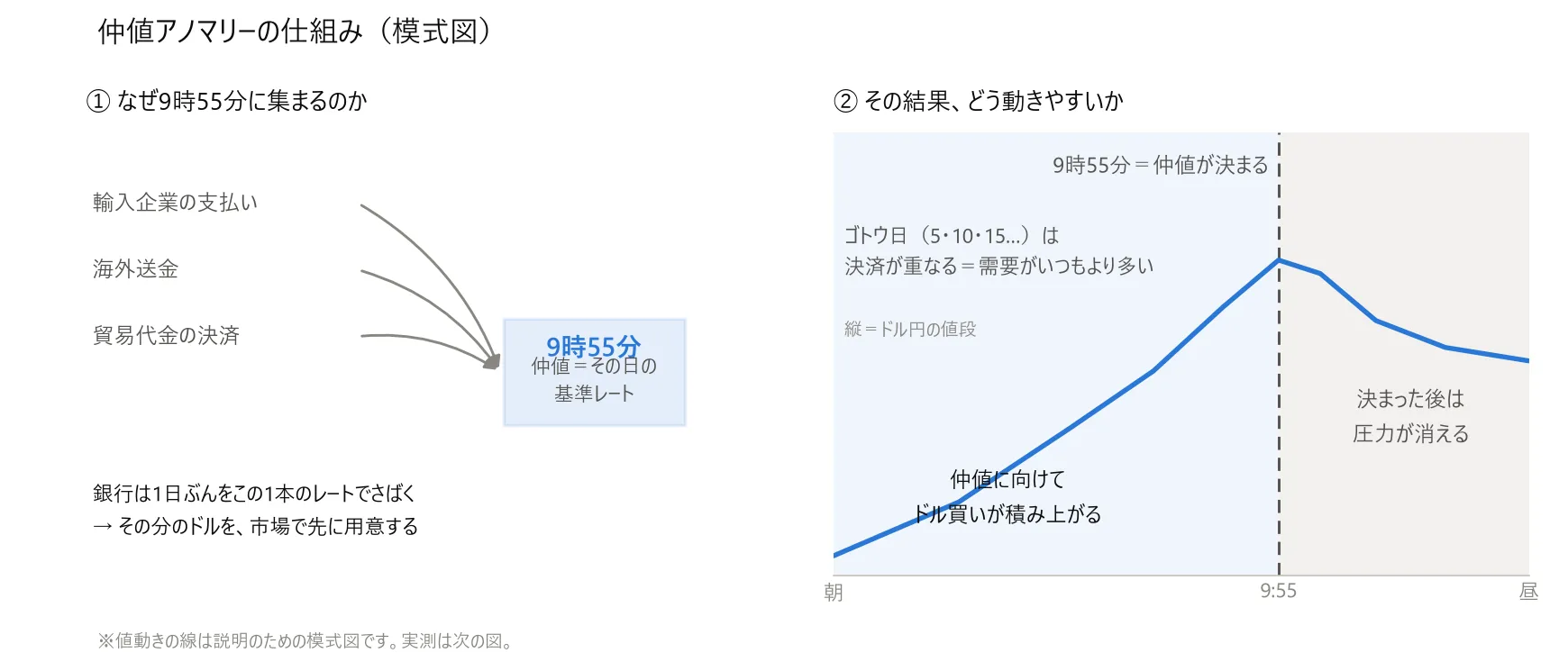
When banks buy and sell foreign currency with corporations or individuals, they do not quote the market rate for each transaction.Around 9:55 each business day, they decide the "base rate of the day" based on the market rate at that moment, and in principle use that rate for the day.This is the reference rate. Most foreign currency transactions at banks’ counters for payments like overseas remittances and trade settlements are processed with this one rate.
In other words, 9:55 is the moment when the demand to execute transactions using "this instant rate" concentrates the most in a day.If there is a price movement bias, it naturally appears here.
2. Why such a bias occurs — Dollar buying for payments
The key players are importers. Companies that import goods from overseas pay the cost indollars. Banks sell dollars to these companies at the reference rate, so the banks must procure that amount of dollars in the market.This procurement creates dollar-buying pressure ahead of the reference rate.This is the driver of the bias toward the reference rate.
Furthermore, in Japanese business practices, corporate settlement dates tend to cluster on days that end with 5 or 0, i.e., the 5th, 10th, 15th, etc. (Gotou days). This is a long-standing custom, similar to salaries often being paid on the 25th.
Combining these two factors yields the following:
On Gotou days, there is usually higher demand to buy dollars toward the 9:55 reference rate. Therefore USD/JPY tends to rise toward the reference rate, and once the reference rate is set, the pressure disappears.
This is the skeleton of the Nikkei Anomaly. It can be explained not by investors’ psychology but by real-money flows, one of the few anomalies that can be explained by actual demand.
We ran a simple EA that follows this bias (buying the day before around the reference rate and closing near it, selling after the reference rate and closing by early afternoon) from 2000 to 2026 using all tick data.
- The inherent bias before costs has been observed for all 26 years.During the strong-yen period (2000–2011) and the yen-weak period (since 2012), the strength of the bias toward the reference rate was almost the same.
- However,the realized profit after deducting costs such as spreads varies greatly by era. The total from 2000–2009 was almost flat (slightly positive), and most profits emerged after 2010.
- The raw EA (no protection mechanism, fixed lot) over 26 years showsPF 1.45, maximum drawdown 0.71%
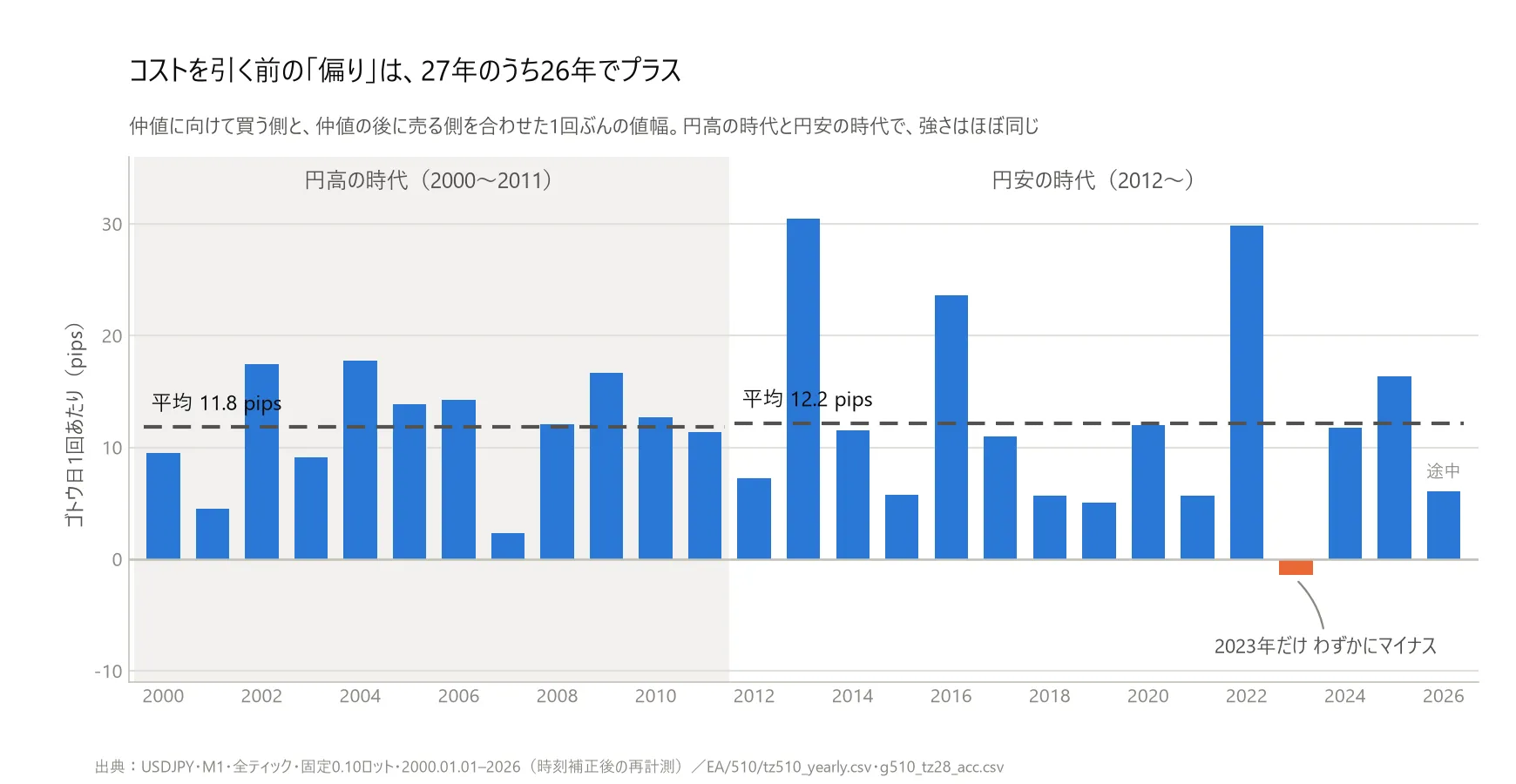
▲Figure 2: A chart of the bias before costs by year. The vertical axis shows how many pips of bias per Gotou day (sum of buys ahead of the reference rate and sells after). In 27 years, 26 were positive; only 2023 was negative. The strength was similar in the yen appreciation period (2000–2011, average 11.8 pips) and the yen depreciation period (2012–, average 12.2 pips). USDJPY with time-adjusted re-test.
The answer is“The bias has existed for 26 years. However, the profitability after costs changes with the times.””
Under the market conditions at the time, settlements were not ideal, and even with a bias, there were about 10 years where costs nearly wiped out profits. This is the real picture of this approach. The existence of a bias and the ability to win with it are separate issues. This distinction leads to §4 and §5.
4. The answer to “won’t it disappear if it’s known?”
Anomalies have a fate that “if widely known, those who anticipate it will increase and it will disappear.” Indeed, many statistical biases have disappeared this way. So why has the Gotou-rate bias persisted for more than 20 years?
Because it is driven by real demand flows, not speculation.Importing companies buy dollars not to profit, but to pay. Even if the rate is slightly unfavorable, they will buy on the payment date. Therefore, no matter how many speculators try to capitalize on this bias,the underlying demand keeps coming every month.
However, as §3 indicates, the existence of a flow and the ability to win are not the same thing. “Not disappearing” does not mean “always profitable.” Mixing these up leads to misjudgment.
5. Be honest about the weaknesses
As usual, we won’t end with only good news.
① The “thin decade” actually exists
From 2000 to 2009, there was a bias, but the realized profit after costs was almost flat for that decade. This is not a hypothesis but a measured fact.It is honest to consider that in the future another era may come where the bias exists but the profitability is thin.I handle this issue with an EA design that detects when profits thin and pauses automatically (Adaptive Edge Gate). I have published separate detailed validation records of this mechanism.
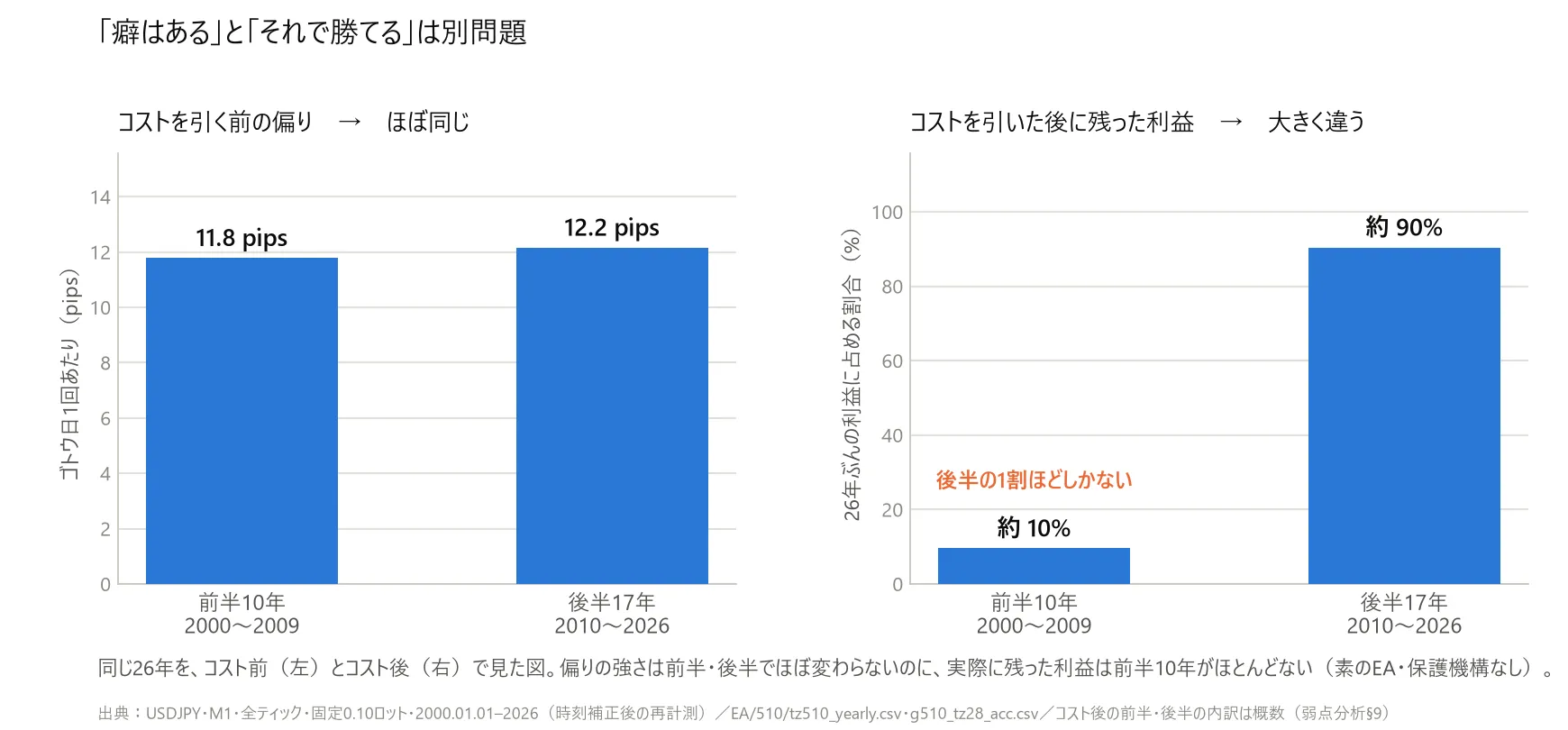
▲Figure 3: A diagram of the same 26 years viewed with costs removed (left) and after costs (right). The strength of the bias in the first 10 years and the last 17 years is almost the same (11.8 vs 12.2 pips), but the profits remaining after costs in the first 10 years are only about one-tenth of the total. “There is a bias” and “you can win with it” are separate issues; the raw EA (no protection) and the breakdown after costs are approximate.
② Short holding period means sensitivity to transaction costs
This anomaly has a short holding period and a small price range per trade. That means it is highly affected by the spreads (the price difference between buy and sell).On accounts with high cost environments, performance drops significantly even with the same rules.Be aware that backtesting and live trading differences can be pronounced for this type of strategy.
③ Using it casually just because it’s famous will feed others
It is most dangerous to imitate only the time and date and enter without any stop-loss. The numbers in §3 are the result of decisions on settlement rules and risk management over 26 years, not a statement that “buy on the Gotou morning wins.”
Summary
- Reference rate = the base rate decided at 9:55 every morning by banks. Real-money orders concentrate here.
- Gotou days see settlements pile up, and dollar-buying toward the reference rate biases the movement.Because it originates from real demand, even knowing it does not erase the demand
- In 26 years of testing, the bias has consistently appeared for all 26 years.However, the profitability after costs changes greatly with the times
Based on this bias, the EA with Adaptive Edge Gate (pause when profitability thins) is being prepared for sale now at GoGoJiang (GoGoJ). It is under review. The gate decision uses price history from the past two years, so the start time of operation does not change the trading dynamics. We will report again here when sales begin.
Verification conditions: USDJPY / M1 / Fixed 0.10 lots / All ticks / 2000-01-01–2026 / Same session / Effective spreads measured ≈ 1.3 pips. The §3 values arere-measured after time correction (base EA configuration) based on the price history with the note that there is a one-hour mislabel in the time stamps before December 2014, which has since been corrected and revalidated across the entire system).
Disclaimer: This article is a development record based on backtest results and does not guarantee future trading performance. It is not investment advice. Please manage EA operations at your own judgment and responsibility.
About this verification: We paired Claude Code AI with full tick backtests for 26 years, annual breakdowns, and weakness discovery. Design and judgment by humans; production and validation by AI — a division of labor.