
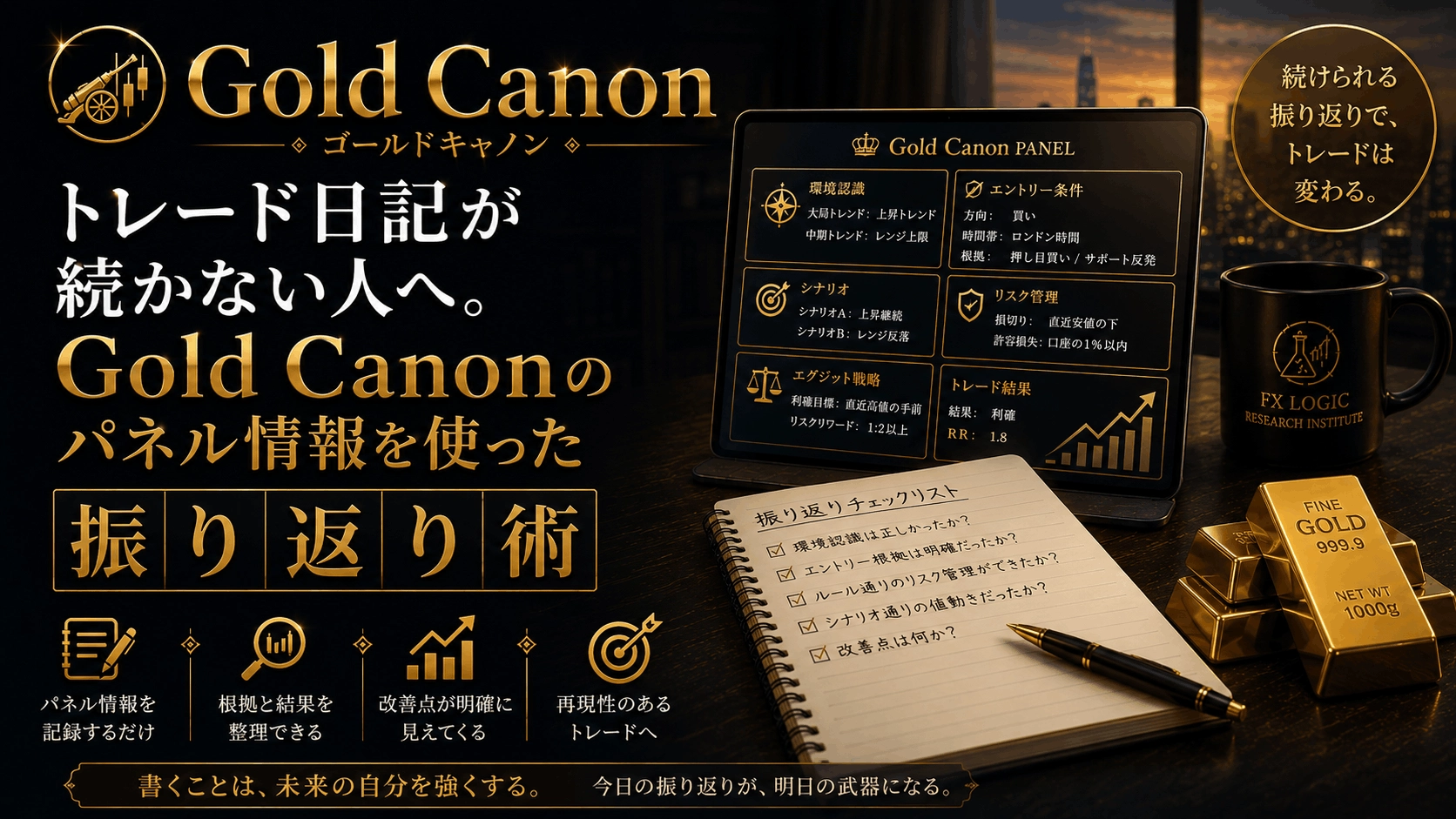
For people who can’t keep a trade diary. A reflection method using Gold Canon’s panel information
FX is not a principal-guaranteed financial product, and due to market fluctuations there is a possibility of losses that exceed the invested amount.
This article introduces one perspective on utilizing the signaling tool Gold Canon, and does not guarantee profits or outcomes. Please read with this understanding in mind.
■ Trade Diary: The Problem of Not Finishing/Keeping It Up Ultimately
The idea that “reflection is important” is something every FX newcomer has probably heard at least once.
Still, not many people actually continue recording in a notebook or app.
The main reasons are that recording itself feels like a hassle and there are no clear criteria for what to write.
As a result, on winning days one just feels satisfied and stops, while on losing days the thought of reviewing is so heavy that recording is neglected.
This prevents reflection from accumulating, and you tend to repeat similar judgments in the same situations.
■ What is needed for reflection is not “impressions” but “record items”
One of the keys to keeping reflection going is to limit what you write to the same items each time.
If you try to write a long essay like a personal reflection, it becomes a burden and does not last.
The three minimum items that are good to have are the following.
● 1) The basis of the entry.
Compress what you saw into a level that can be written in one line to explain why you made that judgment.
●2) The basis for the decision to exit. Regardless of profit or loss, record why you closed at that timing.
If you closed based on a feeling, honestly write “closed by feeling” as material for later review as well.
●3) A self-evaluation of whether that trade followed your own rules.
Separating the quality of the result from whether the procedure was correct allows you to reflect in a less hindsight-driven way.
■ Use Gold Canon panel information as the foundation for reflection
Gold Canon includes not only signal occurrences but also performance data such as win rate, earned pips, and earnings displayed in panel format. These figures are reference for past trends and do not guarantee future results, but they can be used as a foundation for reflection.
For example, if you record the timing when a Gold Canon signal appeared alongside the timing you actually entered (or did not enter), you can more easily see where your judgment diverges from the signal.
If there are many days where you could not move in line with the signal, there may be hidden psychological biases there.
Also, by using the information displayed on the panel as reference points when reviewing weekly or monthly, you can move from an impression-based “felt good/ bad” to a more concrete reflection.
■ Small tricks to make reflection a habit
You do not need special tools to keep reflection going, but there are a few tricks to make it easier to continue.
・Fix the items to be recorded at about three items and do not increase them
・Immediately write after trading while memories are fresh, allocate only 1 minute
・At the end of the week, schedule time to review that week’s records all at once
These are not hard-and-fast rules, but examples of ways to lower the barrier to continuation.
■ Summary
Reflection often fails to continue because the criteria for writing are not decided.
By narrowing down to three points—the basis of the entry, the basis of the exit, and whether the trade followed your rules—and using Gold Canon’s panel information as a foundation, you can reduce the burden of recording while maintaining the quality of reflection.
For details on Gold Canon’s features and panel displays, you can check theProduct Details Page. If you are interested, please take a look at the detailed page.