
Weekly DAO | Target currencies for next week (2nd week of August 2026)
~Understanding the Market Environment through DAO~
Good morning.
Thank you for reading this week's "Weekly DAO."
As August begins, the heat continues. The market enters the summer vacation season, but it does not mean price moves will calm. In fact, when participants are fewer, sudden price swings can occur, so it is more important than ever to check where prices are now.
In the currency market, the environment surrounding the yen moved significantly last week. In late July, the yen-buying intervention by the U.S. and Japan occurred, and even after that, there is continued vigilance for yen-related interventions. Furthermore, on August 7, U.S. payroll data came in below market expectations, and USD/JPY temporarily moved toward the yen strength in the 156 range. After such sudden changes, it is important not to judge solely by the chart pattern visible just before, but to re-check the environment from higher timeframes.
This week too, I will use the environment-recognition indicator "DAO," which I actually use in trading, to organize next week's market.
This "Weekly DAO" is not a scheme to predict next week's price moves.
"At this point, which side—buyers or sellers—has the power?"
That is what this project aims to confirm.
In DAO, we line up MN1, W1, D1, H4, and H1 EMA20s to confirm. Are the directions of the long-term and short-term timeframes aligned, or are they diverging by timeframe? And how far is the current price from EMA20.
Just organizing these three points already changes how you view the market.
Also, this article reflects my personal market-recognition, and is not intended as investment advice.
This Week's DAO One-Point
“Display ON/OFF by button”
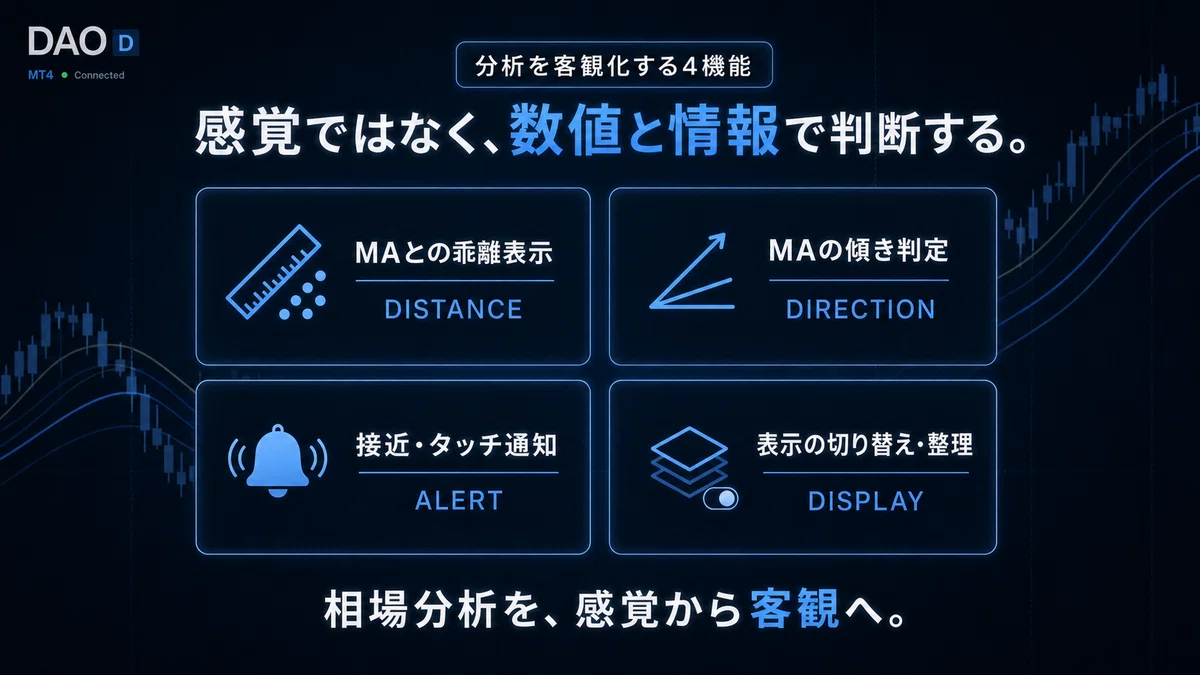
The convenient feature of the DAO being introduced this time isDisplay ON/OFF for each function via a button.
When analyzing charts, too much information can make it harder to read.
When you want to check EMA.
When you only want to check the panels.
When you want to carefully observe the candlesticks by removing the lines.
In such situations, this display ON/OFF feature is convenient.
In DAO, you can display only the necessary information and temporarily hide the unnecessary information.
This is not merely a cosmetic feature.
“What I want to check right now”
is also clarified by this feature.
For example, in market recognition you show only EMA20 on higher timeframes, and when searching for entry candidates, you display only the necessary lines and signals.
Thus, you can adjust the amount of chart information according to the analysis stage.
In market analysis, increasing information is not always the correct approach.
View only the necessary information at the necessary timing.
This is also an important concept when using DAO.
Top 3 Currencies to Watch Next Week
In this DAO analysis, 12 instruments were compared.
From those,
Direction of long-term and short-term timeframes
Density of EMA20
Distance to the current price
Consistency among timeframes
Clarity of the environment recognition
Based on these criteria, three instruments are picked.
3rd place: AUDUSD
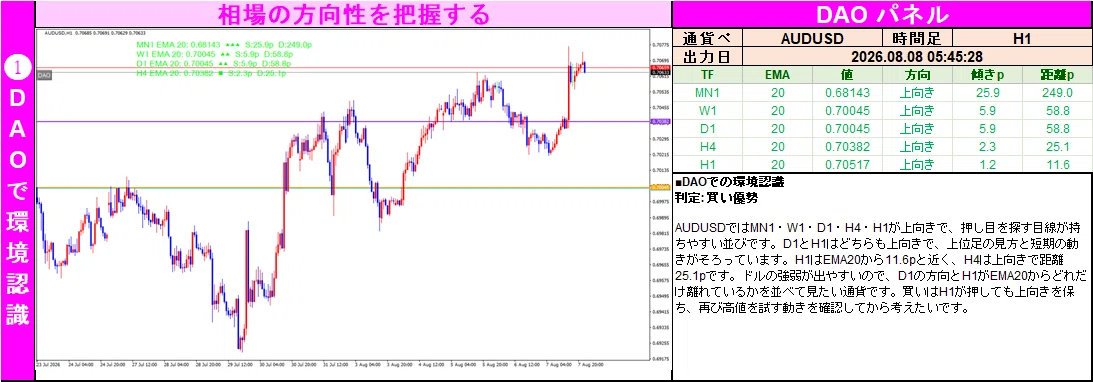
AUDUSD has EMA20 on MN1, W1, D1, H4, and H1 all pointing up.
H1 is 11.6 points away from EMA20, H4 is 25.1 points away, and the directions across higher to lower timeframes are aligned. W1 and D1 EMA20 are also around the same near 0.70045, making cross-timeframe comparison easy.
Currently biased toward buying. Next week I want to check the relationship between EMA20 on H1 and the current price.
2nd place: GBPUSD
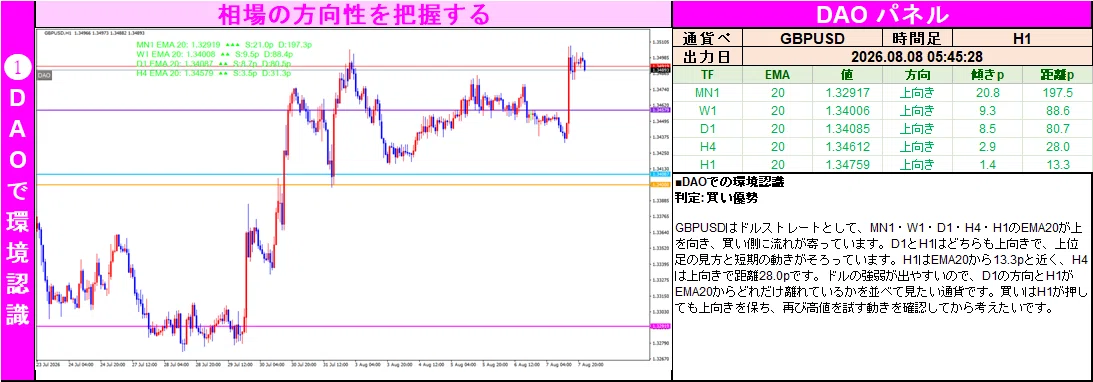
GBPUSD also has EMA20 rising on MN1, W1, D1, H4, and H1.
H1 is 13.3p away from EMA20, H4 is 28.0p away, and the distance between short- and medium-term is relatively close.
Furthermore, D1 and W1 are also rising, so the long-term to short-term directions are aligned.
In DAO, the bias is to buy, but the important thing is not "buy because it’s a buy."
This is the instrument where I want to confirm whether the current buyer strength near EMA20 on H1 is maintained.
1st place: EURUSD