

Are you still using the order block (OB) from textbooks? How to change your trades with the "real OB" that 99% of people don't know
Introduction
“I pulled an order block, but it doesn’t react at all.”
“When looking at the 1-minute chart, there are countless order blocks that look like they could work, and I don’t know which one is effective.”
“I followed the textbook, yet it broke through again.”
If this sounds familiar, today’s discussion is for you.
I’m a former engineer who has traded FX for 20 years. Every time an order block broke, I held a drawdown and prayed for it to come back, moving the stop just in case—many times.
A broken order block becomes merely a counter-direction breaker, after all.
The reason for these failures wasn’t that I was bad at drawing.
It was that the enclosure itself was misaligned from the start.
What textbooks don’t teach about order blocks
The textbook definition is as follows.
An order block is the last counter-move foot immediately before a strong directional move.
If it’s moving up, it’s the last bearish candle before the strong move up; if moving down, it’s the last bullish candle.
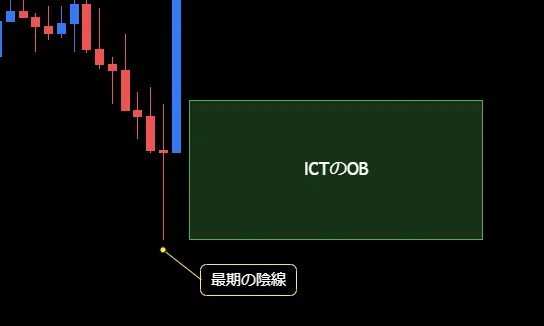
In Japanese explanations, there is often a further step: “There is no clear definition for how to draw order blocks; generally, draw along the peaks and troughs of the most recent high and low.”
This is where misunderstanding begins. This definition isn’t wrong.
However, it’s merely a convenience to make it easier to understand and not the core concept. Merely memorizing the candles won’t help you draw order blocks that don’t break eventually.
In fact, before I knew ICT, I was already using a zone similar to OB.
Back then I privately called it the “starting point neck.”
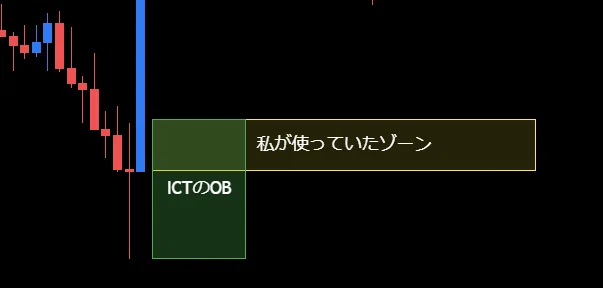
Because it was so similar to ICT’s OB, I felt a mismatch with the textbook definitions.
Three reasons your order block will break
Order blocks are among the most searched concepts in ICT, and at the same time among the most misused.
Many people call every candle before a strong move an order block, try entries on all of them, and when win rate doesn’t improve, they doubt the concept itself.
But what’s wrong isn’t the concept.
What’s wrong is
“the criterion for validity.”
Your order block will break if it fits one of these three conditions.
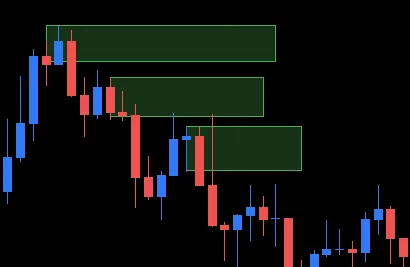
First, you’re surrounding every counter-move candle you notice.
You assume any candle before a strong move is an order block, and end up holding many baseless candidates.
Second, you enter without confirming a structural break.
A valid order block is formed at the starting point of a structural shift. If there is no structural change, no matter how convincing it looks, it isn’t a valid order block.
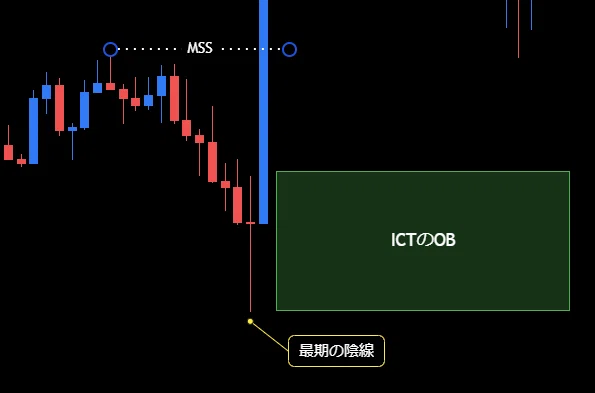
Third, you judge order blocks by candle size alone.
Big candles appear during news surges, stop hunts, and liquidity grabs as well. Size alone is not proof of real propulsion.
If any of these three resonate with you, it’s highly likely what you were drawing were “candidates that look plausible” rather than true order blocks.