
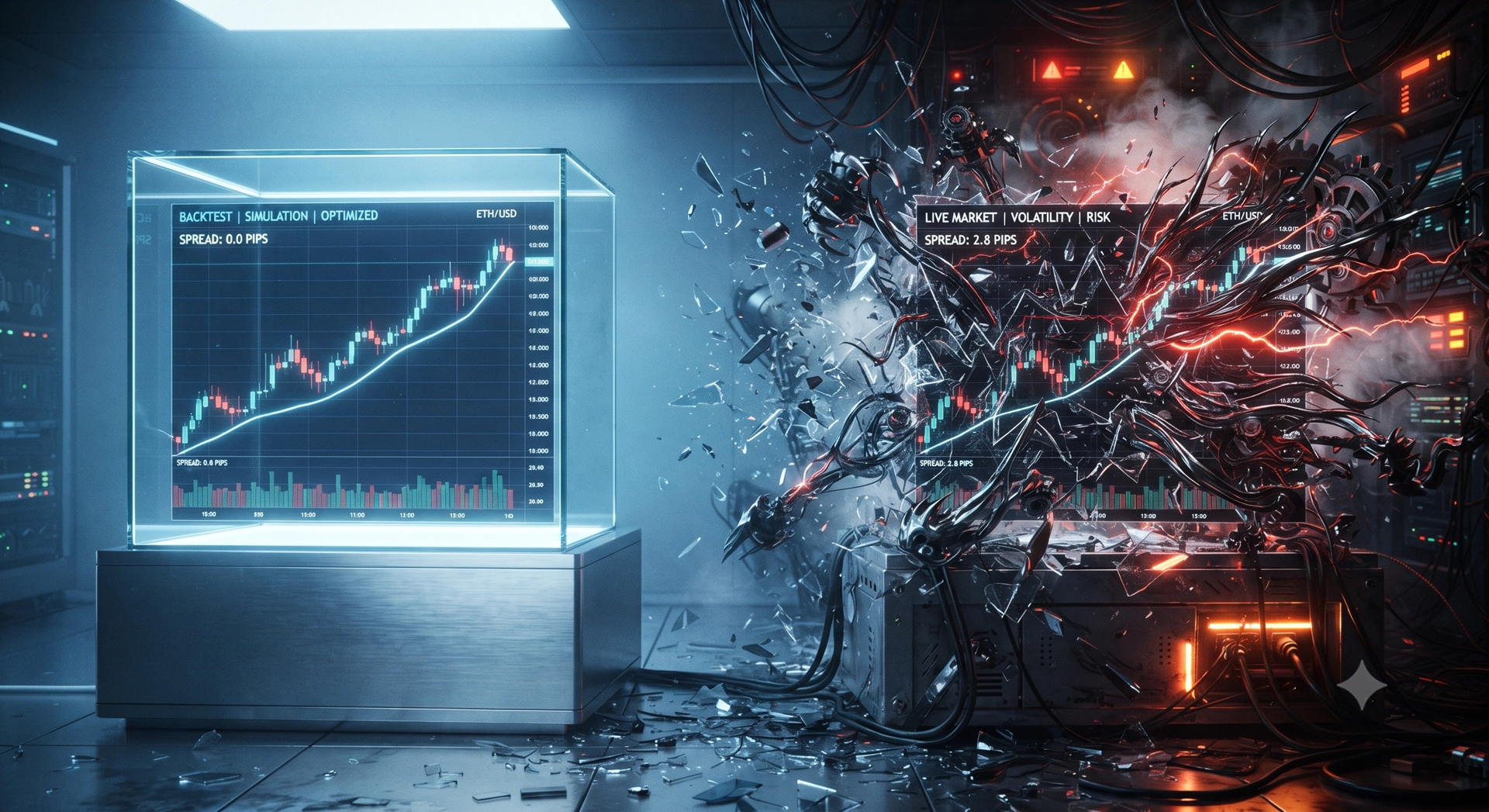
[Technical Report] Observational Design of “Environmental Noise” That Kills the Logic of a Clean Room — A Cost Management Case Study to Eliminate Illusory Advantage and Adapt to the Prototyping Farm Live-Fire Specification
The rise of Prop Firms, starting with Fintokei (フィントケイ), has ushered in an era where individual traders can operate prop funds of tens of millions of yen. Every day, many challengers step into tests with hope in their hearts, but a considerable number of examinees are blocked by the harsh wall of “disqualification” and exit the market.
The reasons for their defeats vary, such as excessive risk-taking and collapse of funds management. However, in cases where they are disqualified while tilting their heads and thinking, “The backtest was perfectly upward-trending,” or “The logic superiority should have been proven,” there is an extremely large contributing factor.
That is the "invisible cost monster" lurking behind the charts, quietly yet surely eroding funds—namely, the structural divergence from environmental noise such as spread widening and slippage in the actual trading environment.
In this report, we explain from a technical perspective the physical mechanisms of trading costs—extremely important yet easily overlooked in prop firm攻略—and the process design to maximize survival probability to the extreme.
The Structural Limitation of the “Sterile Room” Called the Strategy Tester
When developing and operating automated trading (EA) and system trading, everyone runs backtests using MT4's historical data. When a beautiful system is completed with a profit factor (PF) over 2.0 and a win rate above 80%, people imagine, “This will easily clear Fintokei’s tests.”
However, from a process design perspective, typical backtesting environments are a very convenient “sterile room.”
Tick data generated in the sterile room (price updates) and real-time ticks delivered from actual servers contain structural gaps that cannot be bridged. Spreads are kept constant (fixed), there is no slippage (no difference between order price and execution price), and broker server delays are not considered at all.
If you throw the logic nurtured in this sterile room into the harsh real-time environment of volatile spreads, unexpected events can occur.
Physical Mechanisms of “Invisible Costs” in Real Trading Environments
To clarify the identity of the environmental noise that causes backtest discrepancies, we compare the environmental assumptions under which the system operates.
| Comparison Item (Environmental Noise) | Backtest (Sterile Room) | Real-Time Environment (Live Trading) |
| Spread (Base Cost) | Fixed at a set value (e.g., always 0.6 pips) | Always variable; widens severalfold when liquidity dries up |
| Slippage (Execution Deviation) | Nonexistent. 100% fill at signal price | Occurs due to liquidity gaps (price skips) |
| Execution Latency | Zero (0 ms) | Delay due to physical distance and server load |
| Tick Density | Interpolated pseudo-ticks (no Tick gaps) | Ticks may jump or drop depending on server state |
In particular, for prudent systems that limit risk and accumulate profits in small steps (strategies with tight profit and stop-loss ranges), the deviation from a baseline spread imposes a very heavy burden.
For example, for a currency pair with a base spread of 0.6 pips, if the spread widens to as much as 3.0 pips during early morning rollover or around major releases, and the system emits a signal and enters during this noisy period, that trade is not an advantageous one but a risk of simply paying unjustified fees.
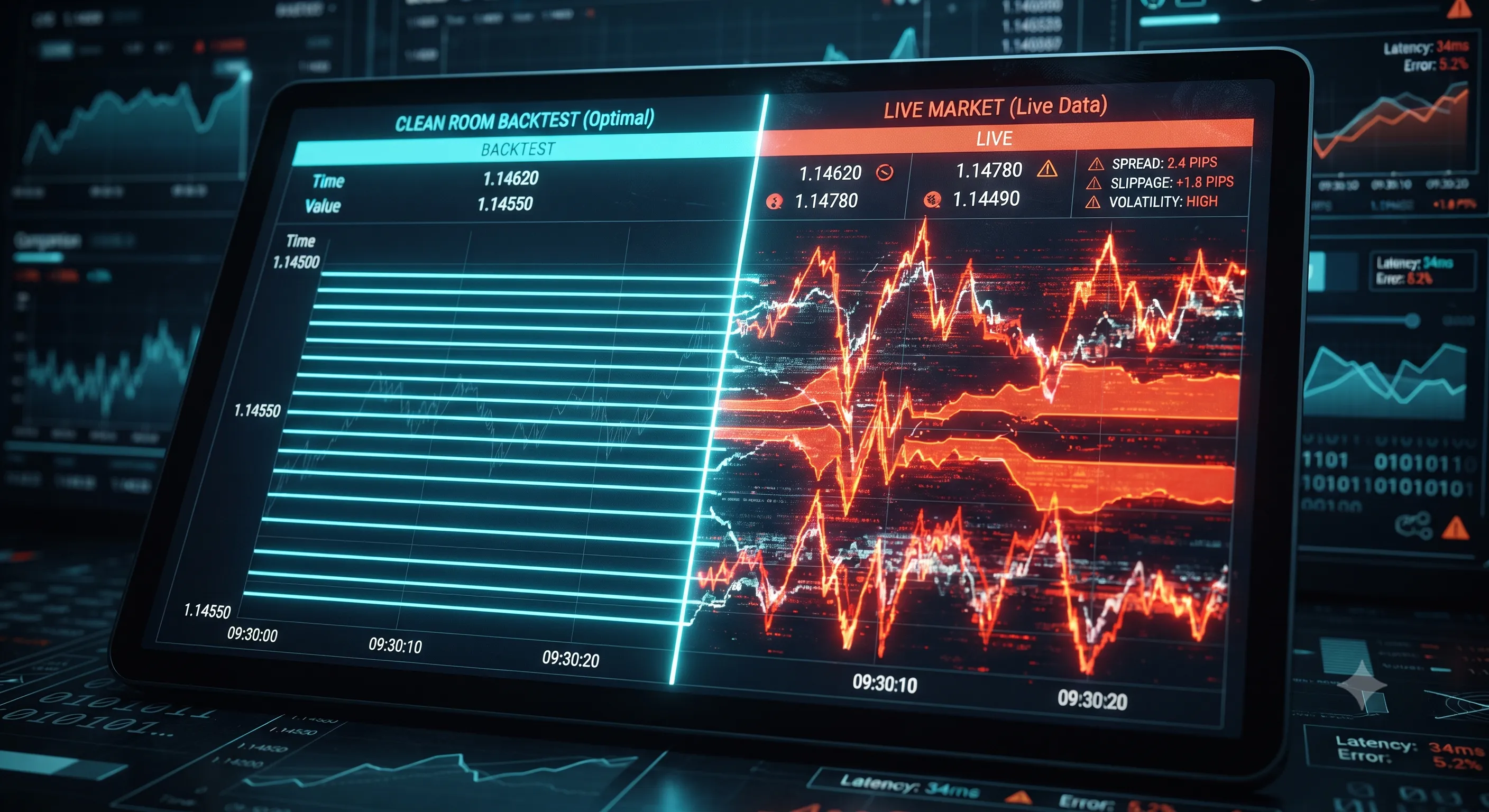
[How a clean sterile-room data stream becomes distorted by noise (spread widening and slippage)]
Fintokei’s Strict Disqualification Rules and the Chain of Environmental Factors
Why can this “invisible cost” be a fatal blow for Fintokei? Because prop firms enforce extremely strict disqualification rules, such as a daily loss limit (daily drawdown) and the overall maximum loss limit.andThese rules make it possible to disqualify even if the sterile-room logic predicts that the maximum drawdown will stay within 3%—in real MT4 environments, consecutive spread widening and severe slippage can cause losses to balloon.
Even if the logic itself correctly predicted the market direction, environmental factors—“situations where you should not be trading”—can trigger and inflict decisive damage on Fintokei’s drawdown cap. Disqualification reasons are not limited to technical inadequacies or mental breakdowns; they also include self-destruction from failing to quantify the environmental noise you are fighting.
From Prediction to Observation. Process Design to Control Environmental Noise
So, is there a Holy Grail that completely eradicates this monster?
In short, no. We traders cannot change spreads offered by brokers and liquidity providers themselves (the laws of physics). It is impossible to overcome this problem with logic that tinkers with indicator values (curve fitting).
However, it is completely possible to observe facts and avoid risk.
Process design engineers and serious traders who understand the essence have a “ruler” to measure the current environment (facts) coldly before predicting the market’s future direction.
“Is the current spread within normal limits?” “Is this time period likely to generate noise based on past data?” Visualizing such environmental factors and quietly stopping the system when the criteria are not met is essential.
During times when the invisible cost monster is raging, seek shelter and endure. This is a highly effective defensive formation to protect oneself from Fintokei’s strict disqualification rules.
Conclusion: Carry a Ruler to Measure Facts
The path to passing Fintokei is not merely about seeking a 100% undefeated logic.
Accept as a possibility the strict reality (Strict Reality) that “every trade inevitably involves an unfair cost.” And build a “process” that accurately measures your current environment and intentionally separates your system from unnecessary noise.
Does your chart now correctly visualize the facts of the environment you are fighting in?
Automated trading systems become weapons for real trading only when they can visualize and control the environmental noise lurking behind the charts. Considering the presence of an unseen enemy and acquiring the means to observe the environment will be a very powerful shield for surviving prop firm tests.
Semura Lab. continues to pursue the development of pure physical engines (EA) based on these honest-to-facts realities and the process design to optimize trading environments.