
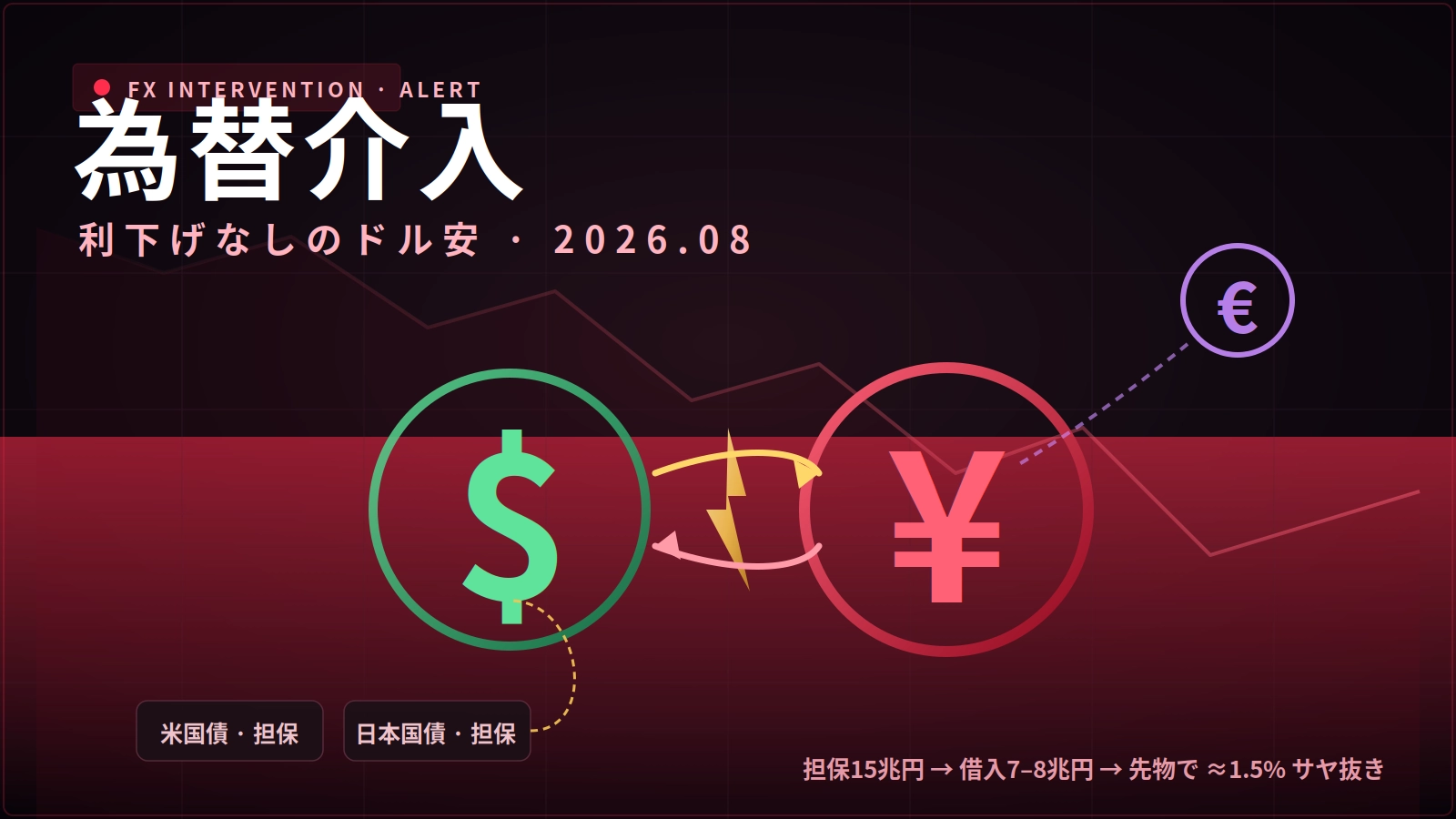
No rate cuts, dollar weakness — This is "the tactic of this currency intervention"
Dollar depreciation without rate cuts — A beginner-friendly解読 of “how this FX intervention worked”
Introduction (an important premise)The latter part of this article is not presenting confirmed facts, but rather speculation (hypotheses) about how the mechanism might have worked. In reality, authorities do not publicize details such as which banks were used, how much was borrowed, or what futures were placed. Therefore, I will clearly separate “facts” from “speculation.” This is not investment advice.
0. To put it briefly
“Lower interest rates not used, yet the dollar was made cheaper” — this is the main point of this episode.
Normally, if you want to weaken the dollar, a central bank wouldcut interest rates. But cutting rates would have side effects on growth and prices. This time, without touching rates,by combining “how to borrow money” with “futures as a tool”they orchestrated a dollar down move, and moreoverthey earned about 1.5% in spread (carry) in the process— which is the core of the “tool” described here.
To put it another way,an air conditioner (rates) is left alone, but by clever placement of fans (capital flows) to lower the room temperature, they even saved electricity.
1. Facts part — What was actually reported
First, confirm the publicly known “facts.”
By the end of July 2026, the yen had fallen to roughly a 40-year low. In response,Japan and the United States cooperated to intervene in the FX market by buying yen (selling dollars), which the two governments confirmed. According to reports, on one dayabout $59 billion (over 8 trillion yen)was spent to buy yen, and the yen rose about3–4% within a few days, while the dollar weakened broadly and the yen strengthened against the euro and the pound as well.Policy rates were not changed at that time(the Bank of Japan signaled future rate hikes while keeping rates unchanged).
In other words, the outcome of “depreciating the dollar and appreciating the yen without cutting rates” actually occurred.
What follows is—the speculative part—“how were the funds and the execution structured?”Speculation part.
2. Speculation Part ① — Where did the money come from? “Borrowing by putting up collateral”
Interventions require massive funds. In this speculation,they borrowed yen using government bonds as collateral.
- Early June: U.S. Treasuries and Japanese government bonds wereposted as collateral (total about 15 trillion yen)in exchange for borrowing 7–8 trillion yen in yen terms.
- This borrowing method was calledABF, and it is believed to have been place byGoldman Sachs (GS), Morgan Stanley (MS), and Japanese banks.
- The key point is that this was the first attempt where a government entity“borrowed money without selling U.S. Treasuries”to raise funds.
This is a concept identical to a pawnshop. If you sell an important ring (the government bonds), you may never get it back. But if you pawn it and borrow money, you keep the ring and receive cash, and you can reclaim the ring later.
If you “sell” government bonds, supply in the market increases, and the price falls (yields rise) — a side effect. Therefore, you borrow with collateral instead of selling.This is a clever funding method that doesn’t disturb the market but yields cash.
Note that the collateral was 15 trillion yen, but the borrowings were 7–8 trillion yen because you lend more than you borrow to build a safety cushion. This extra margin is calledhaircut.
3. Speculation Part② — Buy dollars with yen, and use futures to create the flow
The next stage (June–July) is a bit tricky.
- Use the borrowed yen tobuy dollars.
- Thenset up a “yen long, dollar short” futures position.
- In Chicago (CME) futures, theNonRepcategory has traces seen.
- During the same period, payments due in dollars were settled “via futures,”effectively converting dollar cash flows into a “dollar→yen” flow, reducing dollar currency in circulation.
Plain language
“Long / Short”: Long means you profit if prices rise (buy); short means you profit if prices fall (sell). Here it means the yen would rise and the dollar would fall, i.e., they bet in that direction.Since you are generating dollar depreciation and yen appreciation yourself, it makes sense to bet in that direction.“Futures”
: A contract to buy or sell at a preset rate on a future date. Like making a reservation for a future rate. You can lock in the direction without moving all the physical dollars now.“NonRep”
: A category in CME futures reporting, outside the reporting framework. Its mention suggests a large player entering in a way that is hard to identify.
In short, this stage is about pre-digging a channel where dollars would gradually become yen through futures before actually selling dollars in the market.
4. Speculation Part③ — Involving the euro to "carry the spread"
The climax is here.
- During the last three days of July, there was a euro selling and yen buying action.
- On the 31st, some dollars were bought back via futures, and thenfrom August 3 to 14, dollars were bought back again.
- As a result, even though rates were not cut, a dollar depreciation and yen appreciation were realized. Furthermore, during the same period, even though the total dollar payments did not change, there was about a 1.5% “carry” spread.
- The winners gaining this profit wereU.S. agencies and others who benefited while conducting empirical tests— that is the conclusion.
Plain language — what is “carry”?
Carry means taking a nearly risk-free profit by exploiting price differences for the same asset.
For example, if the same vegetable costs 100 yen at Store A and 98 yen at Store B, you buy at Store B for 98 and sell at Store A for 100, securing 2 yen. This 2 yen is the “carry.” In this case, the design involved a back-and-forth of selling high and buying back lower, using euro sales and futures to create a flow, resulting in roughly a 1.5% carry.
This is the key to this discussion. Normally, interventions are seen as acts that require public funds and impose costs on the market. If this speculation is correct, the objective to make the dollar cheaper is achieved while profits were earned, which is why it’s described as a Proof of Concept with a built-in exit.That’s why the intervention is described as a proof-of-concept that could be withdrawn with gains while testing it in practice.
5. Why can this be called a “PoC” — Reading for financial institutions
Going one step further (a note for experts).
The operation appears to have had two main aims to test.
(A) Can dollars be arranged without disturbing the U.S. Treasuries market?When authorities need to marshal large dollars, they can use theFIMA Repos facilities (the Federal Reserve window allowing foreign central banks to borrow dollars against U.S. Treasuries) orcentral bank swap lines (institutions swapping currencies to provide dollars). These are beneficial because they don’t pressure the interbank market. This time, rather than relying entirely on these, a portion was distributed to private investment banks (GS, MS, etc.) for circulation.
(B) Can private advanced algorithms execute in a way that’s hard to detect?If you flow dollars to the private sector, banks facehaircuts (collateral depreciation) andcapital regulation impacts — measures likeLCR (short-term liquidity ratio) and (long-term funding stability). There are costs to transferring to private sector, butthey deliberately chose private channels to minimize market impact, prioritizing market impact reduction.
Combining these two approaches in the actual market demonstrates why this could be considered a PoC for emergency funding and dispersed execution — hence, the article’s title and the caption “PROOF OF CONCEPT” was included in the initial image.
6. Mini-dictionary of terms in this article
- FX intervention: Government or central bank buys or sells currency to move the market. This time: buying yen, selling dollars.
- ABF: Financing method where government bonds are put up as collateral; funds are borrowed (in this case, yen). The key is “borrow without selling.”
- Collateral (tánpo): assets posted as security for a loan. In this context, U.S. Treasuries and Japanese government bonds.
- Haircut: the margin shaved off when valuing collateral. With 15 trillion yen collateral, only 7–8 trillion yen can be borrowed due to this safety margin.
- Repo: short-term funding where bonds are used as collateral and later repurchased.FIMA Repo: the Fed’s version for foreign central banks.
- Central bank swap line: arrangement where central banks exchange currencies temporarily to provide liquidity in another currency.
- Interbank market: wholesale market where banks lend to each other. If disrupted, interest rates move widely, so authorities watch it carefully.
- Futures (saki mono): contracts to decide future delivery at current rate. A “reservation ticket.”“Reservation ticket”
- Long / Short: Long = buy (profit if up), Short = sell (profit if down). This time: Yen long, Dollar short.
- NonRep: a category in CME futures outside the reporting framework. Leaves room for large players to enter without clearly exposing identity.
- Carry extraction (saya nuki / arbitrage): using price differences for the same asset to earn nearly risk-free profits. The roughly 1.5% here is an example.
- LCR / NSFR: regulatory measures of banks’ liquidity and funding stability. Moving trading to private side incurs costs in these metrics.
- Capital regulation: rules on how much of your own capital a bank must hold against risk. Increasing trading activity can burden the balance sheet.
- PoC (Proof of Concept): testing in practice whether something can work before full deployment. In this article, it’s the emergency dollar sourcing and dispersed execution model in practice.
7. Summary
- Fact: At the end of July 2026, Japan and the United States coordinated to intervene, andwithout rate cuts, the yen strengthened and the dollar weakened. The scale was about $59 billion at once, and the yen rose about 3–4% in a few days.
- Speculation (the mechanism): They did not sell bonds but used collateral to borrow yen (ABF, collateral 15 trillion yen → borrow 7–8 trillion yen),and created a “dollar→yen” channel via futures, while engaging in euro selling and futures buybacks to achieve adollar depreciation without rate cuts. Moreover, they captured about1.5% carry.
- Implications: This is not just market maneuvering but a PoC for whether a dollar sourcing strategy that avoids market disruption and dispersed private-sector execution can work in a crisis.Winners include U.S. entities that benefited while testing the approach.
One more time――From Chapter 2 onward, this is not officially confirmed fact but rather an inference drawn from the situation. Details (amounts, counterparties, timing) are not publicly disclosed by authorities, so please read this as one coherent scenario among possible ones.
※This article aims to provide information and explanation and does not advocate any specific investment actions.