
[Lab Development Perspective] "Disclosure of Uncomfortable Facts" ~ The Edge Cut by Spreads and Slips ~
In system trading and EA development, backtests that paint a beautiful, steadily rising asset curve are nothing more than results in a “sterile chamber.” In the previous voyage log, I mentioned the structural limitations of that setup.
So, when we drag the system from the sterile chamber into the real market environment (live trading), what specifically destroys our advantage (edge)? In this voyage log, from the lab development perspective, I objectively record the “inconvenient truth” that many system developers avert their eyes from and hide in sales promotions—the invisible friction in the real environment.
Structural divergence of “friction” between backtest and live environments
In a backtest environment, spread (difference between bid and ask) and fill speed are often treated as fixed, ideal values for computational simplification. However, in the live (forward) market, this leads to a critically fatal design flaw.
The following table summarizes the differences in physical friction between the sterile chamber (testing environment) and the live environment (forward operation).
| Comparison item | Sterile chamber (backtest environment) | Live environment (forward operation) | Impact on the system |
| Spread | Always fixed (fixed ideal minimum) | Always variable. Maximized at indicator times and rollover | Presses on profits, and induces stop losses that could have been avoided |
| Execution speed (Ping) | Zero latency (fills occur simultaneously with signals) | Hundreds of milliseconds of physical communication lag | Loss of edge due to delayed entry timing |
| Liquidity | Infinite (fills at the specified price) | There are times when liquidity dries up. Thin order books cause slippage | Severe slippage (discrepancy between entry price and actual price) |
In real markets, spreads vary as if breathing, and orders routed through broker servers always experience physical communication lag. Especially in moments when the system bears the heaviest load (e.g., during volatility spikes), these friction resistances can swell several times over the normal level.
System “play” and slippage tolerance
This invisible friction resistance varies greatly depending on the system logic (target range and frequency). The more tightly parameterized a system is, the less “play” (tolerance) it has against friction in real seas.
| Characteristics of logic | Resilience to slippage and variable spreads | Edge decay risk in live trading |
| High-frequency scalping aiming for extremely small price movements | Extremely low (can be fatal) | [Extreme] A few points of slippage completely offsets profitsA few points of slippage can completely offset gains |
| Day trading / swing aiming for medium to large moves | Relatively high (cost ratio is low relative to the move) | [Medium to low] Edge is eroded, but system collapse is less likely |
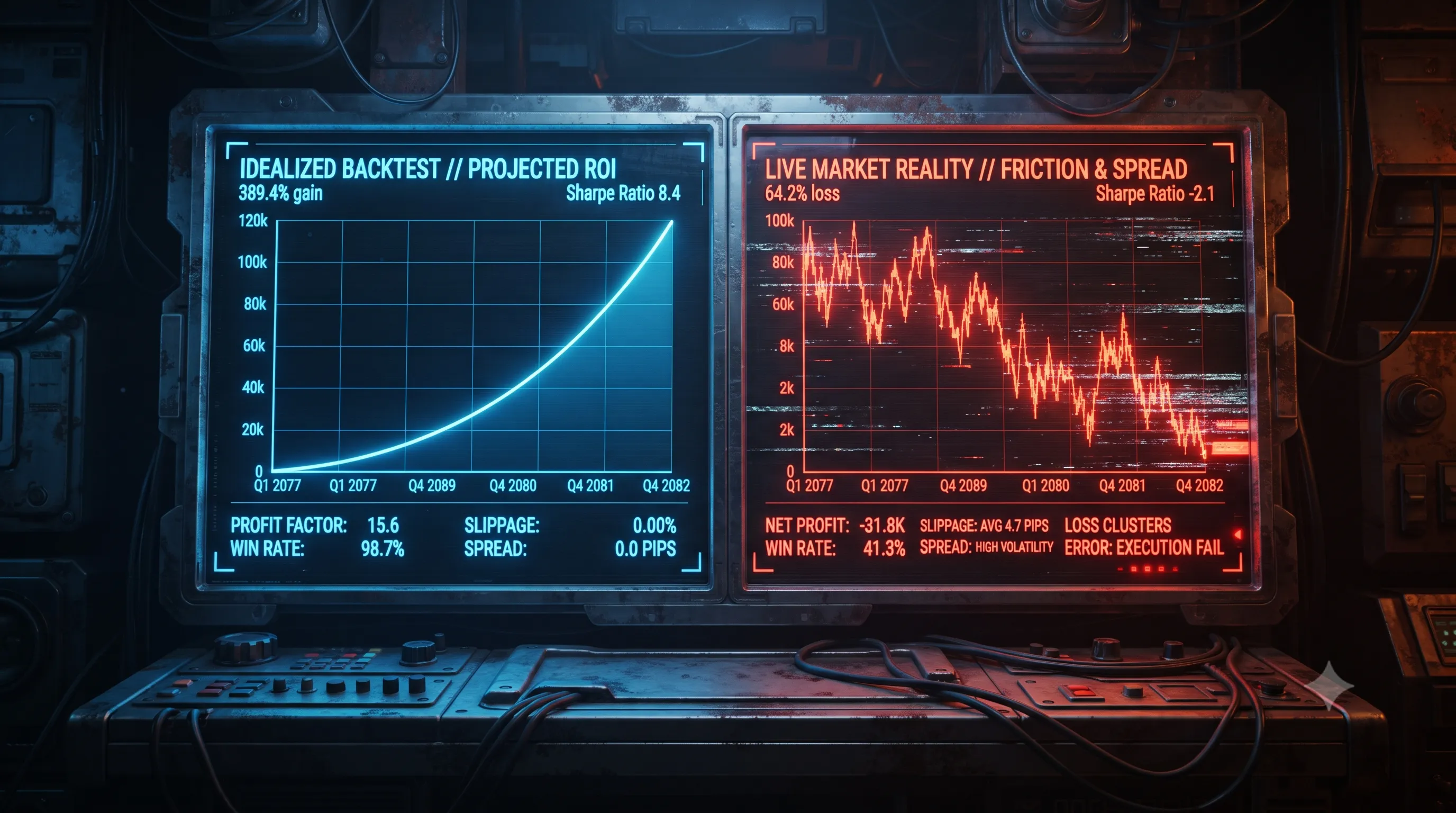
[Figure ①: Comparison of fixed spread ideal and real‑world revenue simulations accounting for variability and slippage]
The apparent profits in backtests are mercilessly eroded by the frictions (costs) of real environments.
The tiny edge that existed in testing is completely offset in live environments by a few points of slippage, and with each trade the account is shaved by fees. This is the essence of the “death valley” where over-optimized EAs plunge into deep drawdowns right after going live.
Process design based on inconvenient truths
Our Semura Lab. approach is not to hide these “inconvenient truths.” From the very top of the design process, we fully incorporate these friction resistances and pursue the system’s “survival.”
Normalization of stress testing:Always assume the worst possible communication environment and maximum spread widening, conducting harsh load tests (e.g., Walk Forward Analysis), and adopt only the residual physical causalities as edge.
Acceptance of noise:Unforeseen losses due to slippage are not “errors to avoid” but inevitable “fuel consumption” in actual operation, to be incorporated into capital management.
Escaping antique infrastructure:Do not cling to old platforms with limited fill power and communication speeds; always consider transitioning to next-generation architectures that can simulate more realistic execution environments.
In the live environment where brutal noise and invisible friction govern, how can we make the system “survive”? There is no compass for survival outside the stubborn process design that faces inconvenient truths head-on.