
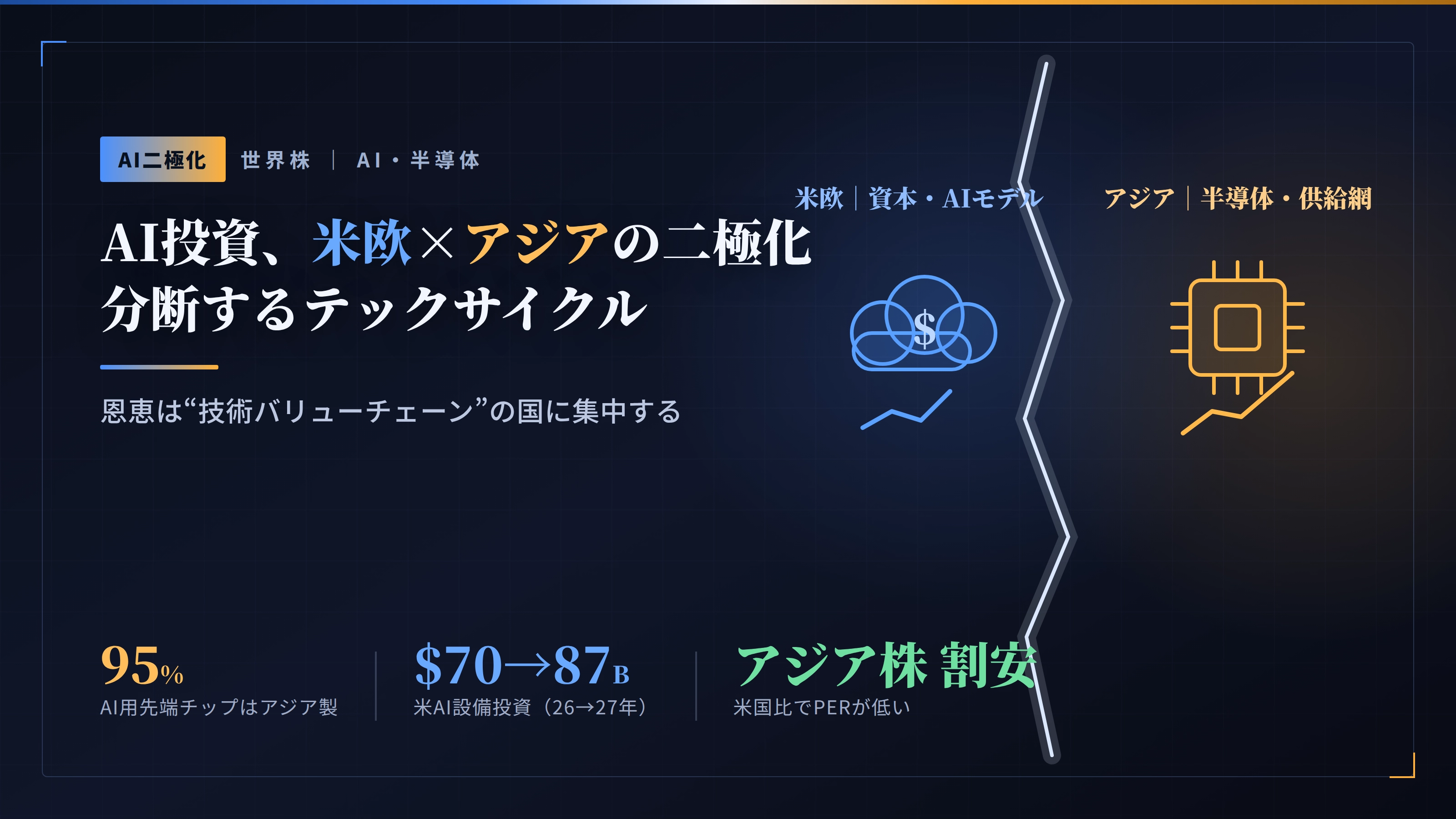
The Polarization of AI Investment: "U.S./Europe vs. Asia" and the Divide in the Global Tech Cycle
The AI Investment Dichotomy of “US-EU vs Asia” and the Global Tech Cycle Split — A Beginner-Friendly Gentle Explanation
In One Line, This Topic is About
The profit created by the world’s AI boom isconcentrating in countries that make the "technology value chain (supply network)" for AI components and equipmentas a result, global stock markets are increasingly bifurcated into “countries connected to AI (winners)” and “countries not connected (left behind),” and into “the United States and Europe that provide money” and “Asia that makes goods (semiconductors).” The era when the world moved in lockstep in the tech up-and-down cycle is beginning to divide by region — this is the theme of this discussion.Dividing by region— this is the focus of this topic.
Premise: Where Does the Money in the AI Boom Come From?
AI requires the enormous computation power ofsemiconductors (GPU—the AI brain chips)and the data centers that operate them. Therefore, the money from the AI boom more reliably ends up with those who sell essential AI tools (chips and equipment) rather than with the “users of AI.” The classic gold rush analogy: the people selling pickaxes and shovels profit more than those mining for gold.
Bifurcation ① — “Money-Providing US-EU” and “Goods-Cupping Asia”
First, roles are bifurcated by function.US-EUspend vast sums to build the cutting-edge AI models and large data centers (hyperscale) — the demand and capital side. US AI equipment investment isprojected to reach about $69.7 billion in 2026 and about $87.3 billion in 2027However—the components of that investment (chips and parts) are almost all produced in Asia.
On the other hand,Asiaacts as the supply side that physically underpins the AI foundation. Data shows thatabout 72% of the world’s semiconductors, and about 95% of the leading AI chips, are manufactured in Asia.Taiwanis at the forefront for advanced logic chips,Koreanearly monopolizes high-bandwidth memory (HBM) essential for AI,Japandominates in semiconductor materials and manufacturing equipment—AI cannot operate without Asiain this structure. In short, Asia is in a prime position to “sell pickaxes and shovels” during the AI boom.
Bifurcation ② — “Countries in the Value Chain” and “Countries Outside It”
Another bifurcation is whether a country is embedded in the AI supply chain.Countries integrated into the supply chaininclude Taiwan, Korea, Japan, and major US tech firms; these nations and companies attract AI money flows around the globe. Semiconductors-related stocks (TSMC, SK Hynix, Samsung, Japanese equipment manufacturers, etc.) surge and lead stock indices.
Conversely,countries not involved in the AI supply chaintend to miss the wave of global stock gains and get left behind. As a result,the global stock market splits into “markets with strong AI exposure” and “markets without,”and the concentration of a few AI stocks lifts the indices more and more.
Focus: Why Do Stock Markets bifurcate (Value Shift)
The key is theshift in value created by AI. Leading-edge AI models face price-lowering competition (for example, major Chinese players sharply cut prices for key models),reducing the pricing power of those who “build the models.” This shifts profit sources fromthe models themselves to the layers beneath — “infrastructure, semiconductors, platforms.”Who grips this “underlying layer”? Asia — hence“You value more the affordable Asia semiconductor and infrastructure companies than the expensive US AI model companies”, leading to bifurcation in the stock market (indeed, Asia tech stocks often have lower P/E ratios than their US counterparts, making them appear cheaper in many cases).
Furthermore, thepolicy zeal differencesacross countries amplify bifurcation. India offers up to 21 years of tax exemption for AI data centers, Japan expands R&D tax credits to 40–50%, Korea designates AI data centers as a national strategic technology, and China provides ultra-large cost deductions for R&D — Asia is aggressively promoting AI investment through favorable policies.
What the “Global Tech Cycle Split” Means
Until now, the booms and busts of semiconductors and IT hardware (the tech cycle) tended to align almost everywhere in the world.But now, due to export controls, economic security concerns, and friend-shoring of supply chains, the supply chain partitions into US bloc and China bloc, and tech waves begin to move region by region (split apart). The era moves from a “global boom” to a division between winning regions and regions that cannot ride it — this is what “the split of the cycle” means.
Important Cautions Not to Miss
First,concentration risk. When capital and indices skew toward a small set of AI and semiconductor stocks, a stumble can cause a large correction (the previous US tech stock crash is an example). Second,both “the sellers” and “the makers” have weaknesses. The US and Europe face questions about the profitability of massive investments, while Asia’s performance hinges on whether AI demand will persist. Third,geopolitical risk. As splits deepen, export controls and Taiwan developments increase the risk that supply chains are disrupted by political moves.
A Reading Method for Beginners to Keep in Mind
What matters is to view “who profits from AI” through the lens of layers (tiers).Look at the value ladder: the semiconductor, memory, manufacturing equipment, and data centersthat underpin AI, not just the flashy AI models. Focus on those who sell tools rather than those who use them, and on the countries embedded in the value chain of those tools, to glimpse the bifurcation of the landscape.
From an investment perspective, AI is an attractive theme, butconcentration in a few winners is advancing. Instead of betting on a single country or a single stock,diversify by region and by layerand prepare for a sharp pullback from concentration.
Key Point: The AI boom’s protagonists are not only the models. The countries and companies that hold the “pickaxes and shovels (semiconductors and infrastructure)” gain the value and stock-market gains.
Summary
The benefits of AI investment are strongly skewed towardcountries and companies embedded in the technology value chain, and global stock markets are bifurcated into “winners connected to AI” and “markets left behind,” and into “capital-providing US-Europe” and “Asia supplying semiconductors.” Export controls and economic security measures have regionalized the tech cycle that once came in a global wave. Behind the flashy model competition, value is shifting to the “underlying supply chains.”Reframe the world by “layers” and “regions”— this is the key to reading this era of division.
※This article provides a general explanation based on publicly reported information. The figures and circumstances may change over time. It does not constitute investment advice. Please make investment decisions on your own judgment and responsibility.
This article is a general explanation based on publicly reported information (State Street, Deloitte, Fidelity, etc.). Figures and circumstances may change in the future. Please make investment decisions at your own risk.