
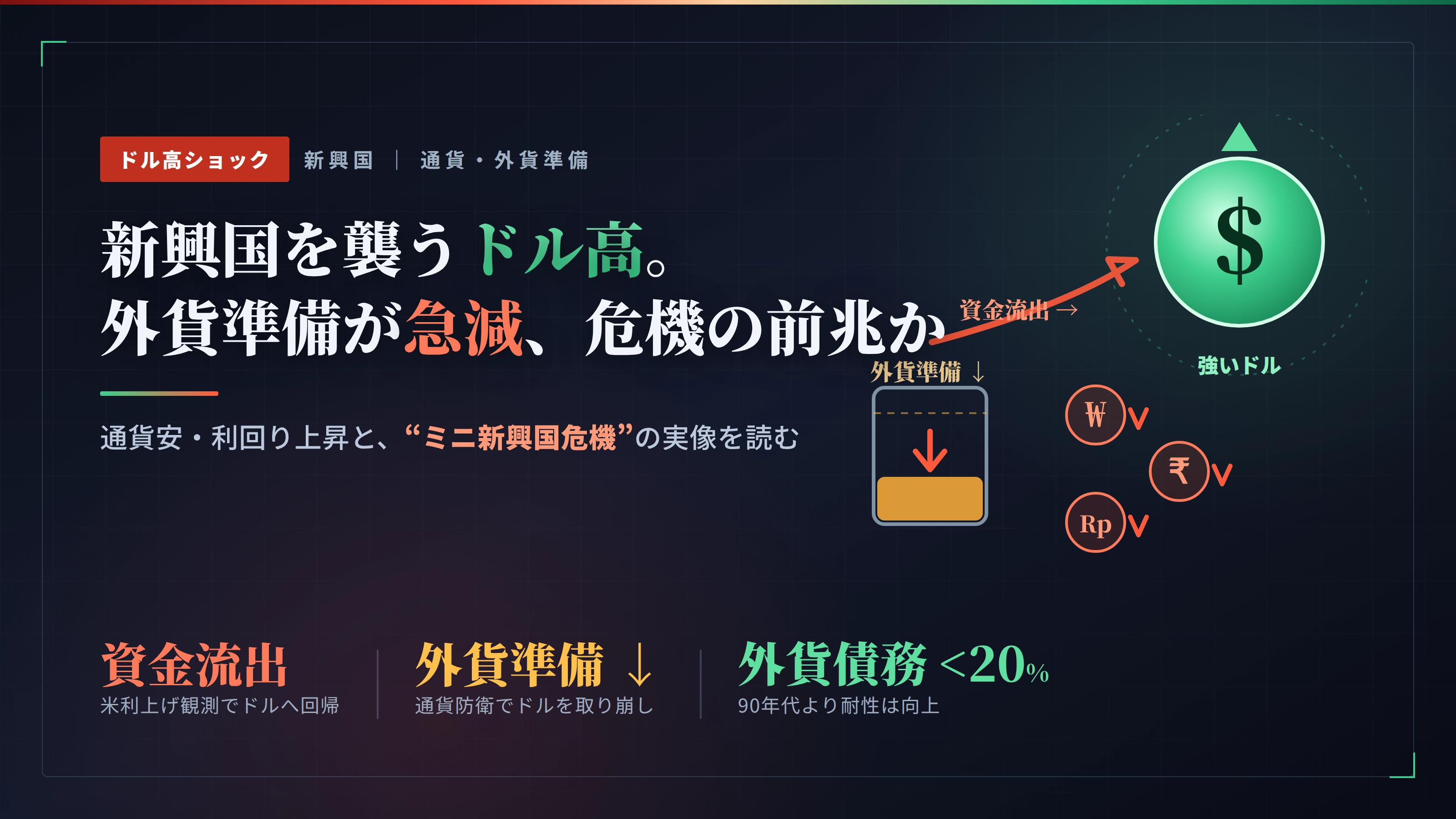
Emerging market “dollar surge shock” and rapid decline in foreign exchange reserves — a warning sign of a “mini emerging market crisis”?
Emerging Markets’ “Dollar-Strength Shock” and Sharp declines in Foreign Exchange Reserves — Is this a precursor to a “Mini Emerging Market Crisis”? A Beginner-Friendly Explanation
In One Sentence About This Topic
As expectations for further US rate hikes strengthen and **the dollar strengthens (dollar appreciation)**, global money flows back from developing economies to the United States. This puts pressure on emerging markets toweakened currencies, depleted foreign exchange reserves, and rising sovereign yields. The pain is especially evident in Asia (e.g., Indonesia) and Africa, and market chatter has even asked, **“Could this be the precursor to a mini emerging market crisis?”**. But to state the conclusion first,a broad, 1990s-style “full-blown crisis” is unlikely, and we are in a phase of country-by-country differentiationa selective divergence among countries. The real picture is
Premise: Why Does a “Strong Dollar” Harm Emerging Markets
Money moves in search of safety and higher yields. When the United States moves to tighten (i.e., U.S. interest rates rise), it looks more advantageous and safer to invest in dollars, soglobal money flows from emerging markets to the United States. This “withdrawal of funds” weakens emerging market currencies, causingcurrency depreciation (the domestic currency loses value). A rising dollar works like a magnet that drains money from emerging markets.
Focus: How Do Currencies, FX Reserves, and Sovereign Yields Move?
The Fed’s hawkish stance (toward rate hikes) triggers the following chain in emerging markets.
First① Currency depreciation. Capital outflows weaken currencies such as the Korean won, Indonesian rupiah, and Thai baht. Reports note thatthe rupiah has reached levels not seen since the Asian financial crisis of 1997–98
Next② Decrease in foreign exchange reserves. To prevent excessive currency depreciation, central banks sell their dollar holdings (FX reserves) to buy their own currencies. If continued, FX reserves shrink sharply. FX reserves are a “call in case of emergency,” so shrinking reserves heightens market anxiety.
And③ Rising sovereign yields. When funds flee and risk is feared, emerging market sovereign bonds must offer higher yields to attract buyers,causing yields to rise (bond prices fall).Moreover, many emerging markets carrydollar-denominated debt. As currency depreciation worsens, debt-servicing burdens become heavier in real terms,raising repayment burdens. Import prices for energy and other goods rise, creating a vicious cycle of inflation and policy deadlock.
Why Asia and Africa Are in Focus
In Asia,Indonesiais pointed to as the most vulnerable due to “fiscal weakness + currency depreciation,” with currency declines feeding concerns about the independence of fiscal policy and central banking.Indiafaces inflation and heavier burdens from weakening rupees, as costs for essential imports like oil rise.
Africaand some frontier economies are in even tougher terrain.Many have large dollar-denominated debt and thin FX reserves, making dollar appreciation and capital outflows more likely to lead to debt repayment crises (default) or foreign currency shortages.
Focus: Is This a Precursor to a “Mini Emerging Market Crisis”?
This is the core question. The answer is **“Local pain is real, but not a full-blown 1990s-style crisis.”**
Because in recent decades emerging markets have built stronger defenses. First,FX-denominated debt has fallen sharply (non-financial sector debt relative to GDP from 40–60% to below 20%, a drop in the share of total debt that is dollar-denominated to about 10%), socurrency depreciation is less likely to directly trigger a balance-sheet crisis. Second, many countries have moved to a floating exchange rate regime, allowing exchange rate fluctuations to act as a cushion absorbing shocks. Third, policy credibility has improved (inflation targeting and central bank independence), with a credibility index rising from 0.55 in 2007 to 0.70 in 2021. In the 2022–23 rate-hiking cycle, many emerging markets avoided a comprehensive financial crisis.
In short, what’s happening now is not a universal crisis but a selective one.The “weak” countries—those with thin FX reserves, large fiscal and current account deficits, and heavy dollar-denominated debt—are more exposed. Stronger countries with ample reserves, a focus on domestic currency, and credible policies can withstand the shock. At present, markets have not priced in a 1990s-style shock (where short-term rates double in a year).
What Beginners Should Grasp About Reading This
The key is not to lump all emerging markets together but to assess each country’s resilience.By examining FX reserves, current account, dollar-denominated debt, and fiscal health, the severity of the pain varies. Before reacting to headlines like “Emerging Market Crisis,” learn to distinguish which countries are weaker and which are stronger.
From an investment viewpoint, such episodes bring large swings in dollars, interest rates, and emerging market assets.Avoid concentrating investments in weak countries and diversify, keeping in mind the readiness to withstand sudden changes.
Tip: A dollar-strength shock does not affect all countries equally; it hits weaker ones first. By looking at a country’s external resilience, you can gauge which areas may be at risk next.
Summary
Rising expectations for U.S. rate hikes push up the dollar, exerting pressure on emerging markets with currency depreciation, falling FX reserves, and rising sovereign yields, with more pronounced pain seen in Asia (Indonesia) and Africa. However,decreasing dollar-denominated debt, floating exchange rates, and stronger policy credibilityenhance overall resilience compared with the 1990s; this is more a case of “selectivity” than a universal crisis. Rather than lumping all so-called “emerging markets” together, assess each country’s external currency strength to understand this dollar-strength shock.
Note: This article provides a general explanation based on public reporting. Figures and circumstances are as of the time of reporting and may change. This does not constitute investment advice. Please make investment decisions on your own judgment and responsibility.
This article is a general explanation based on public reporting (Forbes, CEPR, State Street, and others). Figures and conditions may change in the future. Please make investment decisions at your own risk.