

Will the market move even if policy rates do not change? Why remarks from key figures can move the dollar-yen significantly
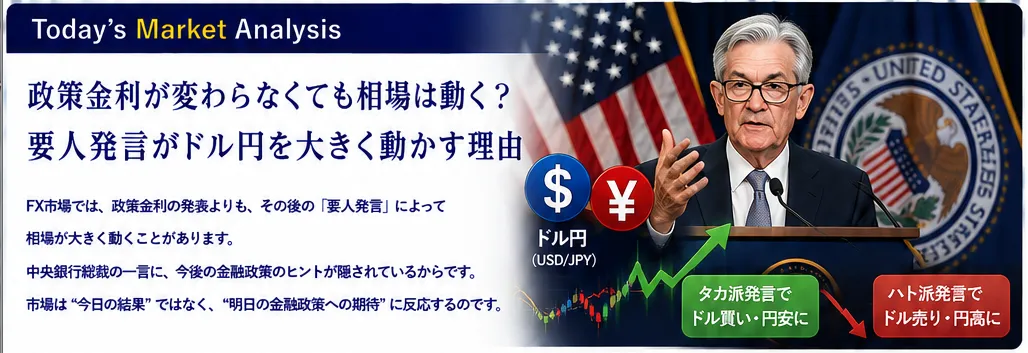
Even if policy rates don’t change, will the market move? Why remarks from key officials can move the dollar-yen significantly
In the FX market,
“Dollar buying after remarks from the Fed chair.”
“Yen depreciation progresses after the Bank of Japan governor’s press conference.”
are news headlines you often see.
However,
“If policy rates haven’t changed, why does the market move so much?”
you may have wondered.
In fact, the foreign exchange market is moving not only based on today’s events but by constantly incorporating “what lies ahead.”
Therefore, what market participants pay the most attention to is not only the policy rate itself.
Because hints for future monetary policy are hidden in every word spoken by central bank presidents.
For example, even if the policy rate is kept unchanged as the market expects, if there is a comment in the press conference like “we will remain vigilant about inflation,” the market begins to price in future rate hikes.
Then, the dollar may be bought, and the dollar-yen may rise.
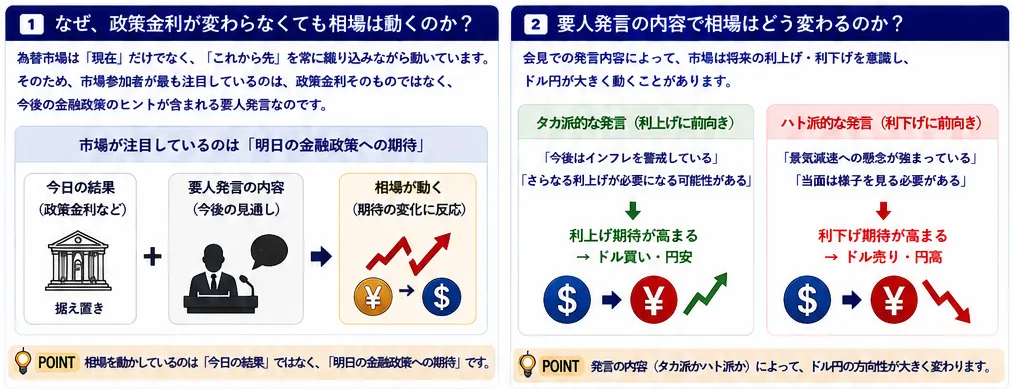
Conversely, if a cautious remark such as “concerns about economic slowdown are intensifying” is made, expectations for rate cuts rise, leading to dollar selling in some cases.
In short, what moves the market is not today’s results but the expectations for future monetary policy.
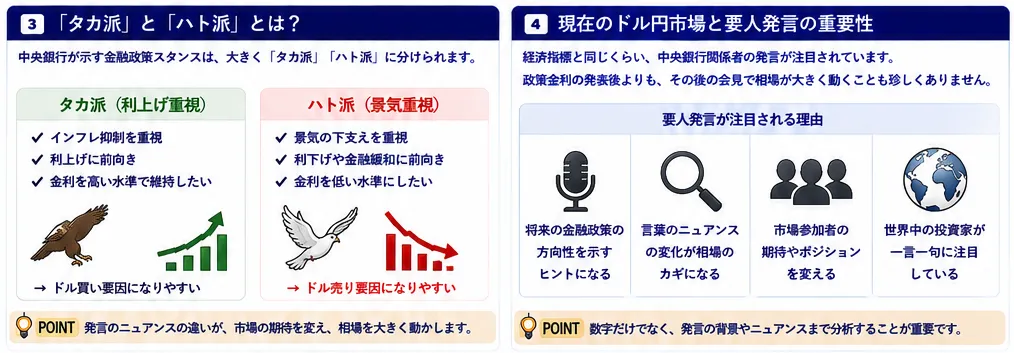
In the market, such statements are described with words like “hawkish” or “dovish.”
A hawkish stance is a mindset that leans toward rate hikes to curb inflation.
On the other hand, a dovish stance emphasizes supporting the economy and is inclined toward rate cuts or monetary easing.
For example, if the Fed chair makes hawkish remarks, it is considered that “rates may stay high for longer,” making dollar buying more likely.
Conversely, if the remarks are dovish, expectations for lower rates can lead to dollar selling.
In the current dollar-yen market, statements by central bank officials attract attention as much as economic indicators.
It is not rare for the market to move more after the press conference than after the policy rate announcement.
This is because market participants try to read future monetary policy from every word spoken.
Professional traders pay attention not only to numbers but also to the nuances of language.
“The language has become more cautious than before.”
“Concerns about inflation have intensified.”
Such small changes can sometimes trigger significant market moves.
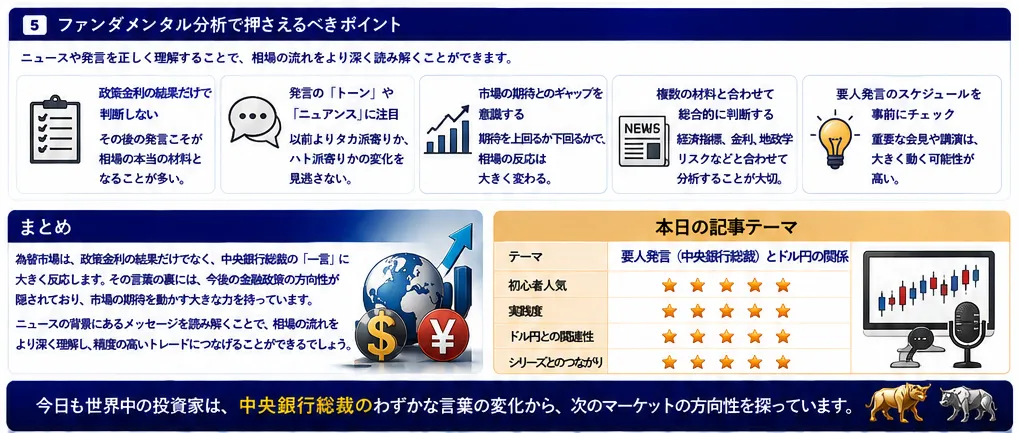
In fundamental analysis, it is important not only to look at economic indicators and policy rates but also to check the subsequent press conference and remarks from key officials.
The market responds sensitively not only to numbers but also to “expectations” and “messages.”
When viewing the dollar-yen market going forward, please pay attention not only to the policy rate results but also to how the central bank governor conveyed messages to the market with his words.
If you can understand the background of that single phrase, you will be able to read not only the meaning of the news but also the psychology of market participants.
Today as well, investors around the world are looking for the next market direction from even a slight change in the central bank governor’s words.
★ URL of this page:https://www.gogojungle.co.jp/users/186761?via=indicators_detai