
Gold Canon Episode 1 | The "Mechanism" of Gold-Only Signs and the Strengths Really Worth Noting
Gold CanonThis is the first installment.
This time, among the set, we will firsttalk about the Sign Indicatorin particular.
The use of semi-automatic EAs and lot management will be covered in later installments.
“If arrows appear, there are many in the world”
That is correct. Therefore, this time we willclearly define what the arrows represent / when they are confirmed / where their strengths liein precise terms as a research institute.
We will not boast flashy earnings.
Instead, we will整理 points where Gold traders truly get puzzled—the difference between a sign you can trust and a sign that makes you trust it.
Introduction | Why focus on “Gold-only”?
Many sign tools claim to work across multiple currencies and timeframes.
Versatility sounds attractive. However, the FX Logic Institute's stance is the opposite.
For each market,
response of indicators and time windows
shape of the spread
how the trend persists
differs. In particular,Gold (XAUUSD / GOLD) is a different entity from USD/JPY or cross JPY pairs.
The more broadly and shallowly you apply it, the more the parameters become compromises.
The more you dig deep into one, the clearer you know what to wait for in that market.
Gold Canon signals are designed from the outset with gold in mind.
Prioritizing reducing hesitation in gold over the idea that it can be used for anything.
※This article explains the product structure and usage. It does not guarantee profits.
“Redefining the Definition of a ‘Good Sign’ from the Start
Many people judge sign quality by the following:
Is the win rate high?
Are there many arrows?
Does it look strong?
But in reality, that is not enough. The institute checks three points first:
When is it confirmed (is it a provisional display during formation or a recorded confirmation afterward)
What is it depicting (entry only, or including add-ons and exit)
How can it be evaluated (not by intuition, but with explicit period and unit)
Signs whose three points are ambiguous leave only a sense of calm at the moment of viewing, no lasting clarity.
Gold Canon incorporates these three points from the start.
Mechanism I | What is being drawn is not an “arrow” but a “basket story”
![]()
Gold Canon’s signs are not just a list of entry points.
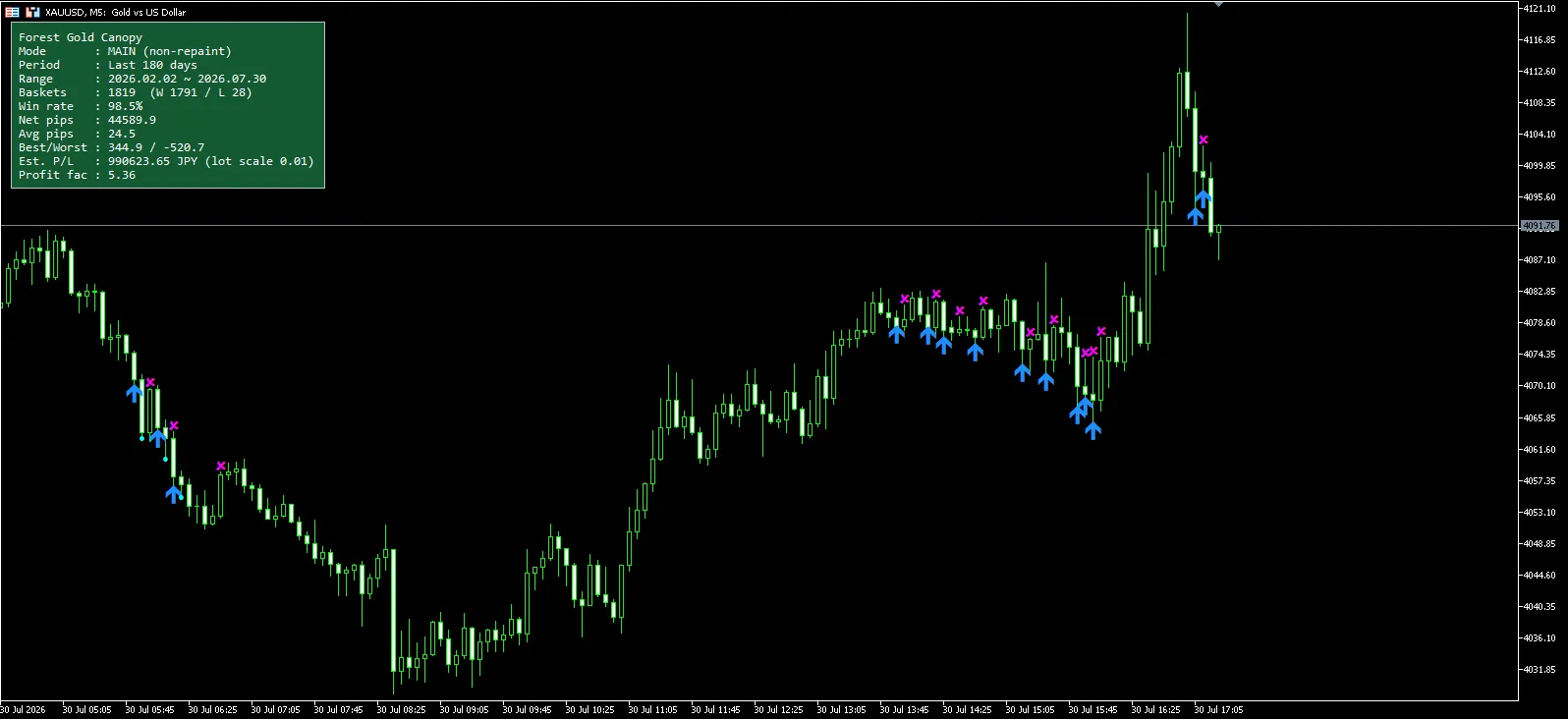
On the chart, you can generally see three types:
Blue arrow (Buy Entry)… Fresh buy. The starting point of a series of trades
Light blue mark (Nanpin Add)… Additional buys (averaging-in positions)
Magenta × (Basket Exit)… Settlement of the entire basket
What’s important here is thatone arrow does not equal one trade.
In a market with wide price ranges like gold, it is more realistic to view from “Entrance → (if needed) Add → Settlement” as one management unit rather than a single completed trade.
The sign side also simulates and displays this unit as aBasket.
Therefore you see both the entry arrow and the ending mark.
For discretionary users, it is more practical when you can simultaneously see
where the discussion started
where it ended
than just seeing the entry point.
Mechanism II | Operates with completely no repaint (confirmed candle)
Gold Canon’s signs assumecomplete no-repaint.
The definition is as follows:
Do not draw signs on forming (unconfirmed) candles
After a candle is confirmed, the sign that appears at that time is fixed
Thereafter, price movements or re-displays do not conveniently rewrite past signs.
On the other hand, some in the industry show provisional arrows during formation and have them disappear/move when the candle closes.
That approach is powerful for catching good-looking moves in real time, but it easily disturbs verification and discretionary judgment.
From the institute’s standpoint, signs should be arecord of a confirmed situation, not a forecast演出 (preference). .Therefore Gold Canon draws signs only on confirmed candles.
Some may say, “Isn’t it slow to react?”
confirmed displays that do not move later rather than early provisional displays.
Semi-automatic EAs are also premised on this confirmed signal.
(Details of semi-automation will be covered in Part 2.)
Mechanism III | Publicly sharing the “design philosophy”
Design philosophy is as follows.
Narrow the entry… Rather than always emitting arrows, focus on moments when conditions align
Don’t rely on a one-shot win… A basket-management approach with phased handling according to market conditions
Don’t fight unnecessarily… In situations with strong counter-trend, limit additions
Be mindful of weekends… Gold also carries weekend-crossing risk that cannot be ignored
Practical safeguards… Do not prioritize mere beauty of display
In short, it is not a “sign-making machine,” but a device that shows the entire sequence from entry to exit under the same rules.
Strength 1 | The act of making information visible itself is a strength
With only automated trading, it can be hard to understand why a given order was placed.
With discretionary trading, reproducing the decision is difficult.
Having signs makes it possible to
see what the current rule is looking at
whether the previous arrow was an addition or a settlement
how the recent rules have fared in terms of wins and losses
shared on the chart.
This is not only a brag about “easiness of winning” but a strength that reduces operational communication costs by making the trading unit visible.
Strength 2 | A statistical panel forces “intuition” to be expressed in language
Gold Canon’s sign includes a statistics panel at the top-left.
What is tallied here is basicallybaskets that have completed settlement.
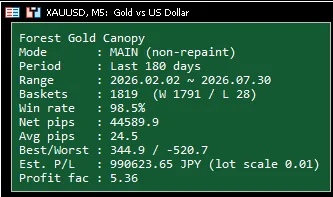
The main items are defined as follows:
Baskets… number of cases (win/loss breakdown)
Win rate… basket-level win rate
Net pips / Avg pips… total and average
Best / Worst… best and worst
Est. P/L… estimated profit/loss in display lot terms
Profit fac… efficiency of gross profit to gross loss
Note thata higher win rate does not automatically mean better.
With designs that include add-ons, the win rate can look high, but the depth of losses is important.
Therefore the institute looks atWorstcountProfit factor.
If the panel is positive, that means the aggregating conditions show a positive result in the simulation.
Nevertheless, it is extremely important as a tool to avoid relying on intuition.
Strength 3 | Timeframe stability (Recommendation: M5)
Gold Canon emphasizes starting fromM5 for gold.
(The trend side is designed to be used in combination with H1.)
It can run on M1/M15/M30/H1, but results tend to differ.
M1 reacts fast but has more noise
M5 has longer confirmed intervals and steadier rhythm of the rules
“The same logic, changing the timeframe, does not give the same results.”
Since distance measurement tools like ATR depend on candle scale,evaluate on the recommended timeframe.
Keep the chart timeframe for signs and the Preset (M5) aligned.
If these are misaligned, even the meaning of the arrows can feel off.
Common misunderstandings and correct usage
Misunderstanding 1: You must enter whenever an arrow appears
That is not correct. Signs are suggestions of rules. Depending on market conditions, capital, and plans, skipping may be the right decision.
Misunderstanding 2: If the win rate is high, you may increase the lot size
That is not correct. Increasing without considering worst-case and available capital is dangerous with gold.
Misunderstanding 3: It’s the same on any timeframe
That’s not true. Start by understanding on M5.
Misunderstanding 4: Panel numbers reflect actual live account performance
That is not true. It is a backtest of the same rule.
It can be informative, but not a substitute for real-money results.
Correct usage is simple.
Attach signs to Gold's M5
Track arrows / additions / exits with your eyes
Check the counts / Worst / totals on the panel
Only after you are satisfied, consider turning on/off the semi-automatic mode
It is not “automatize first, understand later,” but “understand first, automate later.”
End of Part 1 Summary
Gold Canon’s Sign Indicator is built on four pillars:
Gold-only design
Shows the sequence from entry to add to exit as a single chain
Complete no-repaint (confirmed candles)
Quantifies intuition with a statistics panel
This is the four-pillar foundation.
Do not simply claim strengths based on “more arrows” or “higher win rate.”
The true strength lies invisualizing Gold’s trading unit as a record that does not move later.
Next time, we will cover semi-automatic EA (signal-linked, RUN button, cases where the same candle has both new entry and a close) and write from a practical perspective about transitions from “seeing” to “executing.”
We will address practical cautions in moving from visibility to execution.