
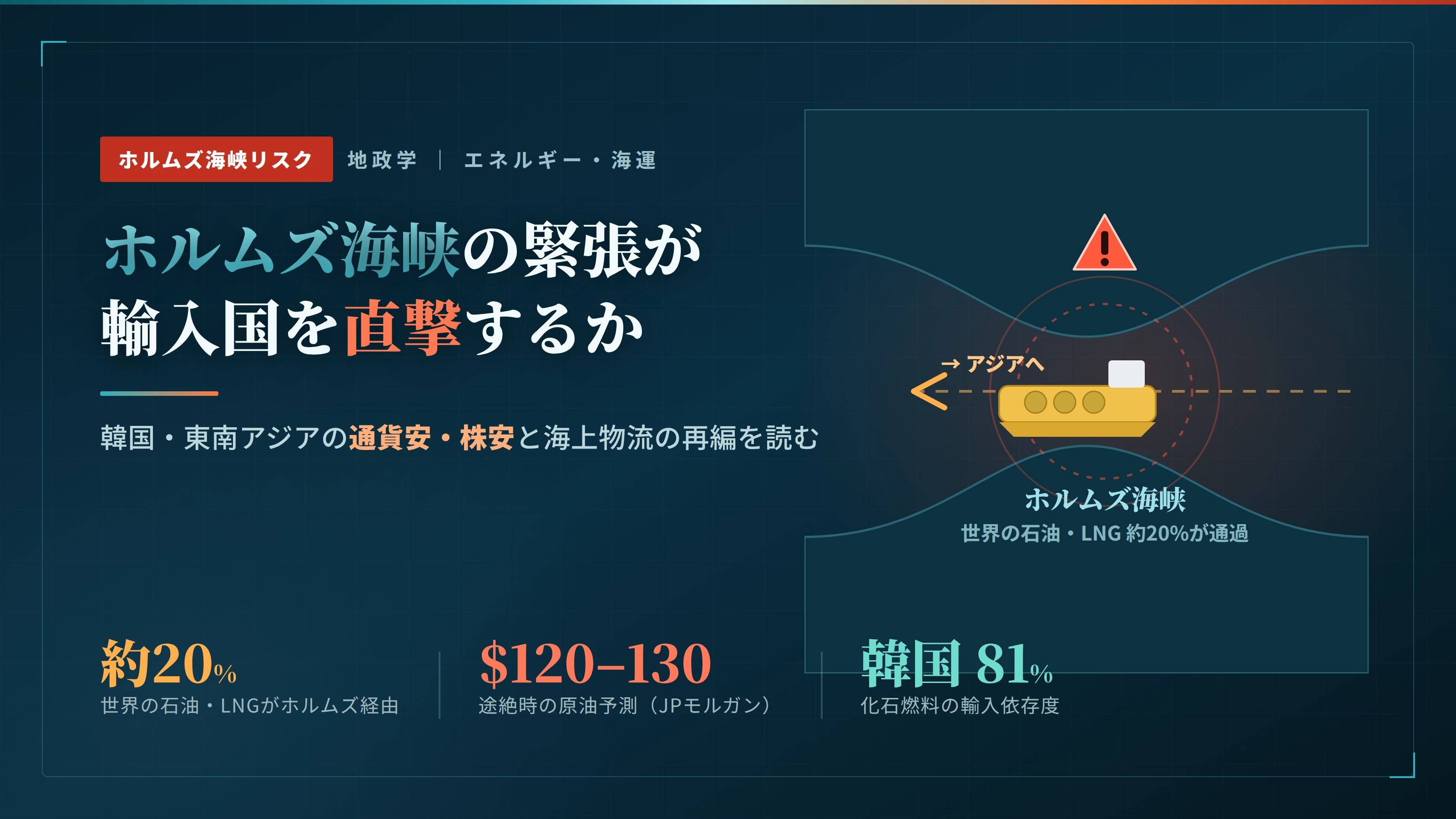
Middle East "Hormuz Strait Risk" and Reorganization of Maritime Logistics — Impact on Energy Importing Countries (Korea and Southeast Asia)
Middle East “Strait of Hormuz Risk” and the Reshaping of Maritime Logistics — A Beginner-Friendly Explanation of the Impact on Energy-Importing Nations (Korea and Southeast Asia)
In One Line About This Topic
The Strait of Hormuzis the world’s major artery for oil and natural gas. When tensions rise here and ships’ passage is disrupted (a supply shock), energy-importing Korea and Southeast Asian countriesare vulnerable to a triple hit: currency depreciation, higher prices, and falling stock prices. Moreover, as ships divert to alternate routes, the very structure of maritime logistics (supply chains) is reorganized, and the flow of global capital will also change.
What Exactly is the “Strait of Hormuz”? Why is it Important?
The Strait of Hormuz is a narrow passage linking the Persian Gulf to the open sea. Exporting tankers from key Middle Eastern oil- and gas-producing countries such as Saudi Arabia, Iran, Iraq, and Qatar pass through here to reach the world. About 20% of the world’s crude oil and LNG (liquefied natural gas) is believed to pass through this narrow strait if this chokepoint gets blocked, global energy supply tightens quickly, and— that is why it is called the “most important choke point on the seas.”
Why Is Asia Most Affected?
A large share of the energy flowing through the Hormuz Strait ends up in Asia. Data show that Asia accounts for about 84% of global crude oil imports and about 83% of LNG imports, with four countries— China, India, Japan, and Korea 75% of crude oil and 59% of LNG passing through the Strait— alone handling. In other words, Asia—the buyers—suffer more than the producers when the strait is blocked.
Looking at each country’s vulnerabilities: Japan’s energy-import dependence is 87% (the highest risk), Korea 81% (second place, 78% of energy from oil and gas), India 35%, and China 20%. The higher the import dependence, the greater the blow from a supply shock.
Focus: How Will the “Currencies” and “Stock Prices” of Korea and Southeast Asia Be Affected?
This is the main topic. The hits to energy-importing countries translate into cascading effects on currencies and stock prices through chains.
First ① A sharp rise in import costs. Since crude oil and LNG are priced in dollars, a spike in prices leads to a rapid increase in the number of dollars paid (even in extreme estimates, crude could rise from roughly $120–130 per barrel to $200–300). Next ② Worsening trade balances and currency depreciation. When import expenditure swells, countries end up selling more dollars to pay, causing their own currencies (Korean won or Southeast Asian currencies) to come under pressure (depreciation). Furthermore ③ Imported inflation. Higher energy costs ripple into electricity, transport costs, and prices (in Japan, LNG prices rose about 170%, causing significant electricity price increases). And ④ Stock prices decline. Increased costs squeeze corporate profits, particularly for energy-intensive manufacturers (Korea’s semiconductors and petrochemicals), making their stocks more likely to fall. Additionally, as global capital seeks safe assets (dollars), capital flows away from emerging Asian currencies accelerate.
Korea faces a double vulnerability: high energy import dependence plus energy-intensive exports, making a scenario of “won depreciation and stock decline (KOSPI downside)” likely. Southeast Asia shows variation by country: net energy-importing nations (Thailand, the Philippines, etc.) face larger blows, while energy exporters such as LNG and palm oil (Malaysia, Indonesia) partially offset are possible, creating differences.
“Reshaping Maritime Logistics” and the Capital Flows of the Global South
As the strait’s risk rises, ships are forced to take longer routes, freight rates and insurance costs rise, and delivery times slip. If this continues, firms will restructure procurement and production locations (reorganize supply chains), geographically reconfiguring trade and capital flows. Involving the Global South (emerging and developing economies in Africa, South Asia, and beyond), this leads to a long-term reorganization of energy supply networks and capital allocation— this is another central theme of this issue.
Important caveats
First, the scenario is wide-ranging. How long and to what extent the strait actually stops will determine whether the impact is a temporary spike or a severe supply crisis. Second, outcomes differ by side. For importers, headwinds; for exporters and alternative suppliers, tailwinds. Third, psychological amplification. Even without an actual outage, merely the fear of disruption can move crude and currencies significantly.
A Beginner’s Guide to Interpreting This
Key is to think in terms of how the chain from “one strait” flows into “energy → currency → prices → stocks.” Recognize this connected chain: distant Middle East news is connected to the Korean won, Asian stock markets, and Japan’s electricity bills—this sense of continuity is essential to reading geopolitical risk.
From an investment perspective, these scenarios involve large swings in energy, exchange rates, and shipping. The effects on importing nations vs. resource-exporting nations can diverge, so avoid betting in a single direction, and favor diversification and readiness for rapid change.
Point: News about chokepoints helps you see who is harmed and who benefits, revealing a three-dimensional view of the impact.
Summary
The Strait of Hormuz is a critical choke point through which about 20% of the world’s oil and LNG passes, and the buyers that need it most are Asia. When tensions rise, energy-importing countries in Korea and Southeast Asia are prone to a cascade of currency depreciation, inflation, and stock declines, and the rerouting of maritime logistics fosters a reorganization of supply chains and capital. The effects can reverse between importing nations and resource-rich countries, so it is important to calmly trace the ripple path from energy to currency to stocks, keeping in mind the range of possible outcomes.
Note: This article is a general explanation based on public reporting. Figures and conditions are as of the time of reporting and may change. Because this touches on sensitive international affairs, please verify with primary sources. This is not investment advice. Invest at your own risk.
This article is a general explanation based on public reports (IEA, Zero Carbon Analytics, UNCTAD, various news outlets). Figures and circumstances may change. Please make your own investment decisions.