
India's "post-election" capital shift and the world's largest emerging marketization
India’s “post-election” capital shift and the world’s largest emerging market landscape — A beginner-friendly gentle explanation
In one sentence, this topic is about
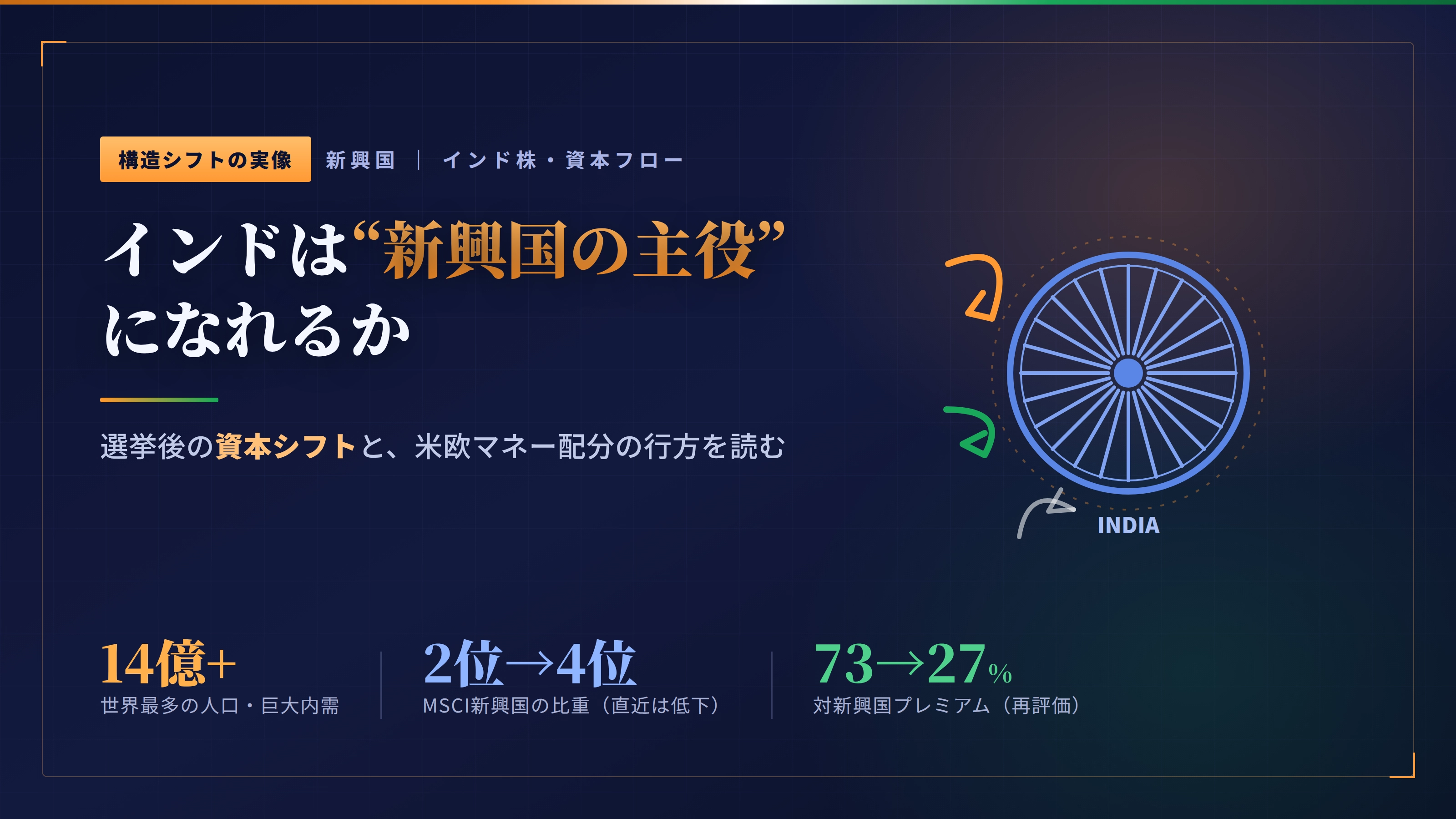
India isthe world’s largest population and high growth potentialto wield as a weapon, and has long been expected to become the main player among emerging markets. Even after the elections, policy continuity was anticipated,and the world’s money would structurally shift toward Indiain an grand overarching story. However — and this is important —by the near term of 2026, foreign investors were actually cautious and funds briefly flowed out. The theme of this piece is to read the gap between long-term expectations and short-term realities in a flat, straightforward way.
Why India is a “top candidate” (long-term structural story)
There are three main reasons India is attracting attention. Firstthe world’s largest population (over 1.4 billion) and youth. The number of workers and consumers keeps rising, and a huge domestic market supports long-term growth. Second“China plus one”. To diversify risks from over-concentration in China, global firms are choosing India as the next destination for production and investment. Thirdpolicy continuity. The view that reforms will continue even after elections provides reassurance for long-term investors. This “big picture” underpins the expectation that India will eventually become one of the world’s largest emerging-market markets.
Focus: how structural shifts will change allocation of funds from the US and Europe
Global institutional investors (pensions and funds from the US and Europe) decide“how much to allocate to emerging markets, and to which countries”based on indices. A representative one isthe MSCI Emerging Markets Index. If India’s weight in this index rises, a vast amount of funds tied to it willflow automatically into India. Hence, “increasing India’s weight means increasing the structural allocation of US/European money to India” — that is the logic. The theme has long been that funds would be redirected from China toward India as part of a major money relocation.
But the current situation (2026) faced headwinds — a reality check
This is the most important point this time.Actual fund flows in 2026 went against the expectations. Media reports indicated foreign institutional investors (FIIs) significantly sold Indian stocksand a prominent figure even said foreign interest in Indian stocks had all but died.
The numbers reflect it as well. India’s position in the MSCI Emerging Markets Index dropped fromsecond to fourth placeas China, Taiwan, and Korea moved ahead. Passive funds that track the index thus saw outflows from India. The core reason wasvaluation levels. The Nifty50 traded at about 20x PER, yielding a premium over the emerging-market average, which shrank from73% to 27%. In short, “India wasn’t a bad market, but profits hadn’t kept up to justify the high valuations.” Additionally,capital concentration in AI-related (China tech and semiconductors in Taiwan/Korea)pulled funds away from India.
How to understand this? — The long-term story vs. short-term prices
It may seem contradictory, but they can coexist.Long-term keeps the structural factors of population, domestic demand, and a China-plus-one dynamic intact, and India’s central role among emerging markets remains on track. On the other handshort-termis the reality that even a “good country” may not be bought if its stock price is too high. In 2026, that high price acted as a drag, and funds pulled back.
In other words, the structural shift is not a straight line but moves in fits and starts. US/European money allocation will trend toward more India in the long run, but in the short term it will swing due to high valuations, growth slowdowns, and other themes (AI) competing for attention.
Important caveats to keep in mind
First,overvaluation risk. When expectations outrun reality and stock prices rise, even a small disappointment can trigger a large correction. Second,practical realization of earnings growth. It’s not enough to have a story; companies must actually earn profits (in 2026, capital goods, infrastructure, and power lead growth, while IT and consumption soften). Third,domestic institutional investors (DII). In recent years, domestic individuals and institutions have supported Indian stocks, helping cushion against foreign sellers, but this is not a cure-all.
A beginner’s guide to how to read this
The key is to separate“the country’s future potential” and “the current stock price valuation”. It’s not simply “buy because it’s a good country,” but “buying a good country at what price.” Even if you believe in India’s long-term growth, the entry timing (valuation) can greatly influence outcomes.
From an investment standpoint, growth economies tend to be more volatile, with larger fund flows in and out.Don’t bet everything on one country or one theme; diversifyandkeep both the long-term story and short-term supply/demand in view— this is especially important in investing in emerging markets.
Point: India is a market where long-term expectations contend with short-term overvaluation. Treat bullish and bearish news with awareness of the time horizon involved.
Conclusion
Backed by the world’s largest population and enormous domestic demand,there is a structural capital shift toward India as a major emerging market in the long run. In the long term, US/European money may tilt toward India via index weights. However,the near term in 2026 saw overvaluation concerns and AI-driven capital concentration, leading foreign flows to become cautious, and MSCI emerging-market weight drop from 2nd to 4th with diminished premium. It is crucial to separate the long-term story from short-term prices, avoid being swept up by expectations, and face facts with attention to valuation.
※This article is a general explanation based on publicly reported information. Figures and conditions are as of the reporting time and may change in the future. This is not investment advice. Please invest on your own responsibility.
This article is based on public reporting (Inc42, State Street, MSCI-related reports, etc.) as a general explanation. Figures and conditions may change in the future. Please make investment decisions at your own risk.