

Virtual currency market analysis [August 4]
Today (2026 year 8 month 4 day-to-day) major cryptocurrencies price movements have continued in a range-bound market lacking a clear overall trend,, with market direction feeling weak. Bitcoin (BTC) is moving in a range from flat to slightly firmer, while Ethereum (ETH), among other major altcoins, is showing slightly softer momentum.
Market cap leaders (based on multiple information sources and subject to data-attribution differences; primarily USD-based withJPY reference values also provided)
Today’s main price movements (estimated data)
Bitcoin (BTC): about63,400–64,000 USD around, for example:63,565 USD vicinity with +0.3% to +0.7% slight rise, or in JP¥ terms around1,000万 (10 million) close to negative0.03%). Its market cap is about1.27 trillion USD. Over the past24 hours it has been largely flat to a small uptick.
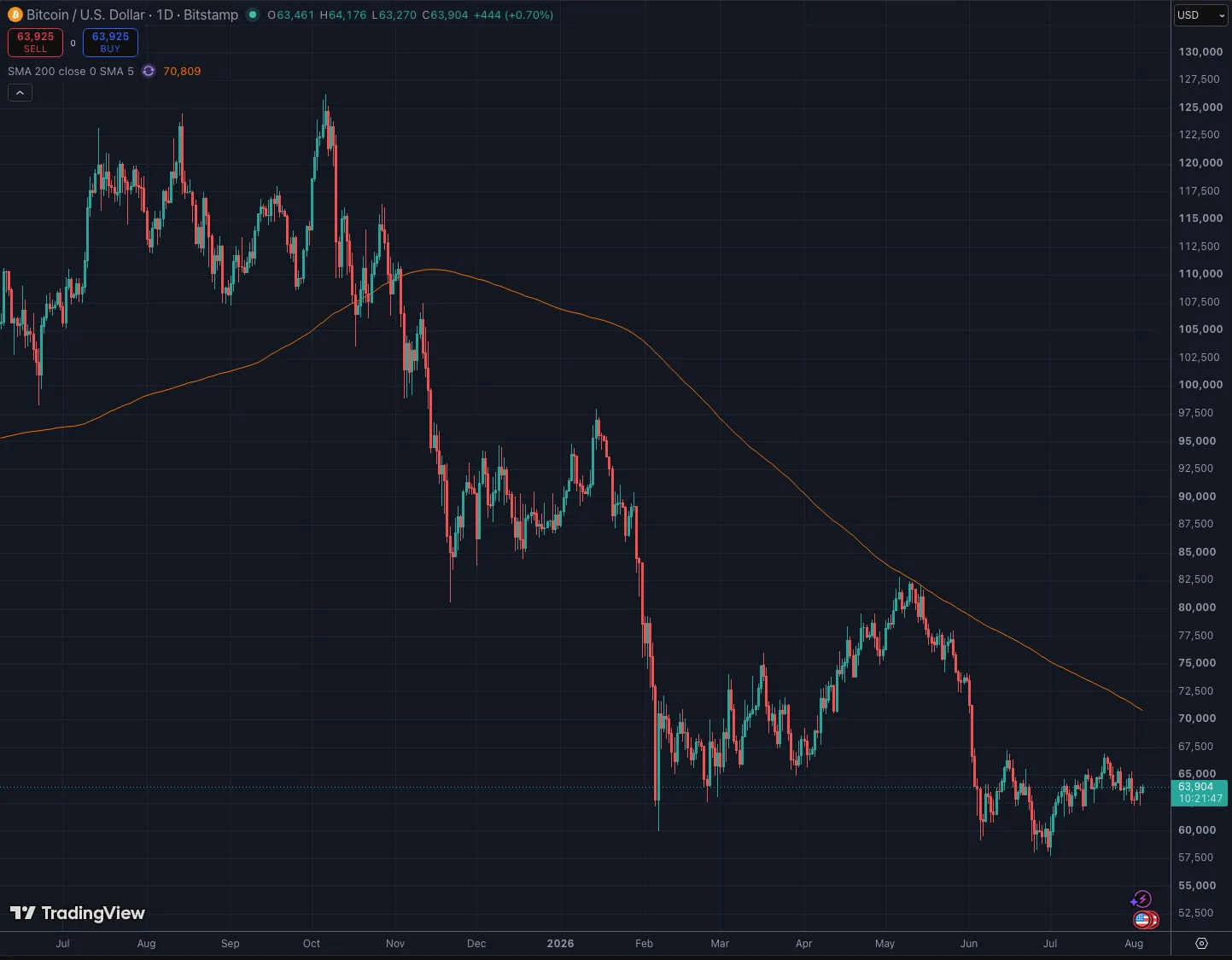
Bitcoin daily chart
Ethereum (ETH): about1,850–1,870 USD around (e.g.,:1,862 USD near-flat with -0.4% to -1.3%, roughly -29万 JP¥ with -1.28%). Its market cap is about2,240 billion USD. Currently, the downside is slightly more dominant.
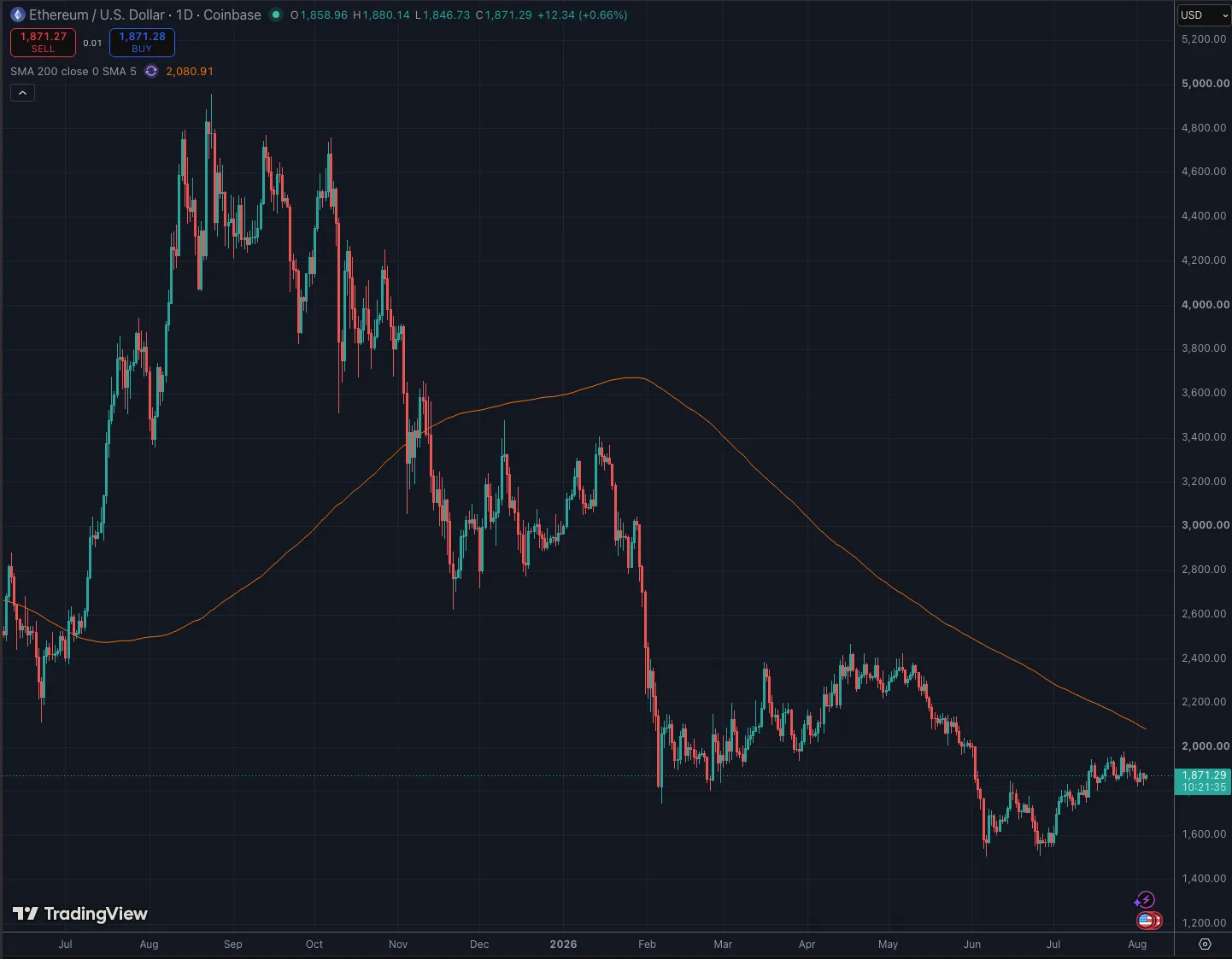
Ethereum daily chart
Other major tokens: Ripple (XRP) around1.07 USD (roughly -1%), Solana (SOL) around73 USD (small moves), Binance Coin (BNB) around590 USD. Cardano (ADA) has shown relatively strong movement, with some occasions of a multi-percent rise.
Overall crypto market: total market cap around2.17 –2.2758%24
Looking at the market as a whole, there is a mix of gainers and losers, with altcoins showing pronounced dispersion in performance by coin.
◯ Key factors and related news impacting today’s price moves
Geopolitical risk trends: Tensions around the US and Iran persist, but reports of diplomatic progress and news of Trump pausing attacks have somewhat eased tensions. Crude oil price movements are also affecting investor sentiment.
Macro economy:US 10-year treasury yields around4.74% (a high since January 2025) have risen and stayed elevated, raising awareness of volatility in the bond market. Meanwhile, stock indices such as the Dow and Nasdaq Composite have shown rebounds, suggesting some risk-on sentiment returning.Institutional investors and corporate movements: MicroStrategy, renamed Strategy, disclosed selling about1,638 BTC (over $100 million) last week. Additionally, concerns persist about hacks and losses related to Coldcard hardware wallets, leading to caution among market participants.Physical ETF and institutional fund flows: Bitcoin physical ETF saw substantial outflows on the prior Friday, but on Monday the 3rd of August there was a net inflow of about$107 million driven by BlackRock’s “IBIT,” which supported the downside and provided a floor.Other topics: BlackRock’s tokenized money market fund (MMF) products and regulatory/security discussions are drawing attention. However, there is a lack of new catalysts to push the market higher, giving an impression of continued consolidation and range-bound trading.Market analysts expect prices to remain in a range roughly between62,500 and65,500 USD for now.◯ Price movement since last week (roughly from late July to August 4)Last week’s market action did not show a clear directional trend, instead moving in a range with a recovery and rebound in mid-July followed by a high-range consolidation and minor pullback.Bitcoin (BTC): roughly63,000–65,500 USD range. From early to mid-week, tested the64,000s, then moved to62,500 to63,500 range by month-end, now recovering around63,500. Weekly basis shows mostly flat to around -1% decline. Support around60,000–63,000; resistance around64,000–65,500 is strongly watched.Ethereum (ETH): tracks Bitcoin but weaker, weekly decline around -1% to -2.5%, trading between1,800–1,900 USD; currently around1,850 USD. Near the50-day and100-day moving averages in focus for price action.Other tokens: XRP or SOL also showed weekly small declines to flat movement. ADA, however, demonstrated relatively strong momentum, recording around20% gain over the past7 days (e.g., from about0.16 to0.195 USD). This appears driven by ecosystem-positive news and large investor buying.Overall, institutional fund flows and macroeconomic/geopolitical uncertainty have prevented a clear upside trend, resulting in ongoing consolidation and range-bound movement. Fear & Greed Index remains at a low level.◯ Bitcoin spot ETF movements:Last week (roughly July 27–31) saw net outflows totaling about$61.53 million. This interrupted the prior three-week run of net inflows.For example, on July 31, due to month-end portfolio rebalancing, a large outflow of about$260.5 million occurred. Around August 3 (Monday), net inflows of about$107 million turned positive, led by BlackRock’s IBIT inflows of about$111 million, supporting the downside.During the past week, overall movements have been mixed, but signs of renewed inflows are appearing. Cumulative net inflows remain substantial, though the trend since the beginning of the year still shows some outflows in parts.◯ Binance Research publishes a shocking analysis reportBinance Research analyzed crypto market dynamics in H1 2026, revealing a shift away from the typical sector rotation to a “broad-based market contraction” across the market. This is a shocking finding that market participants should note.Specifically, they report substantial declines in the following metrics:・ DeFi TVL: a decrease of about $434 billion (down 38%)・ Total market cap of major L1s: down about $246.5 billion (down 42%)・ L2 user activity: minus 77% plunge◯ Japanese yen hits 40-year low and government/BOJ intervene in FX marketThe Japanese yen’s value dropped to a 40-year low in the foreign exchange market, prompting a large-scale intervention by the Japanese government and the Bank of Japan to defend the yen.In response to this drastic currency value movement, the crypto community and investors discussed hedging the yen depreciation by buying more Bitcoin (BTC).In a landscape where trust in fiat currencies is faltering, it is watched whether crypto assets with capped supply can emerge as an alternative store of value.If the yen continues to weaken, the BOJ would be compelled to raise rates sharply.If the BOJ pivots to a serious rate-hike path, the massive yen short positions built up could be unwound rapidly, causing broad market effects.Moreover, if US authorities show a favorable stance toward Japan’s FX defense, the underlying aim may not be mere currency stabilization.The aim would be to avoid a sharp rise in US long-term yields by delaying a wider crisis, thus prolonging the life of the global “yen carry” ecosystem.The US Treasury Secretary and others are protecting not just the yen, but the entire global financial system that has benefited from a massive supply of low-cost yen (ATM). (@kawasaki_axis quote)◯ Arthur Hayes warns: AI bubble could burst around 2028 (from past interview footage)Arthur Hayes, co-founder of BitMEX, in an interview with Bonnie Blockchain, stated the main period when the AI-related bubble could burst would be around 2028.According to Hayes, the current financial market gives excessive value to GPUs with only about a 2-year practical lifespan, applying a 6-year depreciation schedule, which is unjustly high. The massive accounting debt accumulated since 2024 will face a harsh reality about two and a half years later.He further argues that Western data centers built with enormous capital could be displaced by cheaper Chinese AI models with similar or better performance, leading to wide capital cost disequilibrium and the potential for a bubble burst.◯ Latest Bitcoin news・ Strategy, led by Michael Saylor, sold 1,637 BTC (about $120 million). Saylor previously claimed he would never sell Bitcoin, but noted that he hadn’t guaranteed not to sell under legal contracts. There is a framework allowing up to $5 billion worth of BTC to be sold annually to fund dividends, debt payments, and buybacks. The company maintains a stance of “accumulation over the long term.”・ Coldcard hardware wallet hack losses exceed $1 billion. A vulnerability in the firmware’s RNG (random number generator) from a 2021 release was exploited, causing Bitcoin to be drained from dormant wallets over time. The flaw allowed attackers to compute private keys. Legacy wallets once believed to be secure have become targets.CZ (Changpeng Zhao), former CEO of Binance, cautions that no hardware wallet is 100% safe and assets should be diversified rather than held on a single device.Meanwhile, security experts Jayson Lopp and Zach Huberst assert that the Coldcard vulnerability does not mean the end of self-custody. It should prompt reconsideration of what users trust in security, but not abandon self-custody altogether. Lopp commented to The Block that “self-custody remains the optimal form of management for those who are prepared to take on the heavy responsibility.”In summary, Coldcard itself was a well-regarded, robust hardware wallet, but this incident highlights that even excellent products can have bugs. Major manufacturers like Ledger and Trezor have faced vulnerabilities in the past. For most individual users, Ledger or Trezor, with friendlier UI and lower risk of user error, are safer and easier to handle. Coldcard was aimed at advanced users who could operate in an air-gapped environment for long-term storage of large Bitcoin amounts.◯ Eric Trump involved in “American Bitcoin” added 300 BTC; total holdings up to 8,300 BTC.・ Trump Media & Technology Group reportedly holds around $880 million in Bitcoin losses, having sold 2,628 BTC (about $1.65 billion) in the market. They had previously accumulated 11,542 BTC at an average cost of about $118,522, but began selling in earnest about seven months ago. Total realized losses amount to around $880 million.・ Standard Chartered, a major global bank, published a report stating Bitcoin around $63,000 is an excellent buy zone. They note that Strategy’s communications were insufficient and may have created negative feedback loops, yet the bank maintains high liquidity, suggesting STRC could rebound toward $100. They keep a $100,000 price target for Bitcoin by year-end.【Paid subscription information】Paid subscription area offers deeper, value-focused analysis on individual coins.“Bitcoin and Ethereum aren’t the end; we want to invest in the next big profit opportunity.”“Understand the essential flows and future of the crypto market, and ride the wave.”If this is your view, please consider subscribing. Consistent high-quality research is the key to big success.(This report has been delivering market-leading insights since its 2016 launch)4.74%
Institutional investors and corporate movements: MicroStrategy, renamed Strategy, disclosed selling about1,638 BTC (over $100 million) last week. Additionally, concerns persist about hacks and losses related to Coldcard hardware wallets, leading to caution among market participants.1,638 BTC (over $100 million) last week. Additionally, concerns persist about hacks and losses related to Coldcard hardware wallets, leading to caution among market participants.
Physical ETF and institutional fund flows: Bitcoin physical ETF saw substantial outflows on the prior Friday, but on Monday the 3rd of August there was a net inflow of about$107 million
Other topics: BlackRock’s tokenized money market fund (MMF) products and regulatory/security discussions are drawing attention. However, there is a lack of new catalysts to push the market higher, giving an impression of continued consolidation and range-bound trading.
Market analysts expect prices to remain in a range roughly between62,500 and65,500 USD for now.
◯ Price movement since last week (roughly from late July to August 4)
Last week’s market action did not show a clear directional trend, instead moving in a range with a recovery and rebound in mid-July followed by a high-range consolidation and minor pullback.
Bitcoin (BTC): roughly63,000–65,500 USD range. From early to mid-week, tested the64,000s, then moved to62,500 to63,50063,500 range by month-end, now recovering around. Weekly basis shows mostly flat to around -1% decline. Support around60,000–63,000; resistance around64,000–65,500 is strongly watched.
Ethereum (ETH): tracks Bitcoin but weaker, weekly decline around -1% to -2.5%, trading between1,800–1,900 USD; currently around1,850 USD. Near the50100-day and-day moving averages in focus for price action.
Other tokens: XRP or SOL also showed weekly small declines to flat movement. ADA, however, demonstrated relatively strong momentum, recording around7 days (e.g., from about20% gain over the past0.16 to0.195 USD). This appears driven by ecosystem-positive news and large investor buying.
Overall, institutional fund flows and macroeconomic/geopolitical uncertainty have prevented a clear upside trend, resulting in ongoing consolidation and range-bound movement. Fear & Greed Index remains at a low level.
◯ Bitcoin spot ETF movements:
Last week (roughly July 27–31) saw net outflows totaling about$61.53
For example, on July 31, due to month-end portfolio rebalancing, a large outflow of about$260.5 million occurred. Around August 3 (Monday), net inflows of about$107$111
During the past week, overall movements have been mixed, but signs of renewed inflows are appearing. Cumulative net inflows remain substantial, though the trend since the beginning of the year still shows some outflows in parts.
◯ Binance Research publishes a shocking analysis report
Binance Research analyzed crypto market dynamics in H1 2026, revealing a shift away from the typical sector rotation to a “broad-based market contraction” across the market. This is a shocking finding that market participants should note.
Specifically, they report substantial declines in the following metrics:
・ DeFi TVL: a decrease of about $434 billion (down 38%)
・ Total market cap of major L1s: down about $246.5 billion (down 42%)
・ L2 user activity: minus 77% plunge
◯ Japanese yen hits 40-year low and government/BOJ intervene in FX market
The Japanese yen’s value dropped to a 40-year low in the foreign exchange market, prompting a large-scale intervention by the Japanese government and the Bank of Japan to defend the yen.
In a landscape where trust in fiat currencies is faltering, it is watched whether crypto assets with capped supply can emerge as an alternative store of value.
If the yen continues to weaken, the BOJ would be compelled to raise rates sharply.
If the BOJ pivots to a serious rate-hike path, the massive yen short positions built up could be unwound rapidly, causing broad market effects.
Moreover, if US authorities show a favorable stance toward Japan’s FX defense, the underlying aim may not be mere currency stabilization.
The aim would be to avoid a sharp rise in US long-term yields by delaying a wider crisis, thus prolonging the life of the global “yen carry” ecosystem.The US Treasury Secretary and others are protecting not just the yen, but the entire global financial system that has benefited from a massive supply of low-cost yen (ATM). (@kawasaki_axis quote)
◯ Arthur Hayes warns: AI bubble could burst around 2028 (from past interview footage)
Arthur Hayes, co-founder of BitMEX, in an interview with Bonnie Blockchain, stated the main period when the AI-related bubble could burst would be around 2028.
According to Hayes, the current financial market gives excessive value to GPUs with only about a 2-year practical lifespan, applying a 6-year depreciation schedule, which is unjustly high. The massive accounting debt accumulated since 2024 will face a harsh reality about two and a half years later.
He further argues that Western data centers built with enormous capital could be displaced by cheaper Chinese AI models with similar or better performance, leading to wide capital cost disequilibrium and the potential for a bubble burst.
◯ Latest Bitcoin news
・ Coldcard hardware wallet hack losses exceed $1 billion. A vulnerability in the firmware’s RNG (random number generator) from a 2021 release was exploited, causing Bitcoin to be drained from dormant wallets over time. The flaw allowed attackers to compute private keys. Legacy wallets once believed to be secure have become targets.
CZ (Changpeng Zhao), former CEO of Binance, cautions that no hardware wallet is 100% safe and assets should be diversified rather than held on a single device.
Meanwhile, security experts Jayson Lopp and Zach Huberst assert that the Coldcard vulnerability does not mean the end of self-custody. It should prompt reconsideration of what users trust in security, but not abandon self-custody altogether. Lopp commented to The Block that “self-custody remains the optimal form of management for those who are prepared to take on the heavy responsibility.”
In summary, Coldcard itself was a well-regarded, robust hardware wallet, but this incident highlights that even excellent products can have bugs. Major manufacturers like Ledger and Trezor have faced vulnerabilities in the past. For most individual users, Ledger or Trezor, with friendlier UI and lower risk of user error, are safer and easier to handle. Coldcard was aimed at advanced users who could operate in an air-gapped environment for long-term storage of large Bitcoin amounts.◯ Eric Trump involved in “American Bitcoin” added 300 BTC; total holdings up to 8,300 BTC.
・ Trump Media & Technology Group reportedly holds around $880 million in Bitcoin losses, having sold 2,628 BTC (about $1.65 billion) in the market. They had previously accumulated 11,542 BTC at an average cost of about $118,522, but began selling in earnest about seven months ago. Total realized losses amount to around $880 million.
()