
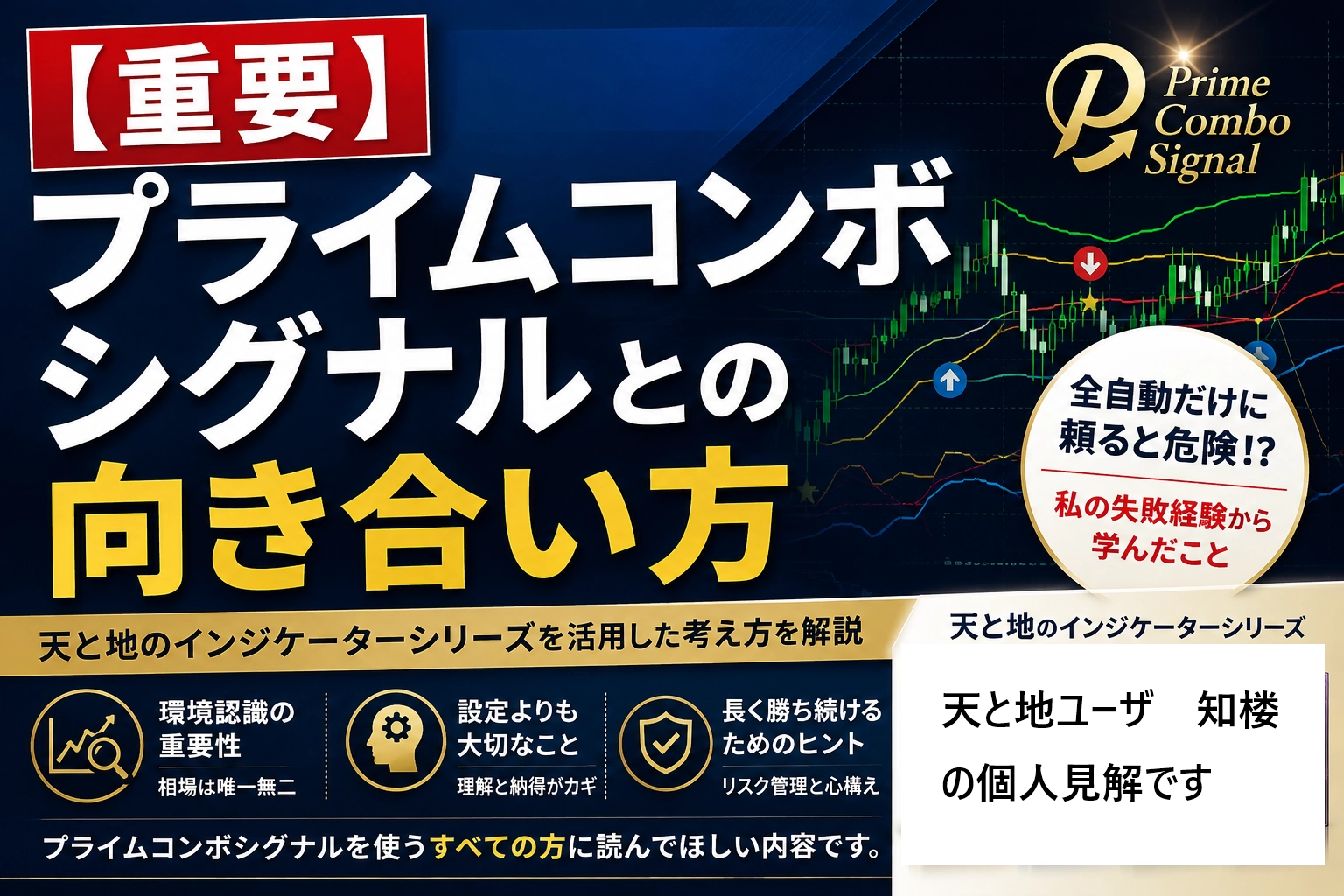
[Important] How to approach Prime Combo Signals
Introduction
This is Chinra Tenchi’s knowledge-building for users!
Prime Combo Signal has undergone many updates, and it has become a much easier-to-use tool compared to before.
I am extremely grateful that it continues to evolve thanks to the efforts of many people, starting with the developer Abu-san.
On the other hand, as updates progress andvarious settings and operating methods are shared, there are things I still want to convey.This article covers not only my own thoughts but also the failures I have actually experienced, discussing “how to approach Prime Combo Signal.”
I also refer to information published on various platforms, whether free or paid.
There are many things that are impressive in their level of detail and truly educational.
However, there are also many times when simply copying those methods may be somewhat dangerous.
What I have been telling you for a long time is
“Full automation alone makes long-term goals hard to see.”
.
- “This setting is good.”
- “No, this one yields more profit.”
- “Total gain in pips is important.”
- “Higher win rate is better.”
- “Prioritize risk-reward.”
There are various opinions, and each has its own justification.
If you aim for profit, such information is very appealing, and I understand the urge to pay for it.
However, if you simply chase that information without adapting it to yourself,it will be difficult to truly find a trading style that suits you.
In this article, I will explain why I think this way, and share what kinds of failures I experienced and how my thinking changed, in as clear a way as possible.
People who operate Prime Combo Signal
People who are already operating Prime Combo Signal
I hope this can be helpful to you.
The Pitfalls of Fully Automated Trading

Fully automated trading is very appealing.
Because it trades automatically while you are working or sleeping, many feel that it is “earning money on your behalf.”
In fact,I was attracted to that appeal as well.
But as I have traded in the market over a long time, I have felt
that
“Full automation alone makes long-term consistent success not easy.”
That is the point.
EA and fully automated operation of Prime Combo Signal are systems that trade by fitting the market to “patterns that are easy to win.”
Of course, if those patterns match the current market, you can see good results.
But the market is not the same every day.
There are trends that continue and ranges that do not.
Sudden speeches by officials, economic indicators, and world events can change the flow in an instant.
To respond to such market changes automatically is by no means easy.
Also,fully automated trading has the following characteristics.
Past backtests do not necessarily apply to the future
When market conditions change, performance can suddenly worsen
It is easy to operate without understanding why you entered
When losses begin, you start searching for “even better settings”
It is easy to switch due to impressive results you see on SNS or X
Market awareness and discretionary judgment are hard to acquire
Not only profits but emotional burden when losses continue is large
You end up operating without a personal rule
Of course, I do not intend to deny fully automated trading.
I also think it is a convenient feature.
But what is important is
“Why this setting?”
to understand it for yourself and operate with that understanding.
I think
“Is this setting compatible with me?”
“Can I explain that setting in my own words?”
these two things are very important.
If you operate fully automated with these two things unclear,you are likely to end up changing the settings whenever you lose,and you may end up reducing your funds as a result.
And in fact, I have experienced exactly the same failure.
Next, I will share that time.
My Failures with Fully Automated Trading

From here, I will share my own failures.
It is a bit embarrassing, but I want others to avoid similar experiences, so I will write honestly.
Before discovering the Tenchi and Earth indicators, I was operating a gold-only “stable averaging EA.”
When you hear “stable,” you might imagine it as very reassuring, right?
At the time, I hoped, “this might be able to operate for a long time.”
But reality was not so sweet.
I actually traded with real money and lost about 500,000 yen of capital several times.
When I opened MT4 on my smartphone, the unrealized loss would occasionally show as-200,000 to -300,000 yen.
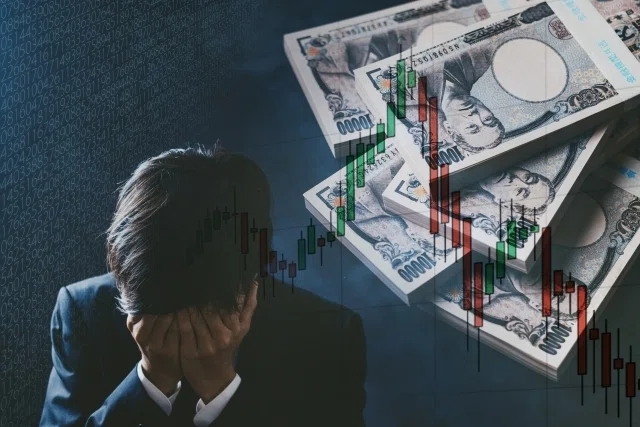
I prayed for the market to stop, and carried the position over to the next day, sometimes into the next week.
“Will this go to a stop-out?”
I spent days like that,with a stomach that hurt from anxiety.
Back then I also participated in open chats, and with others using the same EA, we talked,
“What will happen...?”
“We must endure.”
We spent those anxious times together.
I learned from experience the fear of operating without knowing the logic.
Then one day, I thought,
“If continuing like this has caused so much psychological pain, wouldn’t doing another side job or work faster?"
With that thought, I decided to quit that EA.
And afterward I encountered Tenchi and Earth indicators.
Tenchi and Earth taught me to thoroughly implement “stop-loss” and “capital management,” and gradually my trading began to change.
Of course it did not become winning right away.
Nevertheless, I started to think about “why I won” and “why I lost,” and I became able to face the market more than before.
On the other hand, this indicator has many unique ideas, and it takes time to understand.
Therefore, to deepen my understanding, I started a FX blog and kept revisiting Abu-san’s Investment Navigation, learning continually.
Writing articles was the best form of output for me.
Deepen understanding while writing the blog
Re-examine charts many times
Gain new insights through comments
I believe that these accumulations gradually sharpened my view of the market.
However, this is not where it ends.
Even after starting Tenchi and Earth indicators, I would face another similar failure with fully automated trading.
Even After Purchasing Tenchi and Earth Indicators, I Failed Again

In fact, after purchasing Tenchi and Earth indicators, I experienced another failure.
That was when DSATEA had just appeared.
At that time, support had not yet begun,
“With so many combinations, surely full automation can keep winning.”
I had such expectations.
Back then, I mainly operated with combinations like “point-to-point trades” aligned with the 4-hour oscillator DX Lime direction, or aiming for a band touch when two higher-timeframe directions aligned.
The first two to three months were very smooth.
“This setting should work.”
I also felt that sense of momentum.
But then losses gradually began to increase, and before I knew it, my funds were decreasing little by little.
Looking back now, the reason is very simple.
Every time I lost, I switched to a different setting.
“Maybe this setting is no good.”
“This one might be better.”
In repeating this, I stopped lengthy validation of a single setting, and the act of “searching for settings” became the goal itself.
But there is another big reason now, I think.
the market is different every time.
Even looks-similar charts have various underlying factors such as
- economic indicators
- official speeches
- market participant psychology
and other elements that influence the moment’s market.
There is no market that is exactly the same as another.
Therefore, fully automated trading is just applying a “pattern that is easy to win” to the market, and if the market deviates from that pattern, you will obviously lose.
No matter how excellent the logic is, the market can move in a direction that you did not anticipate.
That is why what I consider important is
“Why did I win?”
“Why did I lose?”
being able to think about it yourself.
That accumulation is essential for continuing FX for a long time, I learned from this experience.
Why Fully Automated Trading Fails – The Market is One-of-a-Kind

There is something I consider most important when operating fully automated trading.
That is
The market is one-of-a-kind.
Even looking at a chart that seems similar, there is never another market exactly like it.
As I mentioned earlier,
market participant psychology
economic indicators
official speeches
world affairs
and other elements overlap to shape the moment’s market.
Therefore, we cannot predict the future with 100% accuracy.
FX is not about finding a “certain win point,” butbuilding trades at high-advantage momentsthat is how I think.
Prime Combo Signal, DSATEA, and other EAs are the same.
These are based on past backtests and logic tofind “easy-to-win patterns” and automatically apply them to the market.
Of course, if that pattern matches current market conditions, it can yield superb results.
However, as the market changes, that edge may not be fully effective in some situations.
This does not mean the tools are bad.
The market itself is different with every trade.
That is why I believedeveloping the ability to recognize the environment is beneficialto have.
The Tenchi and Earth series include many indicators that support market awareness.
Still, it is not easy to automatically determine whether the current market is truly suitable for entry.
For example,
the Tenchi lines may already be rebounding
there are resistance or support levels on higher timeframes nearby
the larger trend may be at a reversal-prone point
Making such judgments by looking at the entire chart is still a discretionary endeavor.
Of course, as technology progresses, there may come a day when environmental recognition can be judged with high accuracy automatically.
But for now, I believe developing your own market-reading abilities is a strong weapon for long-term FX success.
Therefore, what I recommend is
Using Prime Combo Signal as a tool that supports your own judgments
.
Recommended Ways to Use Prime Combo Signal

So far I’ve talked about fully automated trading, but
“So, how should I use Prime Combo Signal?”
Some readers may wonder.
My recommended use is very simple.
Use Prime Combo Signal as a comprehensive sign that supports your trading.
This is also described in the user manual.
Prime Combo Signal was originally born from the concept of a“comprehensive sign.”.
By combining conditions you consider to have high edge,
you display as a sign only the moments when you feel “I want to trade here.”
That is its true role, as I understand it.
In other words,
“Sign appeared, so enter. Leave everything to auto-trading.”
is not how it should be;
“Enter because it matches my rules.”
is how it should be used.
That difference is very significant.
Prime Combo Signal is a very convenient tool that helps shape your own thoughts.
Therefore, it is more important to understand, rather than to increase the number of settings,
“Why did I choose this condition?”
to understand.
Also, the full-automation feature that combines Prime Combo Signal with DSATEA was implemented in response to many user requests.
There is no doubt it is a convenient feature, and many users actually utilize it.
On the other hand, Abu-san also posts on X,
“Environment recognition is important.”
“Don’t rely on automatic trading alone; please monitor the market.”
I strongly agree with that view.
Fully automated trading is convenient, but ultimately you trade yourself.
That is why
you should use Prime Combo Signal as a partner that supports your own judgment.
This is the usage I would most like to recommend.
Is Fully Automated Trading NG?

If you have read this far, you might think,
“Shiro has rejected fully automated trading?”
Perhaps.
To answer briefly,
I do not deny fully automated trading itself.
I find it to be a convenient feature.
However,“One single important criterion to hold tightly.”.
That is,
“Are you comfortable operating your own money with this setting?”
If you feel anxious when drawdowns increase and keep opening charts,
Please absolutely stop.
On the other hand,
“This setting allows for a long-term run even with losses understood.”
If you think so, using it could be one option.
Another important thing is
whether you understand that setting yourself.
“Why enter under these conditions?”
“What market conditions are you targeting?”
“In which scenarios are you more likely to lose?”
If you can explain these in your own words, even in months with losses, you are less likely to hastily change the settings.
Conversely, if you start trading with a setting because you don’t understand it well and only think “this setting seems to win,”
the moment you lose, you are likely to search for another setting.
And
“This setting is also no good.”
“Next, try this one.”
As you repeat this,your funds gradually decrease.
This is something I have experienced and I think it is a common trap for many people.
Fully automated or discretionary decisions
“Is this a trading you can stay convinced about?”
In Summary

So far I have discussed Prime Combo Signal and fully automated trading with my own experiences.
It became a long read, but thank you very much for reading until the end.
What I wanted to convey most in this article is
“No matter how excellent a tool is, ultimately your own judgment is what matters.”
“Rather, view Prime Combo Signal as a comprehensive sign.”
Tools are there to support you.
Ultimately, you will face the market, make judgments, and protect your capital yourself.
I too once searched endlessly for a winning setting and failed many times with fully automated trading.
In the end, you need to have your own rules and methods, and trade calmly including stop losses.
This is a Tenchi and Earth indicators you purchased here for a reason.
Don’t just receive signals; I want you to become able to find advantageous places yourself.
Andplease gain a little more confidence in facing the market.
That is what I wish for most right now.
This has become long, but thank you for staying with me until the end.
I hope this article is a little helpful for everyone using Prime Combo Signal and Tenchi series.