
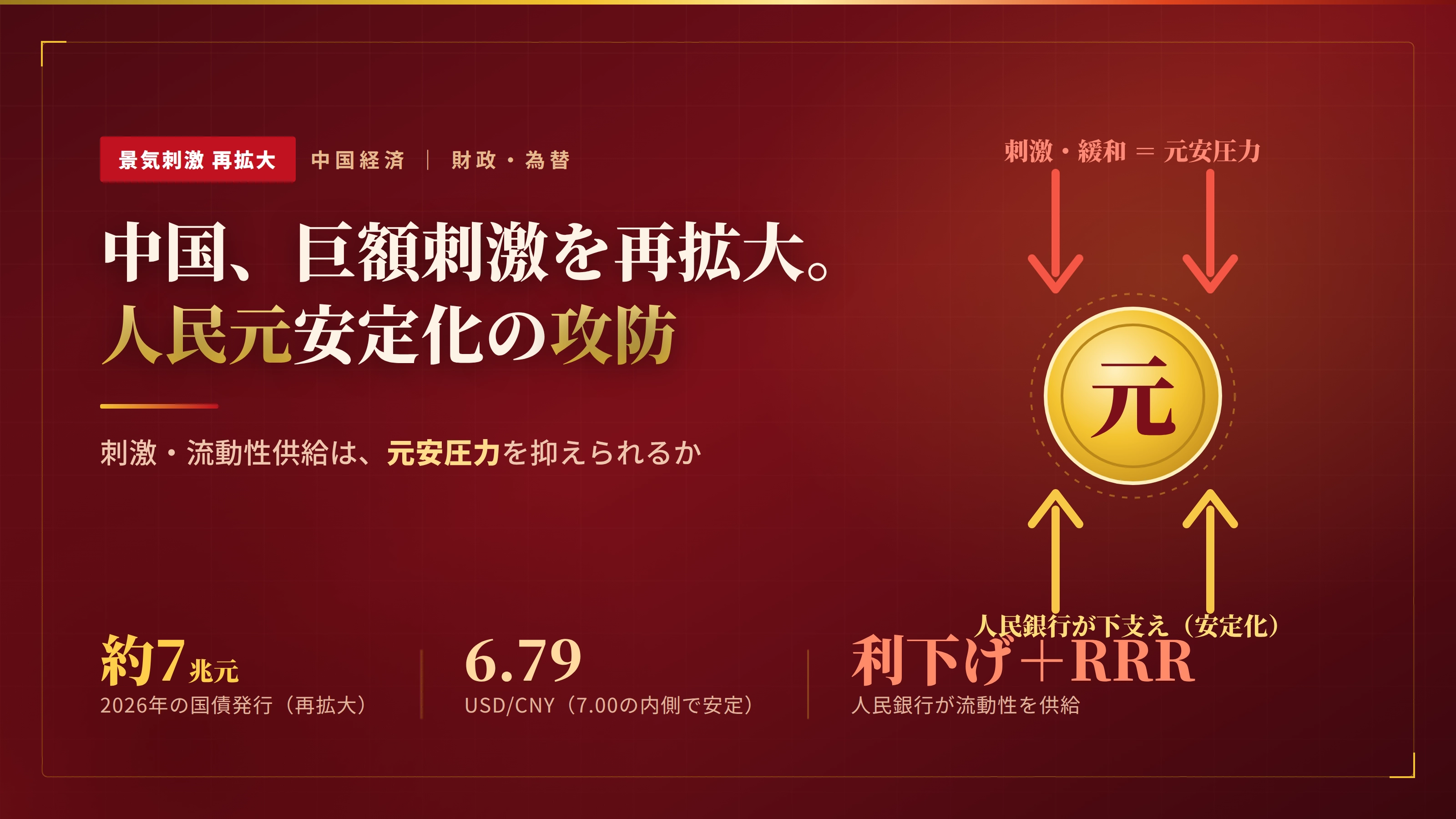
China's "economic stimulus package expansion" and the battle to stabilize the yuan
The Battle Over China’s “Reexpanded Stimulus Package” and the Renminbi Stabilization — A Beginner-Friendly Explanation
In One Line About This Topic
China is once again expanding its stimulus package to prop up a slowing economy, massively increasing government spending and issuing large amounts of government bonds, with the central bank also ready to provide liquidity (monetary easing). However, such stimulus and easing also tend toput pressure on the yuan to weaken. Therefore, the government and central bank are also pursuing “stability” to prevent the yuan from slipping too far,as part of an ongoing tug-of-war between accelerator (stimulus) and brakes (defending the yuan)— this tug-of-war is the central focus right now.
Premise: Why are “Stimulus” and a Weak Renminbi a Set?
To stimulate the economy, the basic approach is to spend a lot of money (fiscal) and to lower interest rates to make borrowing cheaper (monetary ease). But lowering rates tends to reduce the attractiveness of the currency (the yuan), making it easier to sell,leading to a weaker yuan. In other words,the more aggressively you press the accelerator for the economy, the more likely you are to see the currency weaken. Hence China pays attention to balancing both sides.
What’s Happening, Part 1 — Fiscal Stimulus “Reexpanded”
First, fiscal policy (the government’s money). In 2026,government bond issuance is expected to total about 7 trillion yuan. Looking at the breakdown, ultra-long-term special bonds areexpected to rise from about 1.3 trillion yuan (2025) to about 2 trillion yuan (2026), and local governments’ special bonds will alsoincrease from about 4.4 trillion yuan to about 5 trillion yuan.
There are two main uses.“Both heavy”=for important national strategies and security (urban redevelopment, etc.),“Both new”=subsidies for appliance replacements and equipment upgrades,directly boosting consumption and investment. In short, it’s the idea of “the government spending to create demand.”
What’s Happening, Part 2 — Central Bank’s “Liquidity Provision”
Next is the financial side (central bank money). The People’s Bank of China (PBOC) iscutting rates and lowering the reserve requirement ratio (RRR)to make money circulate more easily (provide liquidity). The RRR is the share of deposits banks must keep with the central bank; lowering it allows banks to lend more, sending more money into the economy. This supports the economy but alsocreates downward pressure on the yuan.
The Focal Point: Can Stimulus and Liquidity Supply Contain the Yuan’s Downward Pressure?
This is the main question. In short,for now, the yuan has remained relatively “stable”. The yuan/US dollar (USD/CNY) stands atabout 6.79 by the end of July 2026. It remains at a level inside the psychologically watched threshold of **“1 USD = 7.00 yuan”**, and has not collapsed significantly.
The key lies in China’s unique **“managed floating exchange rate regime”**. Each morning the PBOC announces a daily reference rate (the “fixing”),to prevent the yuan from moving outside a certain range and daily controls are exercised. Even as stimulus and easing push the yuan toward depreciation, this reference rate setting, among other measures, acts tosupport (stabilize) the currency. Additionally, a somewhat softer dollar recently has provided tailwinds for the yuan.
But vigilance is needed.The more aggressive the stimulus and easing, the more the yuan’s underlying strength to weaken persists. Depending on U.S. interest rates, economic conditions, and trade frictions, the pressure can flare up again, making authorities’ defense more challenging. The tug-of-war of “pressing the accelerator while holding the currency’s brake” will continue.
Important Cautions to Not Overlook
First, thequality of stimulus. If the money spent doesn’t translate into sustainable growth (raising consumption or pushing structural reforms), the effect is likely temporary. Second,debt expansion. If government debt increases through more bond issuance, it can become a future burden. Third,the double-edged sword of yuan depreciation. A weaker yuan can boost exports, but it also risks capital outflows (money fleeing abroad) and imported inflation, so excessive weakness should be avoided.
A Beginner’s Guide to Reading This
What matters is to view the two aspects—stimulus (accelerator) and currency defense (brakes)—simultaneously. China is the world’s second-largest economy, and its stimulus measures and yuan movements ripple through world stocks, commodities, and currencies. Being mindful of both the positive side (China’s money boosting global demand) and the cautionary side (yuan depreciation affecting other emerging-market currencies) helps news become a multi-dimensional picture.
From an investment perspective, Chinese-related assets move significantly with policy, soyou should assess the seriousness and sustainability of policy and avoid placing bets in one direction too heavily. Diversification is important.
Tip: China’s currency is not “left to the market” but is “managed.” So the yuan’s moves reflect not only the economy but also the authorities’ intentions.
In Summary
China’s reexpanded stimulus package (about 7 trillion yuan in government bonds and liquidity provision through rate cuts and RRR reductions) is a powerful accelerator to support the economy. In response to the associated yuan depreciation pressure, the authorities continue to stabilize using the managed regime and daily reference rates. The yuan is relatively stable inside the 7.00 mark (around 6.79) at present, but the stronger the stimulus, the more latent depreciation pressure remains.The tug-of-war between “stimulus” and “currency defense”is something to watch calmly from both factual and authorities’ intent perspectives.
Note: This article provides a general explanation based on publicly available reporting. Figures and circumstances may change over time. It does not constitute investment advice. Please make investment decisions on your own judgment and responsibility.
This article is a general explanation based on public reporting (Bruegel, China Banking News, Tradingpedia, ING, etc.). Figures and circumstances may change in the future. Please make your own investment decisions.