

Is it good news yet the market falls? The real reason the market moves is that it was "priced in"
Even though it's good news, the market falls? The real reason the market moves is "what was priced in"
In the FX market,
"The market has already priced it in."
" reacts only modestly because it was as expected."
These are the kinds of news you often see.
However,
"Why doesn’t the market rise even though the news is good?"
"Why does it sometimes rise when the news is bad?"
Have you ever wondered about that?
In fact, what moves the market is not only the "outcome."
What the market really pays attention to is how the outcome compared to expectationsisevaluated
For example, suppose the U.S. policy rate is raised by 0.25%.
At first glance, this seems supportive of USD buying, but if most market participants had anticipated a rate hike weeks beforehand, that information may already be reflected in the market.
This situation is "priced in."
In other words, unless there is a new surprise on the release day, a large USD rally is unlikely.
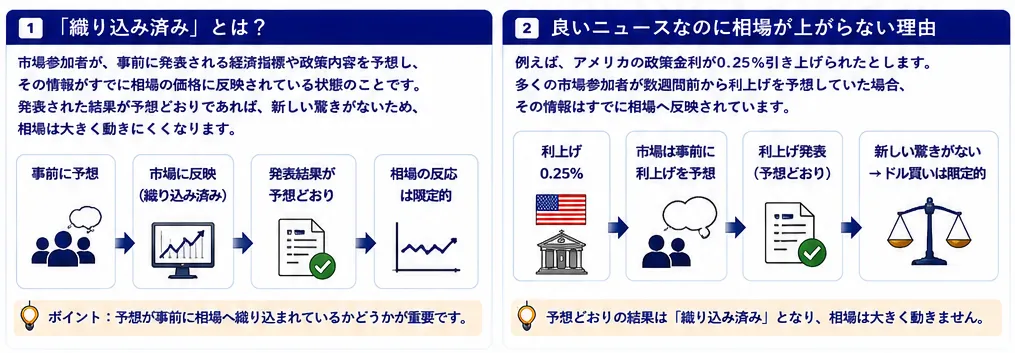
Conversely, what if markets had anticipated a rate hike, but a hold was announced?
The market’s disappointment could trigger a rapid USD sell-off.
The same applies to economic indicators.
For example, if employment data strongly surpasses expectations, the USD may rise.
However, even better-than-expected results can lead to USD selling if the market had anticipated even stronger numbers.
News-only explanations can be hard to understand, but when you focus on the gap between expectations and reality, you’ll find more of these moments make sense.
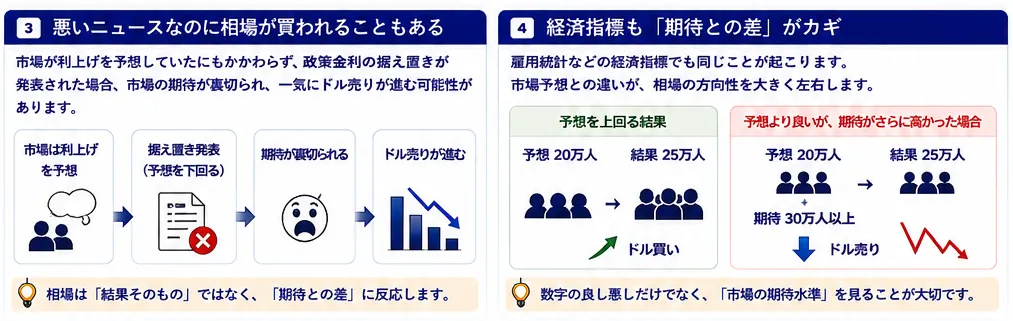
Professional traders don’t just look at the numbers released; they analyze market expectations, pre-positions, and investor sentiment as well.
Therefore, they rarely rely solely on headlines to make trading decisions.
In the current USD/JPY market, for example, many factors such as the Fed and BOJ monetary policy, inflation, and employment data are continually debated over "how much is already priced in."
That is why differences from market expectations become a key driver of market moves.
In fundamental analysis, simply thinking "buy because good news" or "sell because bad news" is not sufficient.
It is important to consider what the market was expecting, whether that expectation was exceeded or missed.
In the future, when looking at economic indicators and policy rate news, also pay attention to "what were the market expectations" and "was it already priced in."
Just adopting that perspective can significantly change how you view news and how you view the market.
Today, investors around the world are predicting the next market while discerning not only the results but also the "gap against expectations."
★ Our URL:https://www.gogojungle.co.jp/users/186761?via=indicators_detai