
[Special Issue] Reading the Foreign Exchange Intervention — Who Decides, What the Bank of Japan Does, and What the Market Reads
This article was posted as a special issue that can be read repeatedly. It is a special reformatted edition that re-edits about six years of accumulated material, totaling roughly 65,000 characters (the size of one light novel) and 39 images.
At the end of July, the market suspected Japan’sforeign exchange interventionand the view broadened to an orderly intervention coordination between the United States and Japan. However, the mere fact that prices moved sharply does not reveal who, with what funds, bought or sold what.
As I investigated, I found that foreign exchange intervention is not a matter settled by a single order. What the government regards as a loss, who makes the decision, how far the central bank handles the operations, and what clues the market uses to infer the truth—one must understand the whole system as an interconnected mechanism.
Between the time when observers began to widen their view of interventions and when I began writing this article, I did not go from scratch to write this. From about 1,250 market articles written over the past six years, I extracted passages related to foreign exchange intervention, monetary policy, political judgments, currency issuance, and impacts on businesses and households, and stitched them together to fit this case. On top of that, I updated outdated perceptions, reorganized the structure, and performed fresh checks against primary sources with new additions.
Therefore this article is not a compilation of old articles nor a single-breaking速報 focused only on the recent price moves. It is a consolidation that re-edits six years of observations using the summer 2026 intervention observations as a case study.
From my experience in an advertising agency, I have a habit of looking not only at the words published but also at who sees those words, when they are shown, and what is deliberately left unsaid. Government viewpoints and reporting should be read not only for the content of the text but also for how publishing it prompted readers to act.
However, the core of this article is not to guess the truth of the latest interventions. Using the summer 2026 events as a case study, this work aims to be a definitive guide to understanding foreign exchange intervention as a unified mechanism—from political decisions that determine interventions, to the authorities with funds, to the central bank handling practicalities, and to the price movements occurring in the market.
And one more takeaway I’d like you to keep: the habit of separating facts from inferences. In this article, the main descriptions are divided into four parts.
- [Verifiable facts]:Things that can be confirmed from official materials and primary sources
- [Media and market readings]:What the market has currently priced in based on multiple reports and price moves
- [Author’s inferences]:The article’s view built on verified materials
- [Unverified]:Possibilities that require waiting for later materials
The “author’s inferences” shown in this article are reader-friendly conjectures that sit between facts in ordinary news or explanatory articles. They are not to be dismissed; they are separated from the facts to help readers verify what causal relationships led to each conclusion and what discoveries would warrant updating these views.
Rather than labeling every paragraph, only put small labels on places where facts and inferences are easily confused. This is not to push conclusions, but to allow readers to update their judgments themselves.
Foreign exchange intervention is not Japan’s Bank of Japan unilaterally buying yen.
What you can learn from this article
- Who ultimately decides on foreign exchange intervention
- What the Ministry of Finance and the Bank of Japan actually share or divide
- Why a yen depreciation becomes a political issue for the government
- How the independence of the Bank of Japan and government pressure are reconciled
- What the market read between the lines in the “structural shock”
- How to distinguish between a standalone intervention, a “rate check,” and coordinated intervention, and other forms
- The meaning of reports that the United States sold euros rather than dollars as the yen weakened
- Conditions under which intervention effects persist into the following days and conditions under which the yen rebound is temporary
- Procedures and primary sources to use in the next intervention observation
What this feature includes
The main body is composed of an “easy-to-understand summary in 5 minutes,” eight parts in total with 29 sections, and an appendix with materials.
In addition to explanations of the制度, we read the rapid yen surge in summer 2026, the Bank of Japan meetings, the骨太 policy, government approval ratings, currency strength and weakness, IMM positions, and the US–Japan coordination observations in the same timeline.IMM Position, and more.
Diagrams are included at least one per part, and for lengthy explanations we add helpful one-point explanations and actual data figures. Rather than fixing the number of pages in advance, they are placed where needed to recall the content of the text.
- Sudden changes after July 30 and the misalignment with the official publication period
- The entire flow from political judgments to market orders
- Roles of government, the Ministry of Finance, and the Bank of Japan
- Unequal benefits and burdens of a yen depreciation
- 骨太政策From draft in 2026 to the final version
- Differences among standalone intervention, rate checks,coordinated intervention
- The meaning of reports that the US sold euros rather than dollars
- One trade sent three messages to the US, Japan, and Europe
- Conditions under which intervention effects remain and disappear
- From the rise of the Takatsu administration to intervention: statements, approval ratings,USD/JPYtimeline
There is no need to read it all at once. We provide a quick way to grasp the overall picture and a way to understand the mechanism step by step, with the option to return to the needed sections for the next intervention observation.
How to use this feature
You do not need to read this feature from start to finish in one go.
If you want to understand the overall picture first, go to the “5-minute summary.” If you want to understand how foreign exchange intervention works, read from the roles of the government, the Ministry of Finance, and the Bank of Japan in order.
When an intervention observation appears, you can return to the necessary chapters from the “checklist” in the Appendix. It is organized more as a reference you would open many times than as a single article to read.
Where to start reading is divided into four according to purpose.
- Capture the initial response in 5 minutes:The opening “5-minute summary”
- Understand the system:Part III “Who decides on foreign exchange intervention”
- Verify the intervention observations:Parts I, VI, VII
- Later, check the answers:Appendix checklist and conditions to revise hypotheses, glossary and primary sources
At the beginning of each part, we place a sentence to carry forward. On a smartphone, read by section and use the table of contents to return when you reopen.
Table of Contents
5-Minute Summary
Part I: What happened this time
- Officially, what remains unconfirmed
- Right after the monthly deadline passed
- The significance of the overlap between the BOJ meeting and the intervention observation
Part II: Why is a yen depreciation a political issue
- Who benefits from a weaker yen and who bears the burden
- Structure of Japan’s small and medium-sized enterprises andcost pass-through
- What a weaker yen means for the government and its “political loss””
Part III: Who decides on foreign exchange intervention
- The decision-maker is not the BOJ but the Finance Minister
- Practical division of labor among the Ministry of Finance, the BOJ, and financial institutions
- From actual ordersto settlement
Part IV: BOJ independence and government pressure
- Monetary policy and intervention are separate decisions
- What the government can tell the BOJ and what it cannot command
- How markets absorbed statements from the Takatsuki administration
Part V: When does the Takatsuki administration become the one pressed into yen depreciation
- What was visible first in “major opinions” about the distance between government and BOJ
- Markets read the骨太原案 as policy intent
- From those who profit from yen depreciation to those who are chased by it
Part VI: Distinguishing standalone intervention from US–Japan coordination
- Intervention, rate checks, and endorsements are not the same
- Meaning when the US would use real ammunition
- Evidence that can be called “US–Japan coordinated intervention”
Part VII: How to read reports that “the US sold euros, not dollars”
- What the market bought was the information of US participation
- What matters is not only what was bought
- The information shown and the information not spoken officially
Part VIII: Does intervention work
- Interventions that change prices vs. interventions that break positions
- What IMM positions reveal and what they don’t
- Conditions under which effects persist or disappear
- Was this intervention successful
Appendix
- Checklist for the next intervention observation
- Conditions to revise hypotheses
Supplement
- Glossary
- Primary sources and verification
This recent yen surge is not important only because it moved greatly.
The Ministry of Finance’s monthly tally published on July 31 covers June 29 to July 29 and shows intervention at zero. Meanwhile, the sharp changes that suggested intervention occurred after July 30, beyond that tally period.
In other words, the “zero” on July 31 does not negate the intervention after July 30. Consequently, immediately after the most recent monthly publication, the BOJ meeting and the yen rally overlapped during a period that could not be confirmed by that monthly report.
If you do not understand this timing mismatch, stories like “there was no intervention,” “the BOJ intervened,” and “the US–Japan coordination happened” may mix together as if they were the same news.
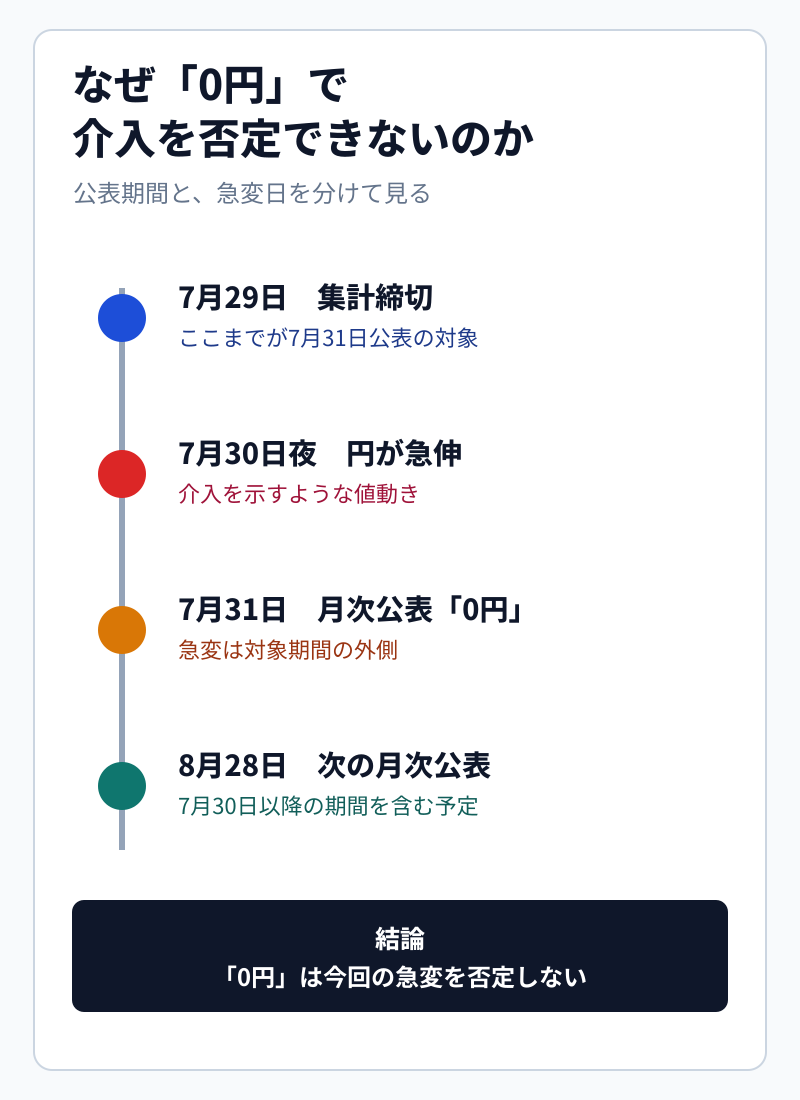
One-line conclusion:The latest zero from the most recent publication cannot by itself negate intervention after July 30.
From here on, using the recent price movement as a case study, this article will break down foreign exchange intervention from political judgment to market practice.