

[Technical Report] A Complete Causal Design of Subtraction to Prevent Backtest Drift — Logic Case for Reducing the Phantom 9.33x and Rebuilding into a Single Built Structure
This manuscript is a technical report from the perspective of a Process Design Engineer, sharing the reality of "reconstruction" in EA development.
Reconstruction is not always a task to inflate numbers. Even if it means suppressing apparent leverage, it is also a crucial process design to reshape architecture that can withstand real capital deployment and brutal forward testing.
The initial complex version showed an illusion of compounding by 9.33x. Meanwhile, the pared-down simple version shows 6.90x. Yet we, without hesitation, adopt the simple version for production.
There is only one reason. When comparing with the same data, same period, and the same strict accounting standards, the higher figure collapses under the waves of live capital and forward testing, while only the lower figure survives in the actual operating environment.
The target data is USDJPY M1. 4,949,507 bars after canonical cleansing (Nov 2012–May 2026 / excluding noise such as Saturdays and timestamp collisions). The validation period spans 2016–2025 (10 years), and the spread is ruthlessly deducted from all trades at 0.6 pip in real values.
1. Core Logic — Only capturing the market mechanism of “Squeeze and Volume Surge”
At the starting point of design, there is no idea of predicting the price direction and relying on it.
“When the range is compressed to its limit (squeeze) and a surge in volume occurs at that moment (surge), we follow the direction in which energy bursts”. This is a perspective that captures only the physical point from compression to release.
Specifically, when the most recent 12 bars’ range width shrinks extremely to the 30th percentile of the past 480 bars and volume reaches the 80th percentile surge threshold, a trigger is pulled in the breakout direction. This is run in parallel on three timeframes with different clocks—H1, M30, and H2 (2-hour bars)—asynchronously to prevent the entire system from dying if one timescale’s advantage depletes.
This perspective is grounded in solid market mechanisms of volatility contraction and volume, and is a very sensible approach. However, the problem lay in how to implement and structure this pure logic.
2. Diagnosis — An evaluation that exposes the 9.33x illusion and backtest holes
The initially built complex logic looked astonishingly impressive.
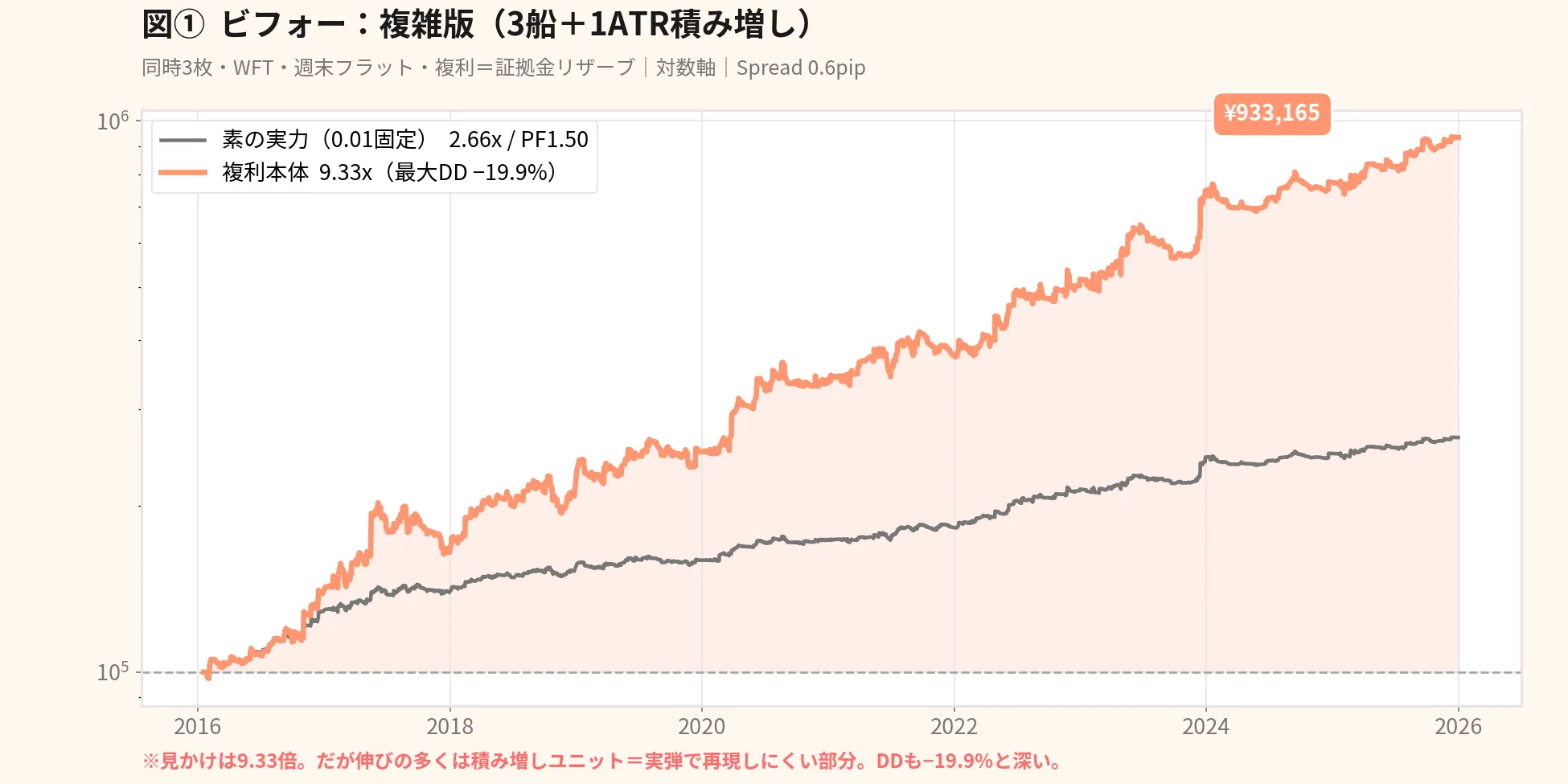
[▲ Figure ①: Before (Complex Version) image ▲]
Compounding to 9.33x, 2.66x in raw capability, and a profit factor of 1.50. At first glance, it seems flawless with a rising rightward trend. However, the beautiful line drawn by backtests does not guarantee survivability in a live account at all.
Here, the system is subjected to the following evaluation criteria in a thorough manner.
Feasibility (order fill reproducibility in a live environment)
The complex version’s performance source is the “pyramiding by 1 ATR each time.” In backtests, if the price touches the limit order even by a millimeter, it fills beautifully. But in live capital, the market easily jumps over limit orders, and market orders often slip badly. About half of the complex version’s profits relied on “on-paper pyramiding gains” that cannot be realized in real capital.
Robustness (elimination of overfitting)
More movable parts mean the system is more prone to break in production. Complex interactions that grab waiting orders amid competition for limited margin create critical gaps between testing and reality. Illusions of fills that only hold in testing evaporate as soon as forward testing begins.
Dependence on large numbers (risk)
The complex version’s maximum drawdown is −19.9%. The win rate sits at 41.3%, and the assets rely on a handful of “miraculous pyramiding trades.” A logic whose profits cannot be fully explained by a complete causal chain is inherently guilty.
【Diagnosis Result】: Core logic survives. However, the architecture is too heavy.
What must be purged is not the perspective but the “pyramiding” mechanism that makes the system cumbersome. We must subtract.
3. Reconstruction — Thorough subtraction to a single-position, fully causal build
From here, reconstruction means thorough pruning.
Three ships running in parallel, the squeeze-and-surge decision logic, Walk Forward Testing (WFT), a symmetric trend filter, and a weekend flatting mechanism — the core of these systems remains untouched.
What changed is only one thing.Completely abolish the pyramiding mechanism and fix each ship’s position so that it always holds only one position (one position equals one lot).
This eliminates competition for position slots and the theoretical favorable fills that exist only on paper at the structural level. Since each ship operates independently with a single position, the system’s overall complexity is reduced, and the backtest and live behavior link in a very straightforward way.
Instead of stacking up a black box, we dismantle it to make causality transparent. This is the essence of process design.