
Can忙しい会社員でもFXで勝負できますか?「2時間だけトレード」の時間帯固定術
If you are a company employee and can only spend 2 hours a day on FX, can you make it work?
Yes, you can.
However, there isn't a single answer like “let's do it from 9 PM to 11 PM.” Even if you say “employee,” people come home late, are morning people, or only have free time during lunch breaks, so life patterns vary.
What matters is not forcing yourself to fit a fixed correct answer, but identifying where you actually have 2 hours you can use and choosing a style that fits those 2 hours.
From here, I will explain how to choose the time slot and how to choose the style, with multiple options for each.
Introduction
“Even if told to do it from 9 PM, I can’t come home then due to overtime.”
“I’m a morning person, so nights are honestly tough.”
“I only have one hour free during lunch.”
Articles that ignore these voices and say “everyone should push through with two hours at night” are honestly not very helpful. What actually works is not fixing the time of day itself, but applying the idea of fixed time to your own life.
Why fixing the time itself is effective
There is one number you should know as a premise.
In a study analyzing 66,465 U.S. individual investors, Barber & Odean (2000) found that the annual return of the group with the most trades was 11.4%, while the market average was 17.9%. The more you trade, the more you tend to lose.
This trend has been consistently confirmed in subsequent studies. Regulators report that 74% to 89% of retail FX traders end up with losses.
The reason is simple in mechanism.
In prospect theory, losses are psychologically painful to about 2.5 times the amount of gains of the same size. This pain creates the impulse to “make up for it,” leading to the next unfounded move (revenge trading).
Having the charts open all day means you are exposed to this impulse all day long.
In other words, the effect comes from “it’s night, that’s why it works” or from “it’s because you segment time.” If you keep this discipline, you can choose among several time-slot options, as long as you do not look outside the separated time unless you are under drawdown.
Where is your 2 hours?
Within your daily life, which of the following is closest to your situation?
1) You have a free window around 9 PM to 11 PM after you get home.
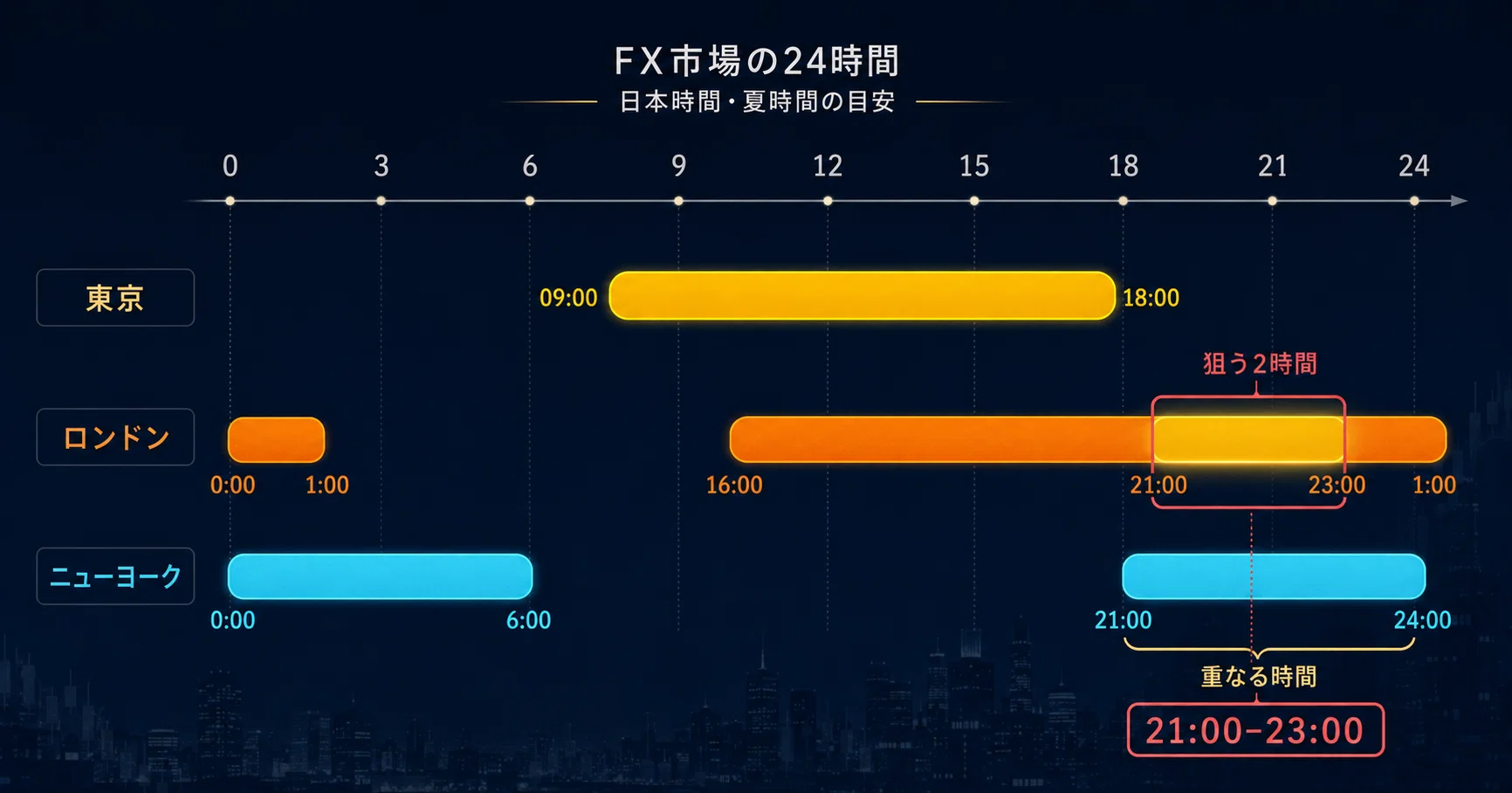
This is the overlap between the London and New York sessions, and about 70% of daily volume concentrates in these 3 hours. In JST, roughly 9 PM to 1 AM (varies by daylight saving). For most office workers, this is the best fit.
2) You come home even later or you perform better late at night.
Even shifting to 11 PM to 1 AM, or 12 AM to 2 AM, still fits within the London-New York overlap.
There is no need to force it to be 9 PM.
3) You are an early riser and cannot use the night.
In this case, you need to target a different time slot. The volume isn’t as high as at night, but between 8 AM and around 10 AM when the Tokyo market opens, currency pairs involving the yen tend to move, and you can allocate 1–2 hours before work.
4) You only have about an hour free during lunch.
To be honest, this is the time with the least price movement during the day.
However, with later discussed “watching on a higher time frame” and “alert-based” methods, the light movement isn’t as fatal.
You don’t have to pick just one slot; you can use different slots on weekdays (night) and weekends (morning). The important thing is to decide “today’s slot” before you open the screen.

What to do in those 2 hours: 6 styles
Once the time slot is decided, next comes the content. Even within the same 2 hours, depending on your day’s focus and market conditions, different approaches fit better. Here are six commonly used styles, with concrete how-tos and honest weaknesses explained.