

Translate the provided HTML to English, keep the HTML format, and ensure decoding is applied before translation. Do not use Markdown code blocks or introduce line breaks. Original: 何をやっても勝てない人へ。本当に効いた逆転の一手 Translated (in the same HTML format, with deco
Introduction
"In the demo I can win, but in real life I can't."
"When my win rate is 70%, I keep winning, but one overly sweet position leads to a big loss."
"It's been four years of suffering. Honestly, I'm on the verge of despair because I can't win."
If this sounds familiar, this article was written for you.
I'll start with the conclusion first.
The reason you can't win isn't that your will is weak.
It's not that your method is bad.
In most cases,
the cause is simpler and located in a more specific place.
You are not in the minority
First, a numbers discussion.
In a recent survey (as of November 2025), about 61% of individual investors reported realizing profits.
A survey by the Financial Futures Trading Association also found that 60.3% had positive annual P/L, while 39.7% were negative (2022 data).
Some of you may have heard that "nine out of ten people lose in FX."
This is said to come from a study by French financial authorities conducted between 2009 and 2012, stating that about 89.4% incurred losses.
However, to be honest,
I cannot directly verify the original sources. The subjects were not in Japan, but overseas. Please treat overseas data as unconfirmed and for reference only.
Regardless of which numbers you believe, one thing is clear.
People who aren't winning are not alone in that.
And there is a striking commonality in the words of those who are losing.
Three loss patterns summarized into three
In nearly 20 years in this field, when I look at how people fail to win, they generally fall into one of the following three categories.
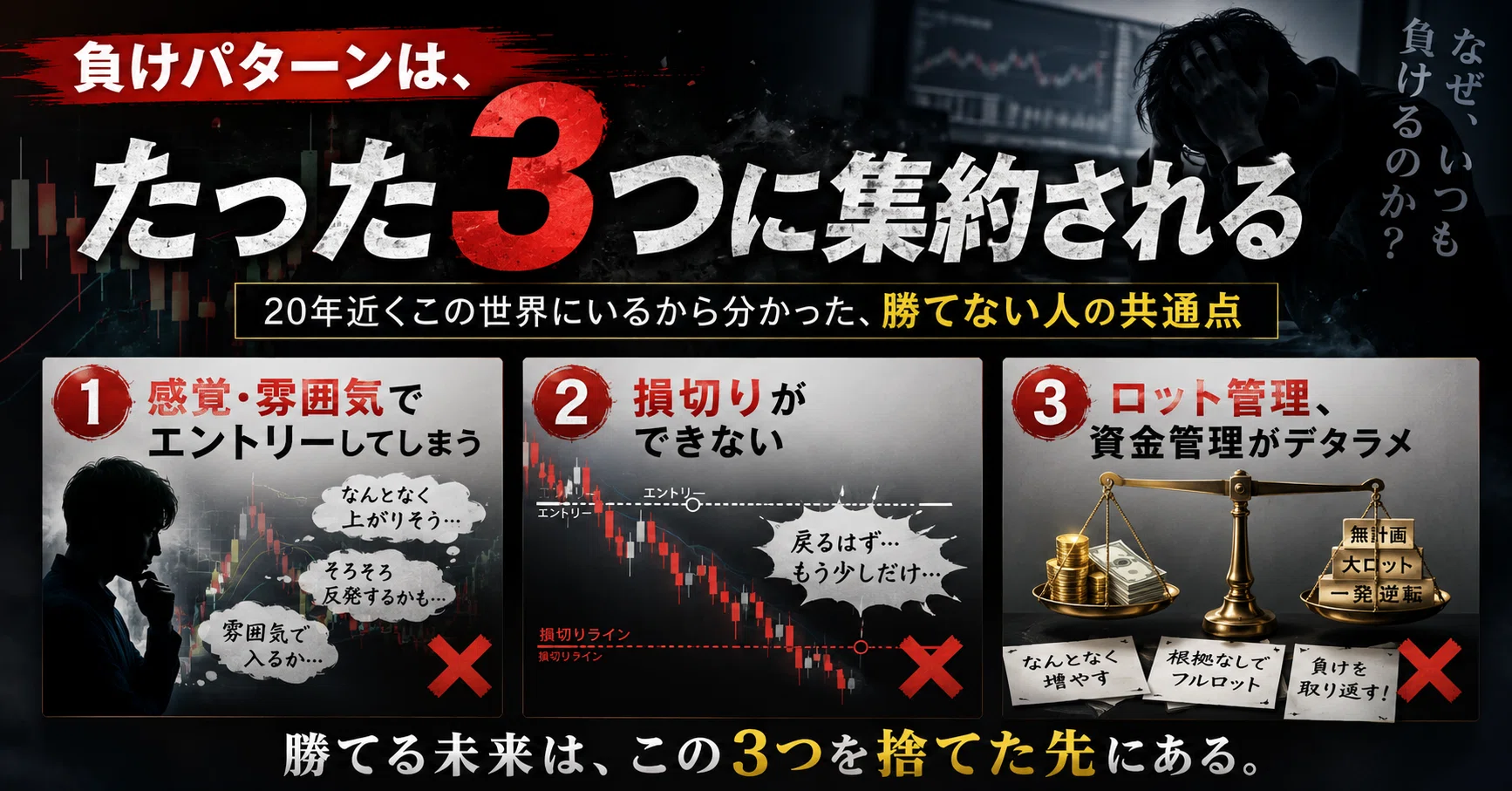
Entering based on gut feeling or ambiance
Unable to cut losses
Chaotic lot size and capital management
And, this is the most troublesome part: while there are periods of win on a weekly or monthly basis, a single big loss can wipe everything out. The so-called "gradual profits, sudden collapse."
After reading this far,
I think many of you feel, "If I can't follow the rules, it's because my mental state is weak."
But that is not true.
It isn't a matter of weak will
In one academic study, analyzing about 80,000 people and 28 million trades, it was found thatthe group incurring losses tends to "take profits quickly and hold losses for longer"— an irrational behavior.
When profits appear, you want to hand them back, and when there is a loss, you hold onto it hoping it will recover. This is exactly theProspect Theoryin behavioral economics.
The human brain is wired to react this way from birth.
In other words, your inability to cut losses and your pattern of “gradual profits, sudden collapse” aren’t due to personal weakness, but a common brain bias that all humans have.
Some of you may feel a bit lighter already.
However, understanding the cause alone won’t increase your account balance.
From here, I will share two concrete, counter-strategies that I have actually found effective.
One is a capital management design to prevent being wiped out after a loss. The other is a method using AI to identify your personal loss habit by name.