
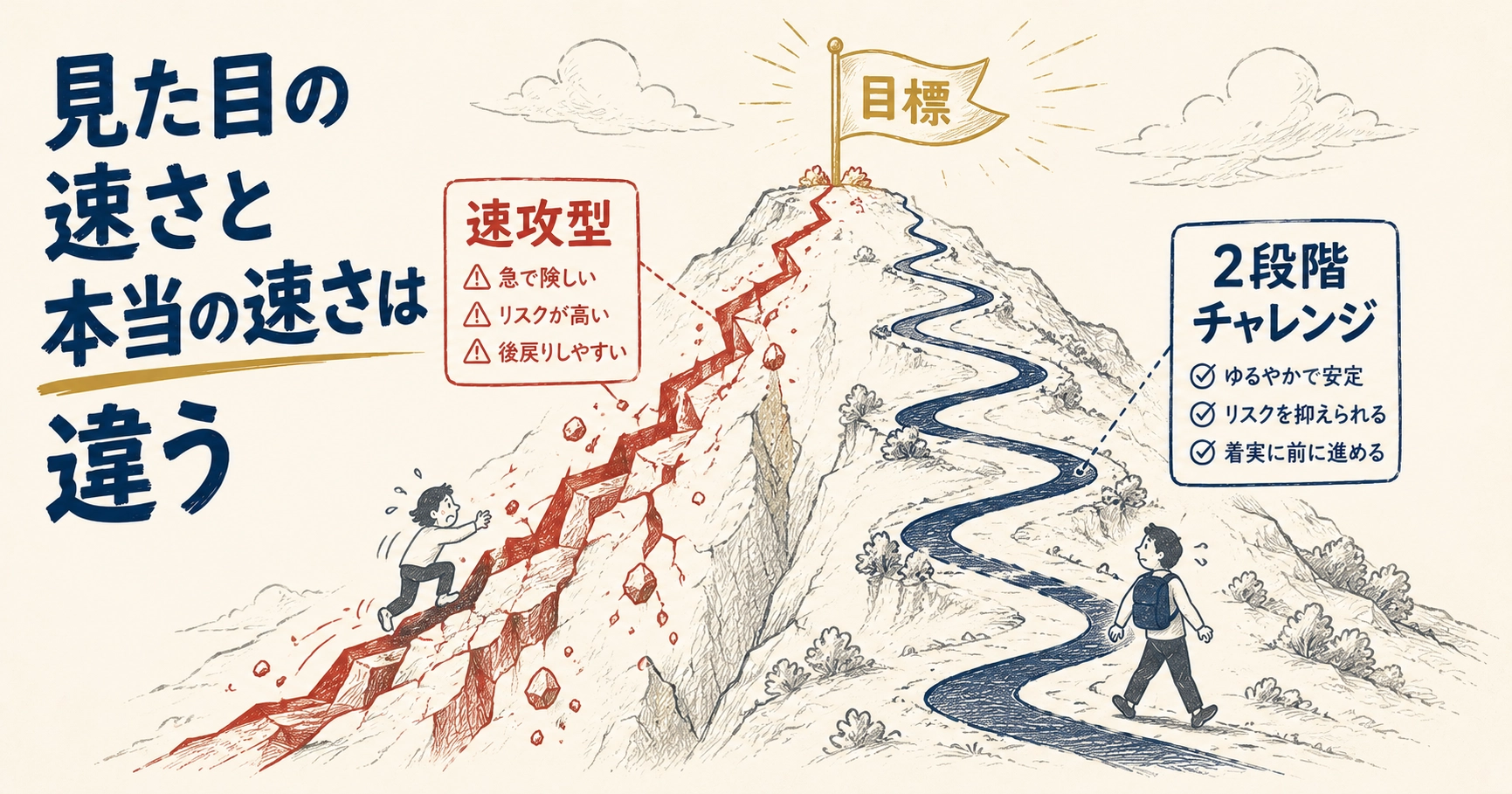
Which yields faster results: an aggressive plan or a two-stage challenge? — An unexpected conclusion revealed by the verification
When comparing prop firm plans, the one I struggled with most was this.“Finish in one stage, an instant win” vs. “Two-stage challenge”; which should I choose?Looking at the name alone, the instant-win type obviously seems faster to pass. I thought so at first too, kept choosing the instant-win type, and remarkably kept failing.
After recalculating calmly with verification data,an unexpected conclusion emerged. “The instant-win type is faster” is probably a misconception many people have. This article dismantles that illusion with numbers.
Forgive me for the delay in introducing myself,lulu.fx. I am a discretionary trader focused on GOLD (XAUUSD), currently challenging a prop firm (Company A). I have changed plans many times, tested them against verification data every time I failed, and the conclusion I arrived at is what I’m writing here.
I’ll state the conclusion first.The shortcut to passing is not an “ability to profit quickly,” but an “ability to protect profits to the end.”That is the most important part of this article.In prop trading, prioritizing profits can actually be the wrong path. I’ll elaborate this with numbers in the latter part.
? Table of contents
▼ Free Release
- The illusion that “finishing in one stage” seems faster
- “Protecting to the end” is actually the shortest path
▼ Continue to Read for the full release
The illusion that “finishing in one stage” seems faster
Prop firm plans broadly come in two types.The instant-win type that aims to reach the target in one stage, andthe two-stage challenge: clear Stage 1, then Stage 2, then pass. Judging by the name alone, of course the instant-win type looks faster to finish.
But the difference is not in speed but indesign difficulty. The instant-win type ends in one stage, but with a tight overall DD (cumulative drawdown) cap.In contrast, the two-stage challenge,increases the number of stages while the overall DD cap is more relaxed. This difference in DD caps completely changes how much risk you can take per trade.
When the DD cap changes, the risk% per trade changes too
As I wrote in the previous article,the risk percentage per trade is calculated from the overall DD cap. If the instant-win DD is about 3%, then dividing by about 8 straight losses and applying a safety factor,the risk per trade is about 0.28%. If the two-stage challenge DD is 10%, then with the same calculationabout 0.94%.The instant-win type has about three times less risk per trade.
What this means is thateven with the same method and same win rate, the instant-win type yields about three times less monthly profit growth (monthly return). Therefore, the time required to reach a target of +6% is not merely shorter; the apparent speed of “finishing in one stage” is a completely different matter from the rate at which profits accumulate.
“Protecting to the end” is actually the shortest path
From here is the most important part I want to convey in this article.To pass prop firm challenges fastest, it’s actually more effective to “never exit” than to “make a lot of profit”.
Why is that? Becauseif you get disqualified even once midway, all the accumulated progress gets reset. If you had accumulated 5%, and you exit, in your next challenge you start again from 0%. Even when calculating the same number of days to pass, passing on the first attempt versus failing 2–3 times makes the actual duration vastly different.
The instant-win type is prone to reset with one fall
The instant-win type has a very tight overall DD of 3%, so a minor downturn can quickly break the linewith a small drawdown, you can be knocked out in an instant. I personally tried the instant-win type many times and often reached “almost the target” only to be knocked out by a single day of drawdown just before the goal.
For example, even if you’ve safely accumulated +5%, a 1–2 day streak of losses can push the DD beyond 3%, and you’re eliminated instantly.Profits accumulated up to that point are no longer counted. And you start over again. Repeating this “accumulate, collapse, accumulate again” several times can stretch the actual total duration to six months to a year.
That ends the free portion of this article. From here on,I will numerically compare the actual duration until passing for the instant-win plan and the two-stage challenge via monthly simulation. And I will explainwhy not prioritizing profits becomes the shortest path, including the reasoning behind it.
From here (Read More) onward is published:
- Monthly simulation until passing for the instant-win plan(evidence that it takes 6–7 months)
- The two-stage challenge,ST1 and ST2 durations and total period(4–5 months)
- The typical missteps of someone who chose the instant-win plan by prioritizing profits.
- Why“protecting to the end is, as a result, the shortest path to profit”, the mathematics behind it
- Before choosing a plan,the one question you must ask yourself