
[Very Important] Before learning environment recognition and methods, decide the version of yourself when your predictions go wrong
Good evening!
I’m Masashi^^
From today, it’s August!
Five months remain until the end of the fiscal year! For those who haven’t done well up to now, it’s not too late.
Let’s calmly review the market from here.
Today, before studying the environment recognition and techniques, I’ll write what you should decide first.
It’s more dangerous to try to protect a wrong forecast than to have a forecast miss.
Before you lose in the market, you’re losing to yourself for trying to defend your forecast.
It may sound a bit harsh, but I’ve been in this state many times in the past (;'∀')
I thought it would rise, so I didn’t enter.
I thought it would fall, so I delayed cutting losses.
I redid the environment recognition and searched for the reason why my view was still correct.
What increased at that time wasn’t the material for judgment.
It was an excuse to defend the forecast.
? The first thing to decide isn’t the future
When you start trading, you first try to learn environment recognition.
Next, you look for entry methods and indicators.
Of course, studying is necessary.
But before that, there are things to decide.
What you will look at and where you will discard your thinking when your forecast is wrong.
If this isn’t decided, no matter how much knowledge you accumulate, you will use that knowledge to fit your forecast.
You’ll find reasons why it should rise, and you’ll find reasons why it should fall.
? Before thinking about the future, decide the conditions under which you will change your mind. Without this, environmental recognition tends to reinforce your forecast rather than confirm it.
⚠ The more knowledge you gain, the more you can defend your forecast
The more you study, the better your judgments become.
Usually, you’d think so, right?
But if you just accumulate knowledge without a criterion to drop a forecast, opposite things can happen.
Even if the price moves slightly in the opposite direction, you think, “the overall trend hasn’t changed yet.”
Even if it moves even more opposite, you think, “with another theory, this is where it reacts.”
As it approaches stop-loss, you think, “this indicator might bring it back.”
Not every piece of knowledge is wrong in itself.
The problem is that after you place an order, you only gather material to reassure yourself.
The more you study just to hit the mark, the less you can cut losses when it misses; that study becomes attachment, not a weapon.
❌ The moment a forecast is wrong, people protect themselves over facts
Forecasts you came up with gain a little attachment over time.
The more you analyze, the more you want it to be right because you thought so much.
Then you start protecting your own correctness, not the market facts.
• Widen the initial stop-loss position
• Add new grounds after the order
• Dismiss the opposite facts as “temporary”
• Confuse the drawdown with the correctness of your judgment
• Become unable to exit because you fear what happens after finishing
What you are defending here isn’t capital.
It’s the forecast you made.
? The market won’t blame those who miss forecast. It’s when you keep defending the same forecast after a miss that losses grow.
⚠ The forecast that once saved you destroys your next decision
The tendency to defend forecasts remains not only when you suffer a large loss.
It’s when you waited instead of closing when you should have, and it came back and saved you.
You widened the stop-loss.
You added other grounds after the order.
And when it finally returns, you feel your view wasn’t wrong.
But what you reproduced then isn’t a correct judgment.
Changing your decided action is a pattern that if you wait, you’ll be saved.
The next time you’re in the same state, the memory of being saved surfaces.
And you’ll again delay the stop-loss hoping it will return, the same as last time.
Just as one success doesn’t make a method correct, one saved time doesn’t justify breaking the rule.
We look at whether you could hold the action you decided when your forecast was correct or not, rather than whether you hit the forecast.
✅ Before environmental recognition, make three promises
What I think you should decide first isn’t a difficult analysis.
It’s a promise to yourself.
1. When facts arise that cause you to discard your current view
Decide the conditions for changing your mind before placing an order.
2. Do not widen the initial risk after the order
Don’t search for convenient stop-loss positions after the market moves against you.
3. If the expected moves don’t continue, end it even before the outcome is confirmed
Endurance until a stop loss is not the only rule.
Only when these three are decided do environment recognition and methods work as decision materials.
If you haven’t decided the exit first, you’ll be more confused the more you learn about the entrance.
? Forecasts and hypotheses look similar but are different
Here, some may wonder, “If you don’t forecast anything, how do you trade?”
I don’t place orders with no thought either.
I create scenarios from observable facts.
However, I don’t make the scenarios future promises.
Forecasts tend to be “should rise, so even if it moves opposite, wait.”
Hypotheses say, “under these conditions, consider it; if it falls apart, end it.”
Forecasts care about whether I was right.
Hypotheses care about whether the conditions still remain.
✔ It isn’t necessary to completely remove forecasts. It’s important to lower them to hypotheses that can always be discarded.
? Don’t turn stop-loss into your own defeat
The pain of stop-loss isn’t only because money is lost.
It feels like your forecast is being denied.
So you want to finish after it returns a little.
You want it to come back to break-even.
However, if the initial conditions you decided disappear, retreating isn’t a confirmed failure.
It’s an action to protect funds and the next judgment.
Conversely, just because you happened to get back and be saved doesn’t mean widening stop-loss was a good decision.
We review not whether it came back but whether you held the decided action.
? After ordering, do not add grounds
Before placing an order, everyone looks carefully.
The hard part is after you place it.
When you are in drawdown, your reason for watching changes.
You start watching not to confirm your judgment but to find reassuring material.
Therefore, I think it’s important not to add new grounds after the order.
Theories you didn’t consider before the order.
News you didn’t care about before the order.
Lines you hadn’t drawn before the order.
Do not add these as reasons to continue holding later on.
⚠ After the order, what you need is not material to strengthen the forecast, but confirmation that the initial conditions still remain.
Looking at charts for long doesn’t guarantee calmness.
You react to small ups and downs, expect favorable moves, and find reasons for the opposite moves.
If you are monitoring, decide in advance what to confirm and which facts to end with.
If you step away, don’t change your management method due to present anxiety.
? Don’t use AI signs in place of forecasts
The same applies when looking at AI or signal tools.
Because a sign appeared, the future is decided.
Because AI indicated it, it is more correct than your forecast.
If you think this way, you’ve simply replaced your forecast with the tool’s forecast.
A sign is not an order to place a trade.
It’s an entry point for verification.
What happened before that sign appeared?
Can you place the risk you’re willing to accept?
When conditions don’t match, can you pass?
If after trying, the movement doesn’t continue, can you end it?
Including these, only then does the tool support your judgment.
? With Golden Line Sniper AI, return to the order of judgment
The Golden Line Sniper AI isn’t meant to give you future answers.
It’s a tool to make it easier to find candidates and states to watch on the chart, and to return to what to check first.
The manual for discretionary judgment isn’t to memorize signs verbatim.
It’s to organize whether you skipped verification after viewing the display, whether there’s a reason to pass, and whether you can decide the initial risk.
In uncertain moments, you can ask the community questions.
Not just to hear the answers, but to put into words again, “where did the forecast change?”
What I want to reduce isn’t time to think. It’s the time spent hesitating to defend your forecast.
✅ I’d like this to be used by people like this
I’d like Golden Line Sniper AI to be used by people who are like this.
• They’ve learned environmental recognition and methods, but judgments change after the order
• When drawdown occurs, they end up looking for different grounds
• They want to use signs not as answers but as verification entry points
• They want to keep reasons for both taking and not taking actions
• They want to refine their judgment while separating the roles of discretionary and EA
Conversely, it may not fit someone who wants to order everything once a sign appears or wants someone else to decide their capital management.
Even with a tool, uncertain markets don’t become certain.
That’s why you should use it to have a sequence that returns to verification.
? Summary: Decide in advance how you will act when your forecast misses
Learning environment recognition and methods is important.
But if your own actions using that knowledge aren’t decided, the knowledge becomes material to defend a forecast.
What facts would cause you to discard your view?
Would you widen the initial risk after placing the order?
If the expected movement doesn’t continue, can you finish even before the result is confirmed?
Decide this first.
You don’t have to become someone who never misses forecast.
Instead, become someone who won’t break funds and judgments to defend a miss forecast.
Golden Line Sniper AI is to make finding candidates easier and to return to verification order more easily.
I hope you use it not as a replacement for forecasts but to distance yourself from forecasts.
Before the method, decide your response when the forecast misses. Only then can the learned knowledge become a real weapon.
On the product page, you can check discretionary support, the role of EA, included contents, and how to use it.
?Details of Golden Line Sniper AI are here
There is no guarantee that using it will yield profits or results.
Please make the final buy/sell decisions and fund management yourself.
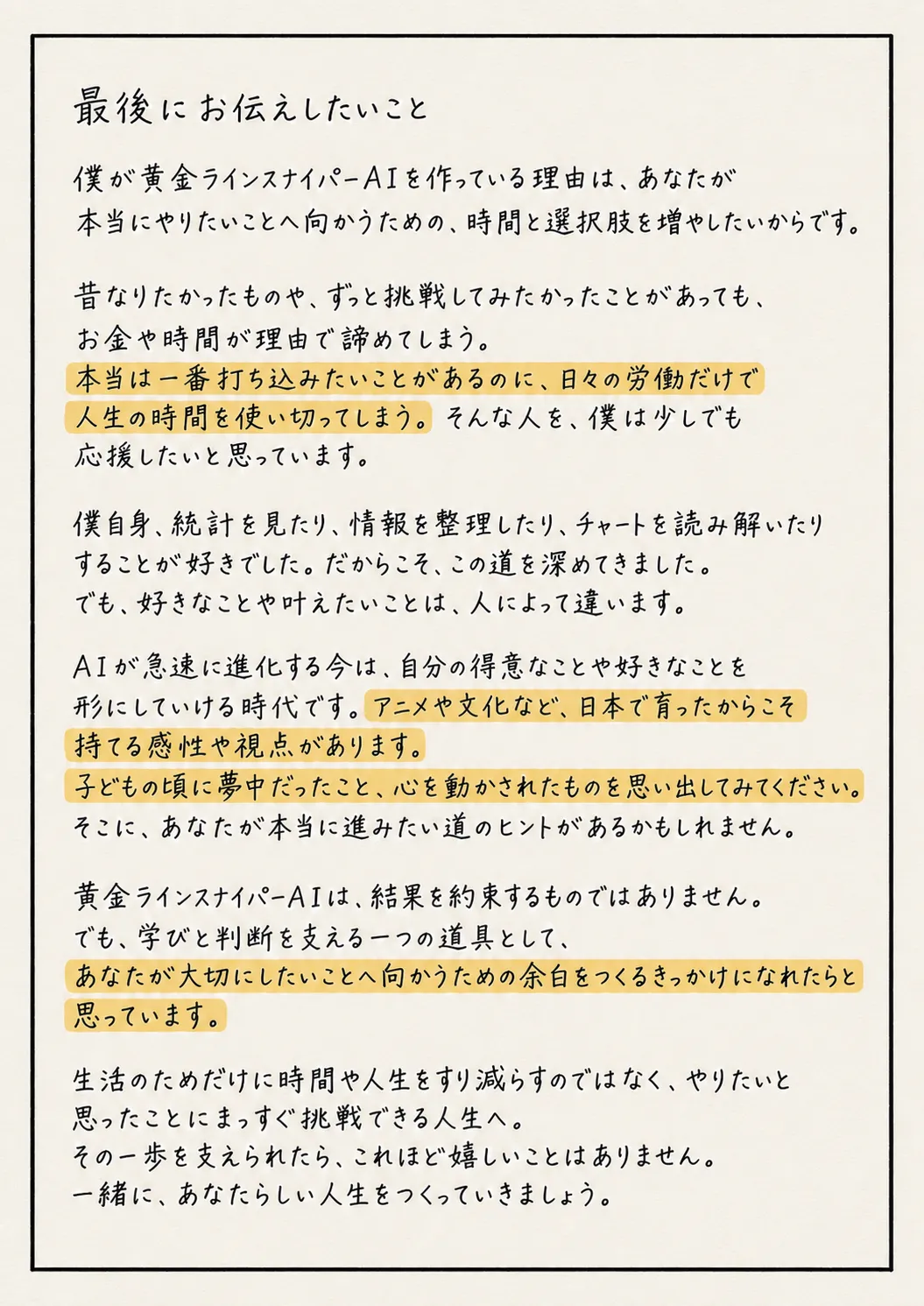
See you again!