
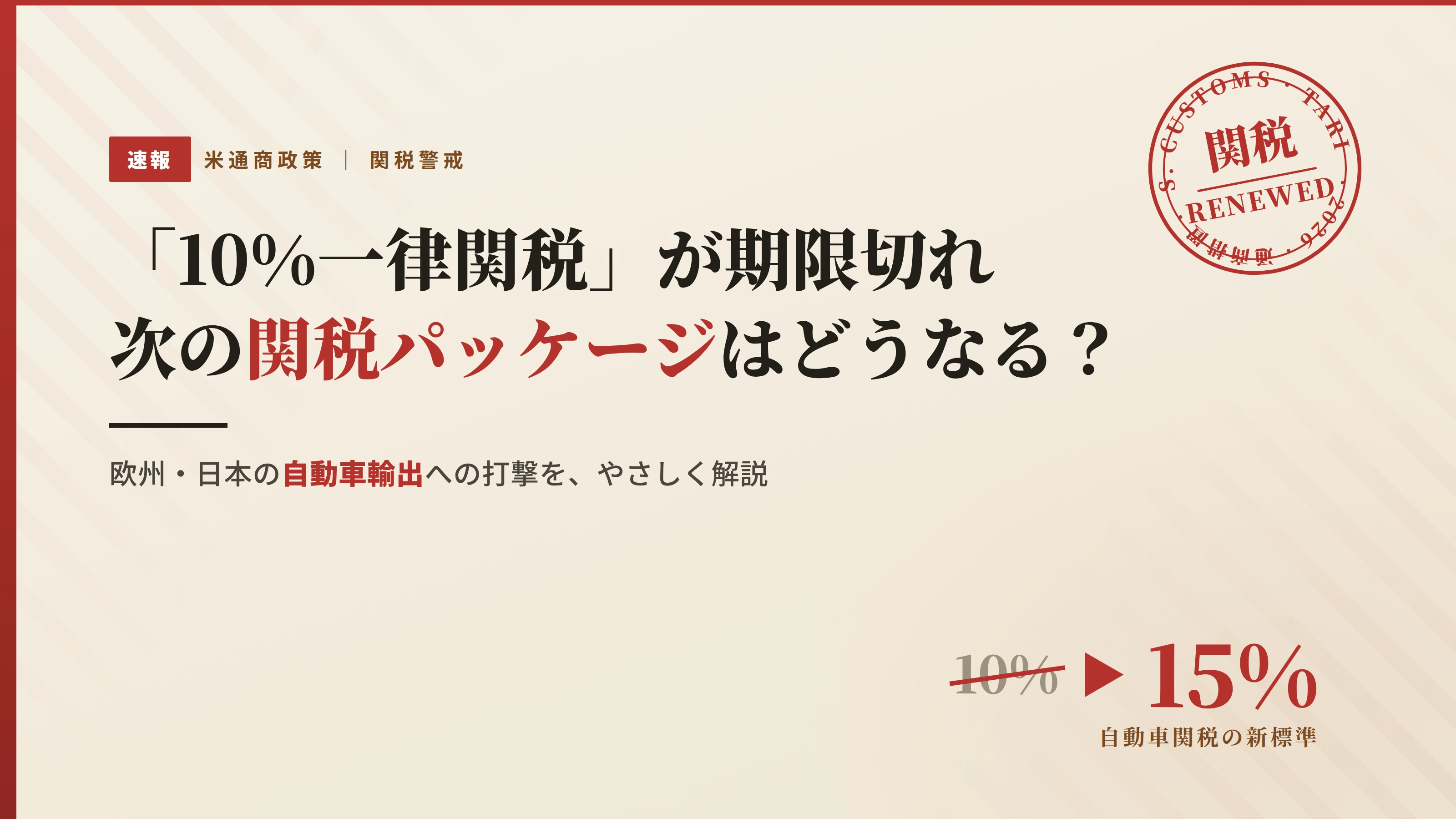
Trump: The deadline for the 10% uniform tariff has expired, and vigilance against new tariffs has begun
Trump's Expiration of the 10% Uniform Tariff and Caution Toward New Tariff Packages — A Gentle Beginner's Guide
In One Line About This Topic
President Trump had introduceda tariff of “uniform 10% on all imports” that expired on July 24, 2026and was replaced by a new tariff package that changes rates by country. This has major implications for global trade and automobile manufacturers in Europe and Japan, prompting market caution.
What is a Tariff, in the First Place?
A tariff isa tax on goods imported from abroad. When tariffs rise, prices of the country’s products increase domestically, making them harder to sell. In other words, tariffs represent a cost increase for exporting companies, i.e., headwinds.President Trump has used tariffs as a bargaining chip to protect American industry and pressure other countries to concede.
What Happened — From “Uniform 10%” to “Country-by-Country”
Until now,a uniform 10% tariff against all countriesexpired on July 24 when the legal deadline (about 150 days) passed. The new system introduced is a two-stage mechanism that sets rates by country.
Broadly speaking,14 countries at 10%(EU, United Kingdom, Canada, Mexico, Taiwan, etc.),46 countries at 12.5%(China, India, Japan, Korea, Vietnam, etc.).
The key point here isthe new tariff has no expiration and has a solid legal basis (Section 301 of the Trade Act) for being durable. Previously, the uniform tariff could be struck down by courts as temporary; the new approach ismore likely to endure— that is, it has shifted from a temporary measure to a norm.
Focus ①: What will the next tariff package look like?
The point isthat the tool has shifted from “uniform” to “country-specific negotiations”. The U.S. has begun to use tariffs as bargaining chips to elicit investment and market access from various countries.
For exampleJapan and Korea managed to cap the tariff ceiling at 15% through negotiations (Korea secured about $350 billion in U.S. investments in exchange, and Japan also secured a 15% ceiling through reciprocal talks). Meanwhile, Brazil has been subjected to a 25% tariff, illustrating wide disparities in treatment by country. Going forward, country-by-country bargaining will continue, and rate changes may occur, so beware.
Focus ②: What about the impact on European carmakers and exporters?
This is also highly relevant for Japanese investors. The U.S. and the EU have reached a tariff agreement,with an approximately 15% baseline tariff on imports from the EU. Notably, car tariffs have been unified at 15% (Japanese cars down from 25% to 15%, European cars likewise at 15%).
Opinions vary. “Positive” aspectsinclude that the previously feared 30% was avoided and uncertainty reduced. In fact, European stocks (Stoxx600) rose slightly after the announcement.“Concerned” aspectsinclude that even 15% is a substantial cost increase compared to free trade, which could squeeze profits for export-led European automakers (especially German manufacturers) and parts suppliers. Additionally,tariffs on steel and aluminum remain at 50%, and further duties above 15% on semiconductors and pharmaceuticals are being considered, leaving sparks of risk.
In short, the reality is that we have “avoided the worst, but cost pressures persist.”
A Beginner’s Guide to Reading It
What matters in tariff news is to look at three things together:① the level of the rate, ② whether it will be permanent, ③ which industries and countries are targeted. This time the essence is the structural change from “uniform to country-specific” and from “temporary to permanent,” which is more important than the numbers alone.
From an investment perspective, tariffs tend to be a headwind forexport-oriented industries (automobiles, machinery, etc.), while domestic production and domestic-demand-focused companies are relatively less affected.Diversification helps prepare for such policy risks.
Point: In tariff news, avoid judging only by whether the rate went up or down; read to see whether it will continue and who is targeted to see the underlying reality.
Summary
Trump’s tariffs have transformed from“a temporary measure of uniform 10%”into a permanent bargaining tool that varies by country. European and Japanese automakers avoided the worst-case 30% but must face the cost increase of 15%. Going forward, rates may move through continued country-by-country bargaining, and investors should consider the new normal of tariff permanency, especially for export-focused companies.
※This article is a general explanation based on public reporting. Figures and frameworks are as reported at the time and may change. This does not constitute investment advice. Please make investment decisions on your own judgment and responsibility.
This article is a general explanation based on public reporting (CNN, Reuters, various news outlets). Figures and frameworks may change in the future. Please make investment decisions at your own risk.