
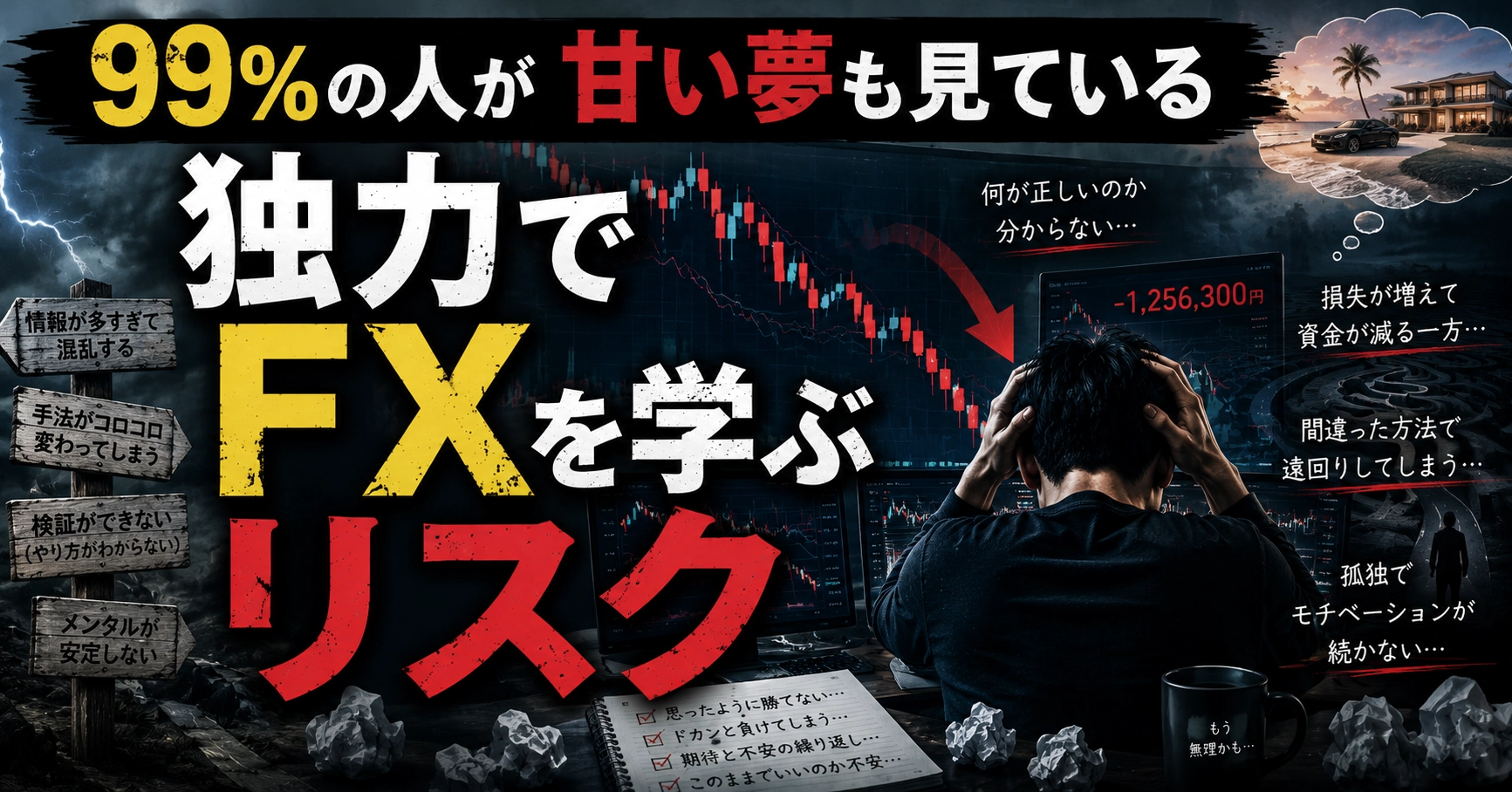
Why 89 Percent of Self-Taught FX Traders Lose Money, and the “Final Gap” That AI Alone Can’t Fill
Introduction
“I don’t even understand why I’m losing for this reason.”
“I’ve read all the books, all the online articles, and watched YouTube, but no matter how much I do, I can’t seem to win.”
“I want to ask someone. But I don’t even know whom to ask.”
If you are
recognizing one of these three situations, please read on.
I’ll give the conclusion first.
What you’re stumbling over now isn’t a matter of talent.
There’s a fundamental hole in the design of your learning process from the very start.
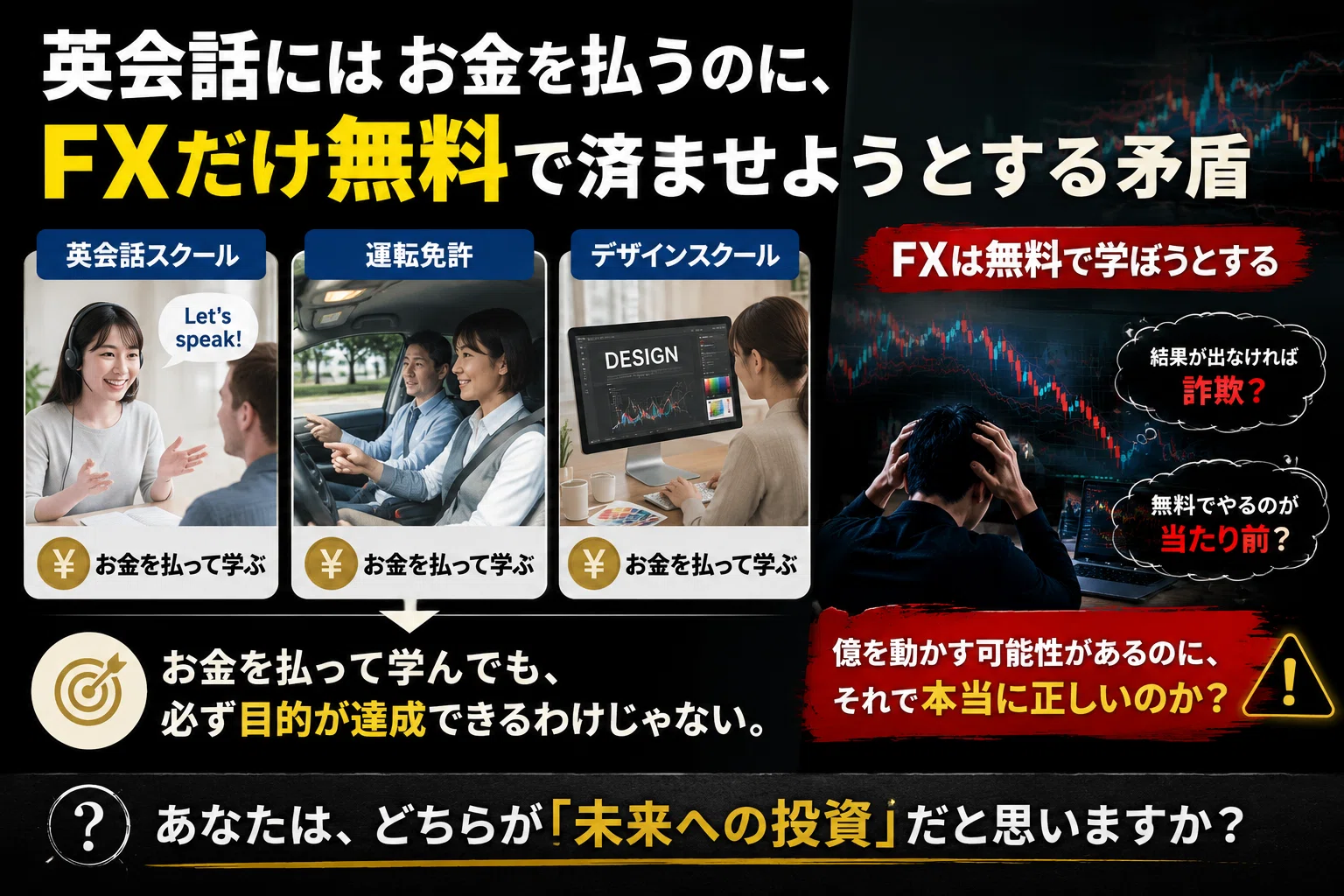
The contradiction of paying for English conversation but trying to do FX for free
People who want to learn English take classes or pay monthly fees for online English conversations. When getting a driver’s license, you pay tens of thousands of yen to the driving school.
Even so, there’s no guarantee you’ll be able to speak English after training, and getting a license doesn’t necessarily make you a good driver.
Still, people don’t question paying money to learn.
But what about FX?
It’s a world where, if you do well, your account balance can multiply many times, and if you’re unlucky, large sums of money can be at stake. More at stake than English or getting a license.
However, many people think this:
“If you’re not getting results, it’s a scam.”
“If there’s truly a method that makes money, someone would teach it for free.”
“I don’t want to spend money. I’ll learn for free.”
People don’t hesitate to spend tens of thousands of yen on English or a driver’s license, yet in FX, where money can exceed one’s annual income, they try to make it completely free.
I’ve traded for 20 years, and I’m astonished at how few people notice this contradiction.
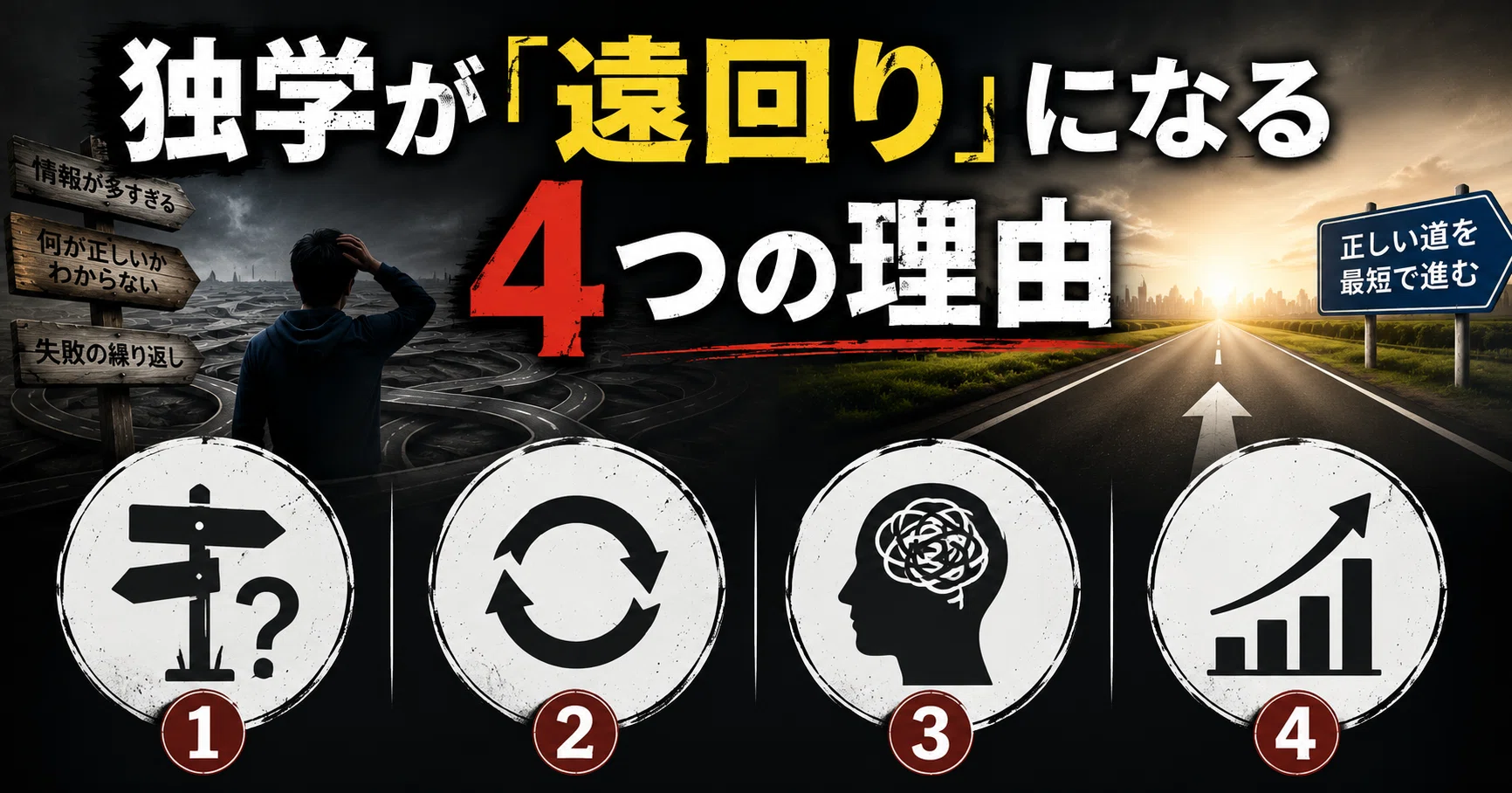
Four reasons self-learning becomes a “detour”
Nowadays, if you search the internet, most methods and theories are free. We live in an era where ICT, SMC, Dow Theory, and more are all accessible. It isn’t that there’s no information making self-study difficult.
The problem isn’t the amount of information but the four walls you’ll inevitably encounter while trying to use that information effectively.
① There’s no one you can ask when you want to
When you’re looking at a chart and wonder, “Is this a real FVG, or just a fake move?” there is no one on the spot to give you an answer in self-study. You have to solve it yourself, and you won’t have confirmation until the next day or even weeks later.
② You can’t notice your own misunderstandings
When you remain with a mistaken interpretation and feel you “understand,” the scariest part is you may not realize the mistake yourself. Mistakes discovered only after someone points them out are highly delayed in self-study.
③ Even if you lose in a trade, you can’t identify the cause
Was the entry bad, was the stop loss too early, or was the market structure entirely mistaken? A single losing trade contains many possible causes. Without a third party’s eye, you’ll keep losing in the same way without ever getting to the root cause.
④ Even if you’re learning wrongly, you can’t notice that either
Certification exams and entrance exams have fixed curricula and correct answers. FX doesn’t. The order of methods and the order of practice must be self-assembled. If the assembly is off and there’s no one to point it out, you won’t notice for months.
Many active traders say that self-learning requires accepting some detours. FX doesn’t have a fixed, established curriculum like professional exams do.
Reality of self-learning told by the numbers
I don’t want to finish on a gut feeling, so I’ll present numbers.
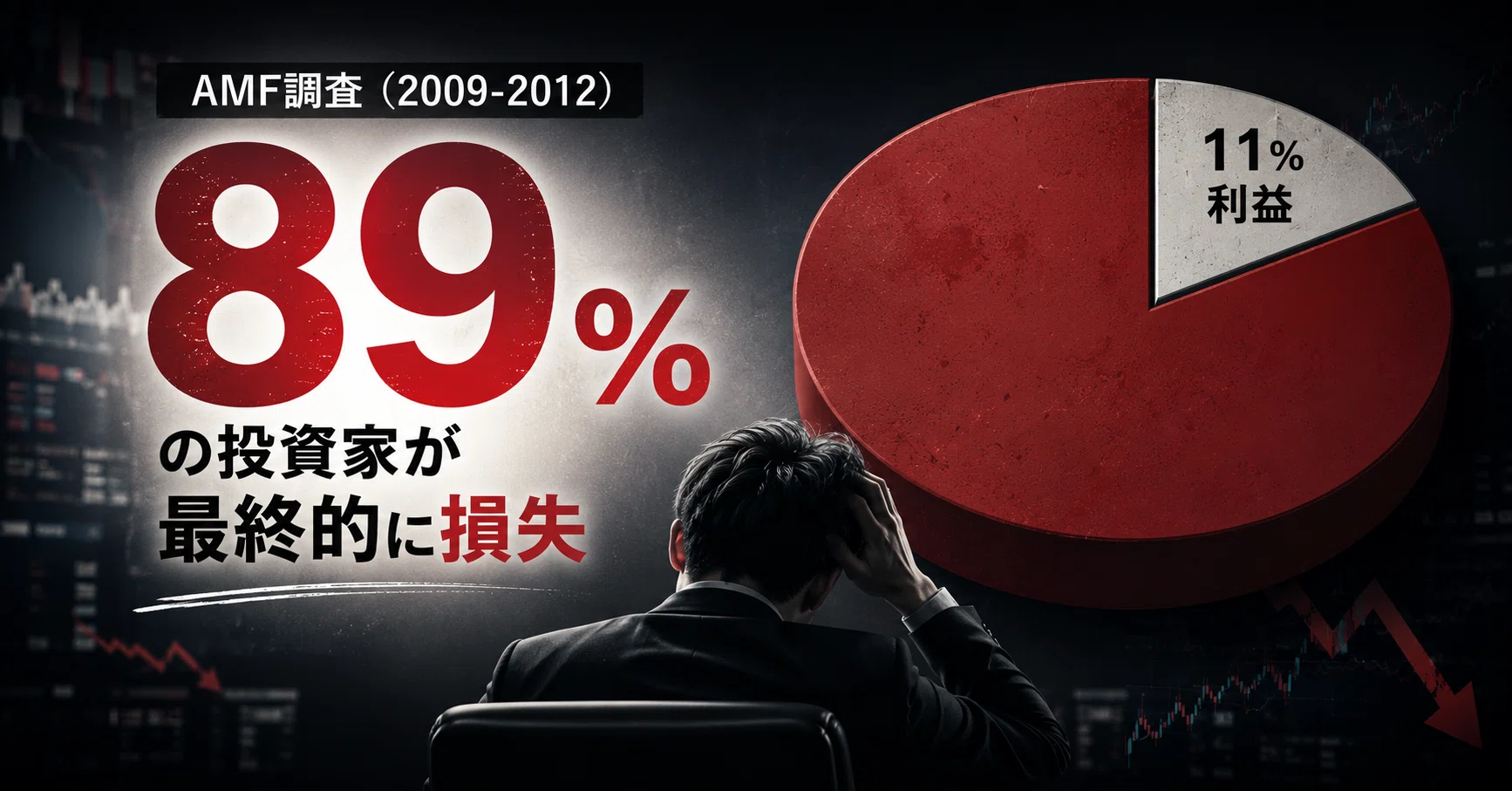
The AMF, the financial market regulator in France, analyzed actual client trading data from 2009 to 2012 and reported that 89 percent of investors ended up with losses. This number is officially cited in Japan’s Financial Futures Association Bulletin as well.
Over a four-year long span, regulators analyzed real data. While some people win temporarily, the longer you continue, the more the majority turn negative. That’s the reality.
On the other hand, a 2017 survey by Japan’s Financial Futures Association found that 60.3 percent of FX investors were profitable. You might think, “So six in ten win.” Honestly, this survey focuses on people who were still trading at the time. Those who lost money and left the market aren’t included in the 60.3 percent. It’s just survivors being counted as having a 60 percent win rate.
Furthermore, the average win rate for individual investors is about 40 percent.
Even with a high win rate, a single large loss can reduce capital.
Even with a 90 percent win rate, if the profit-to-loss ratio is unfavorable, you can still end up with a loss.
The idea that “if your win rate just goes up, you’ll win” is itself a common misconception among self-learners.

If you still insist on free, do at least these
After reading this far, you might still think,
“I want to learn without spending money.”
I won’t deny that feeling. Twenty years ago I thought the same.
However, if you’re going to go free, please absolutely do these two things:
Make AI your tutor above all others
If possible, have one or two traders as mentors
For item ①, you can start right away.
Whenever you’re unsure how to read a chart, want to articulate entry reasons, or want to review a losing trade, ask AI.
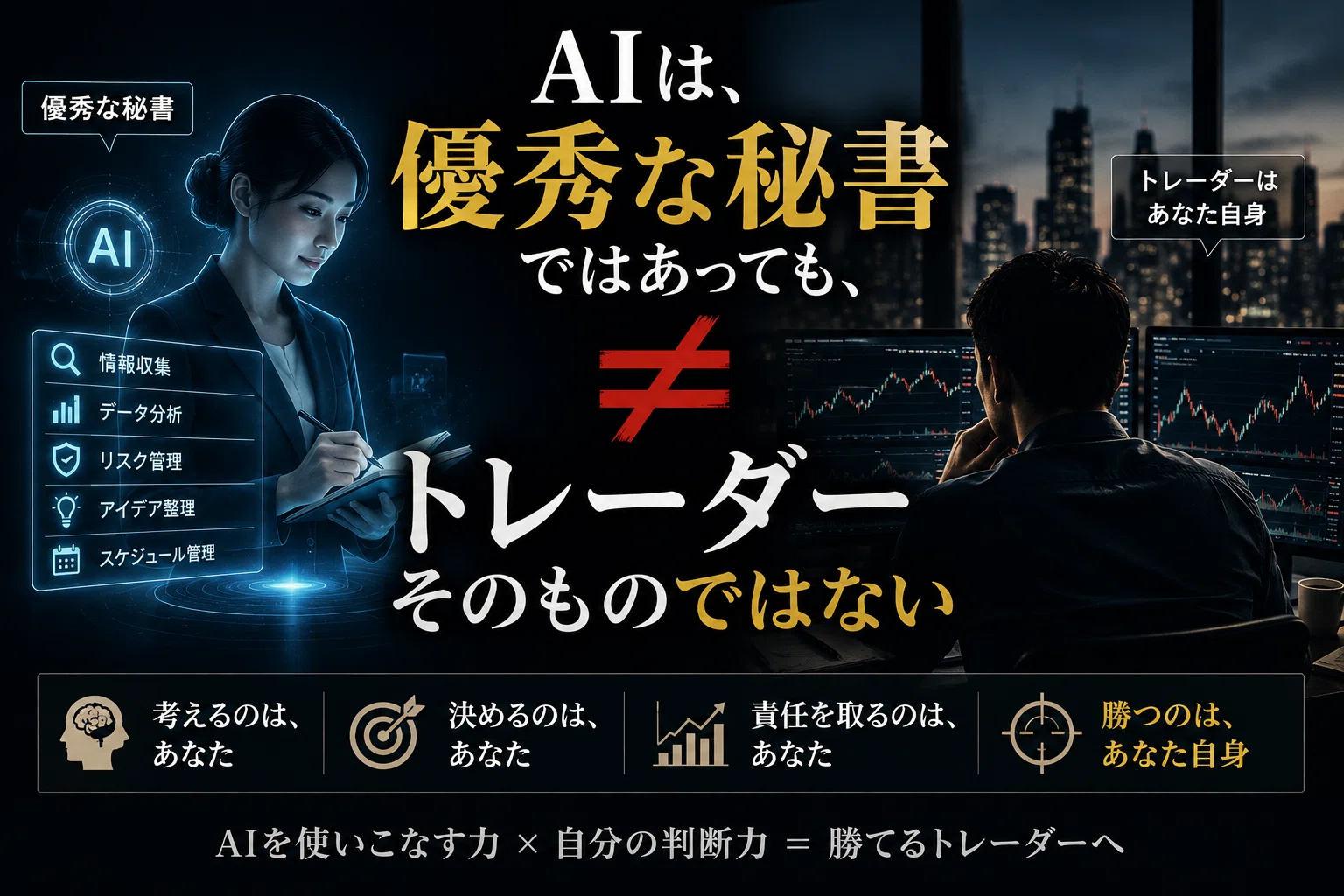
AI will be a 24/7 practice partner as a soundboard.
No matter how persistently you ask, it will tailor its answers to your level. It fills a large part of the self-study’s biggest weakness, the absence of someone to ask when you want to ask.
However,
one thing I want to be honest about here.
As of now,
even if you feed chart images to AI, you won’t always get the correct analysis back.
The rate of hallucinations in generative AI, meaning outputs that are factually incorrect, is said to remain about 8 percent even as improvements progress.
If you ask 100 times, about 8 times you’ll get incorrect answers mixed in.
Moreover, if you ask with incorrect premises,
the AI will continue to build plausible answers from those incorrect premises.
The same applies to chart image analysis.
Current AI can replicate some aspects of human visual judgment, but it has not yet reached the level of fully replacing a human pro trader’s eye.
As a practical aid, it’s sufficient, but for now the safest distance is to use it as a second opinion.
In other words, AI is a superb secretary, but not the trader itself. The final responsibility for judgment remains with you.
So how exactly should you use a mentor who is a person for option ②? What holes cannot be filled by AI alone? I’ll honestly discuss this from here on.