

Isn’t the most traded currency pair in the world the USD/JPY? Why is the euro-dollar the center of the market
Is the most traded currency pair in the world not USD/JPY? Why EUR/USD is at the heart of the market
When you start FX trading, many people first trade USD/JPY.
It's a currency pair familiar to Japanese traders and is frequently covered in the news, so it naturally attracts attention.
However, looking at the world as a whole, the most traded currency pair is **EUR/USD**.
“Why is EUR/USD the number one in the world?”
Have you ever wondered this?
The reason is that these are currencies from the world's largest economic areas: the United States and the Eurozone.
The US dollar is the most widely used benchmark currency for international settlements, trade, and investment.
Meanwhile, the euro is also used by many countries and companies as the world’s second most international currency.
In other words, these two currencies are central to the global economy.
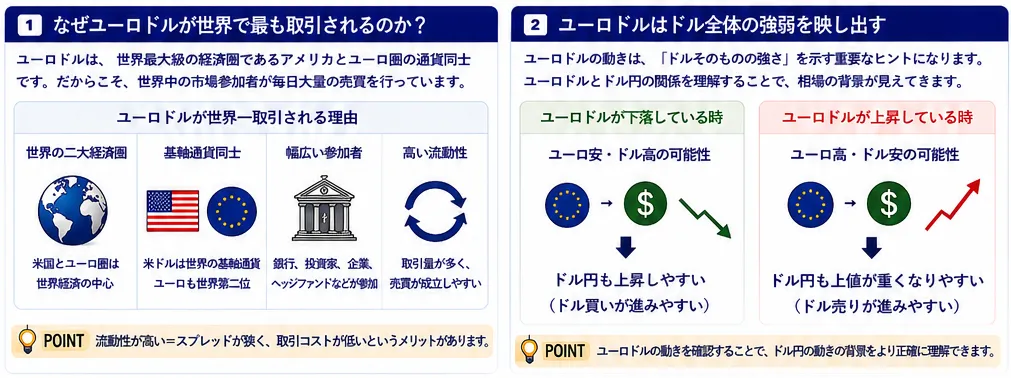
Therefore, banks, institutional investors, hedge funds, multinational corporations, and market participants around the world conduct large trades every day.
As a result, EUR/USD has become the most liquid currency pair in the world.
High liquidity means trades tend to execute smoothly and spreads tend to be relatively tight.
So, what kind of relationship does this EUR/USD have with USD/JPY?
In many cases, the movement of EUR/USD reflects the overall strength or weakness of the dollar.
For example, if EUR/USD is falling, it often means the euro is being sold and the dollar is being bought.
In such a case, USD/JPY can also see more dollar buying pressure.
Conversely, when EUR/USD is rising, the dollar may be selling, which can put downward pressure on USD/JPY as well.
Of course, USD/JPY can move on its own due to Japan-specific factors.
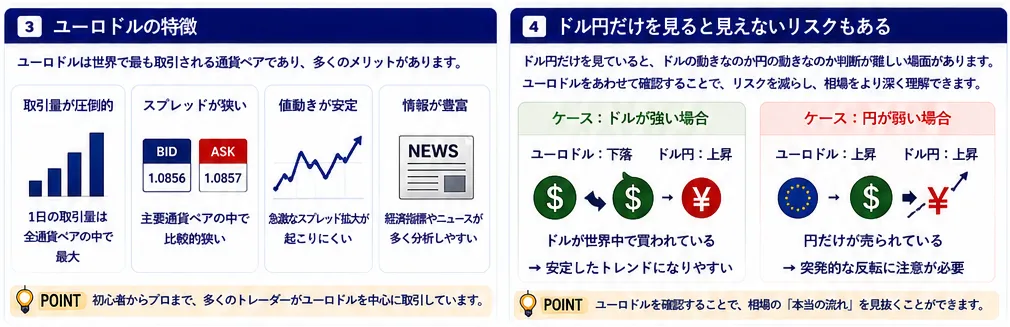
However, understanding the global dollar trend is greatly aided by EUR/USD as a very important clue.
Many professional traders monitor EUR/USD as well as USD/JPY to analyze the market.
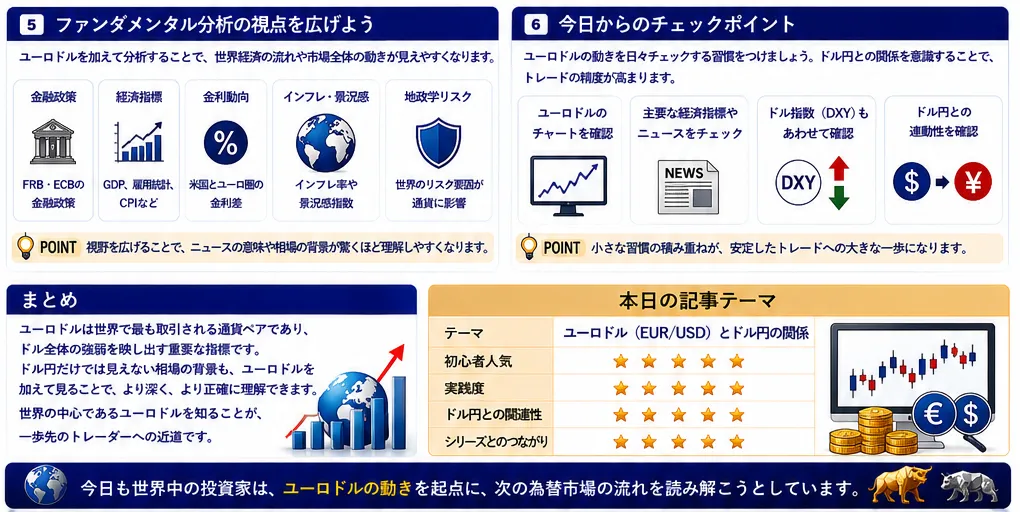
By looking beyond a single currency pair, you can see the overall market flow.
In fundamental analysis, it is important to have the perspective of “which markets are moving the world.”
Scenes that are invisible when looking only at USD/JPY become more three-dimensional when you add EUR/USD to the view.
In the future, when you hear phrases like “EUR/USD plunges” or “euro up, dollar down” in the news, consider how that might affect USD/JPY as well.
That habit will cultivate the ability to take a broad view of the market and lead to more accurate analysis.
Today, investors around the world are again trying to read the next trend in the foreign exchange market, starting from EUR/USD.
★Our URL:https://www.gogojungle.co.jp/users/186761?via=indicators_detail_users