

People who fly with gold are not dying by method but by lot
I have seen many people exit Gold (XAUUSD).
And most of them die at the same place.
It’s not a method. It’s the lot size.
Today, I’ll talk about this. It’s plain, but I think it’s the most important topic.
You can remember where to enter. But no one teaches you how much to risk
Whether it’s a signal tool, a method, or educational materials. Most things in the world tell you “where to enter.”
That’s important.
But that alone won’t keep you alive.
Even if your entry is correct, a wrong amount to risk can end you in one shot. Conversely, even if the entry is somewhat off, if your lot size is appropriate, you can survive.
Only those who survive can seize the next opportunity.
That’s why I think risk management (lot size) takes higher priority than entry.
The danger of Gold lies in its price range
Why is the lot size especially problematic with gold?
Price range.
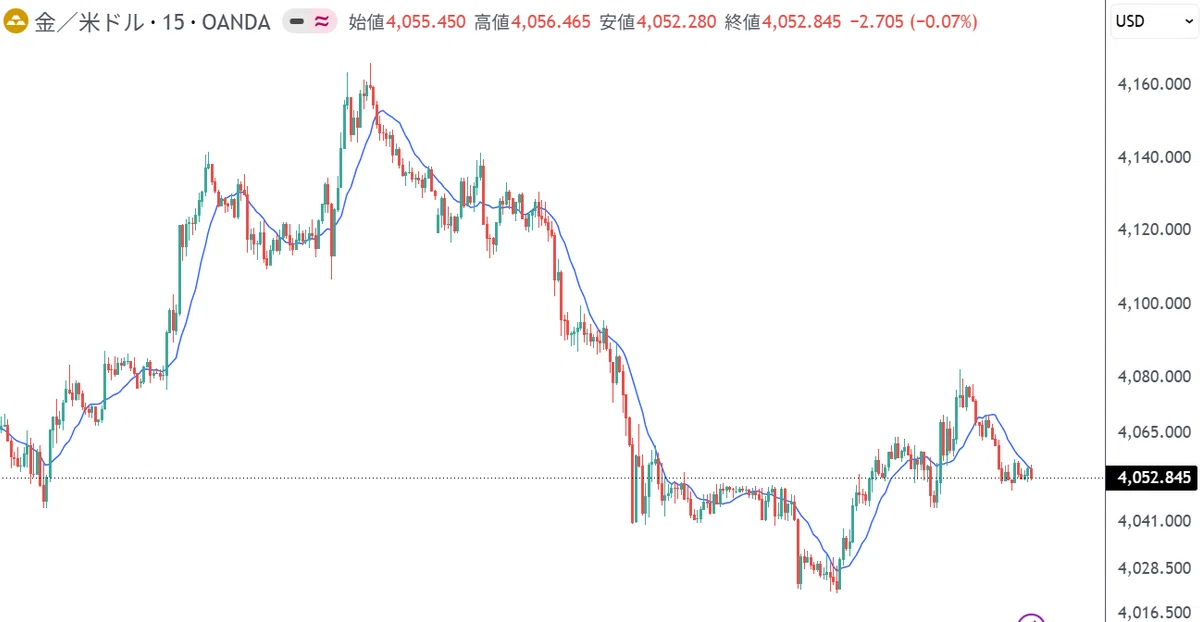
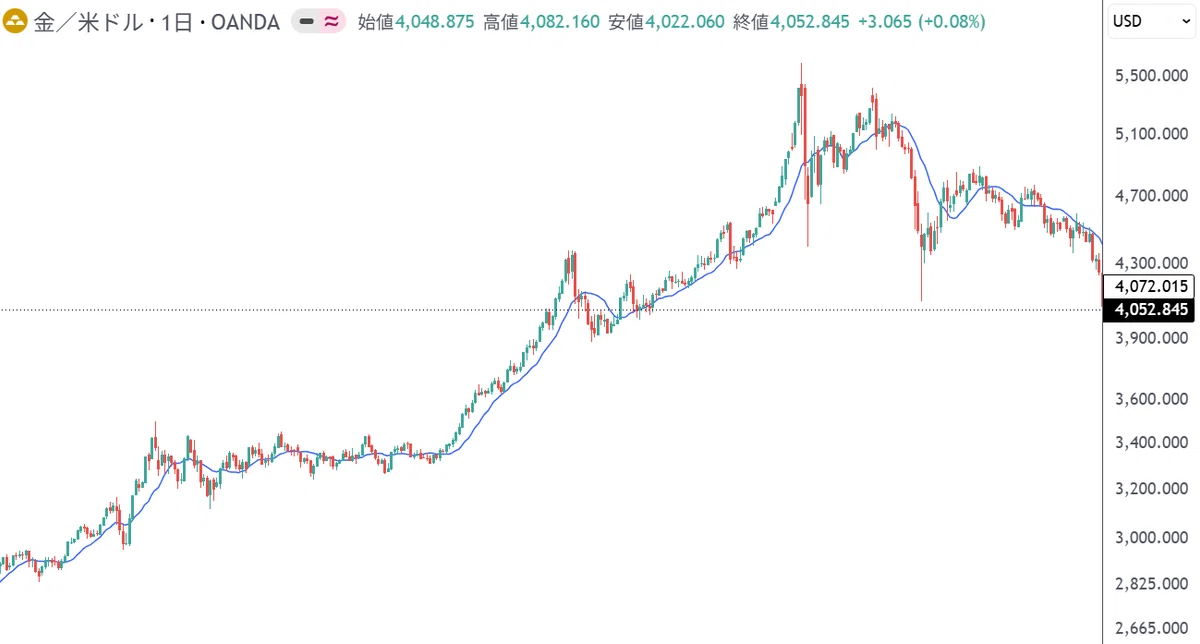
While USD/JPY moves 50–100 pips in a day, gold moves 50–100 dollars in a day at the current levels. If the market is volatile, it can exceed $200 in a week. If there are indicators or emergencies, it can swing within a day.
Let’s calculate concretely.
XAUUSD is 1 lot = 100 ounces. In other words, if the price moves by $1, you gain or lose $100 per lot.
With 0.15 lots, it’s $15 per $1 move. At 160 yen per dollar, that’s about 2,400 yen.
・-$10 against you → about 24,000 yen loss ・-$20 against you → about 48,000 yen loss ・-$50 against you → about 120,000 yen loss
With 200,000 yen in capital, a $20 move against you wipes out about 24% of your capital. A $50 move can erase about 60%.
Gold can move $20 in a day many times over.
“0.15 lots should be fine, right.”
That feeling is the most dangerous.
“Margin is sufficient” and “safety” are separate issues
This is another common misunderstanding.
In overseas high-leverage accounts, the required margin for 0.15 lots can be only a few ten-thousand yen. For 200,000 yen of capital, the utilization rate is a few percent.
Looking at the numbers, it seems generous.
But this only means you can open a position. It does not mean you can endure drawdown.
The capital to withstand drawdown comes from the remaining funds. A small margin cost and low risk are entirely separate issues.
・Margin utilization rate → an indicator of “whether you can open a position” ・Risk% per trade → an indicator of “whether you can survive”
You should look at the latter.
Make losses the same amount each time
So, what should you do?
The answer is simple: “make the amount you lose per trade the same each time.”
I think this is where many people fail.
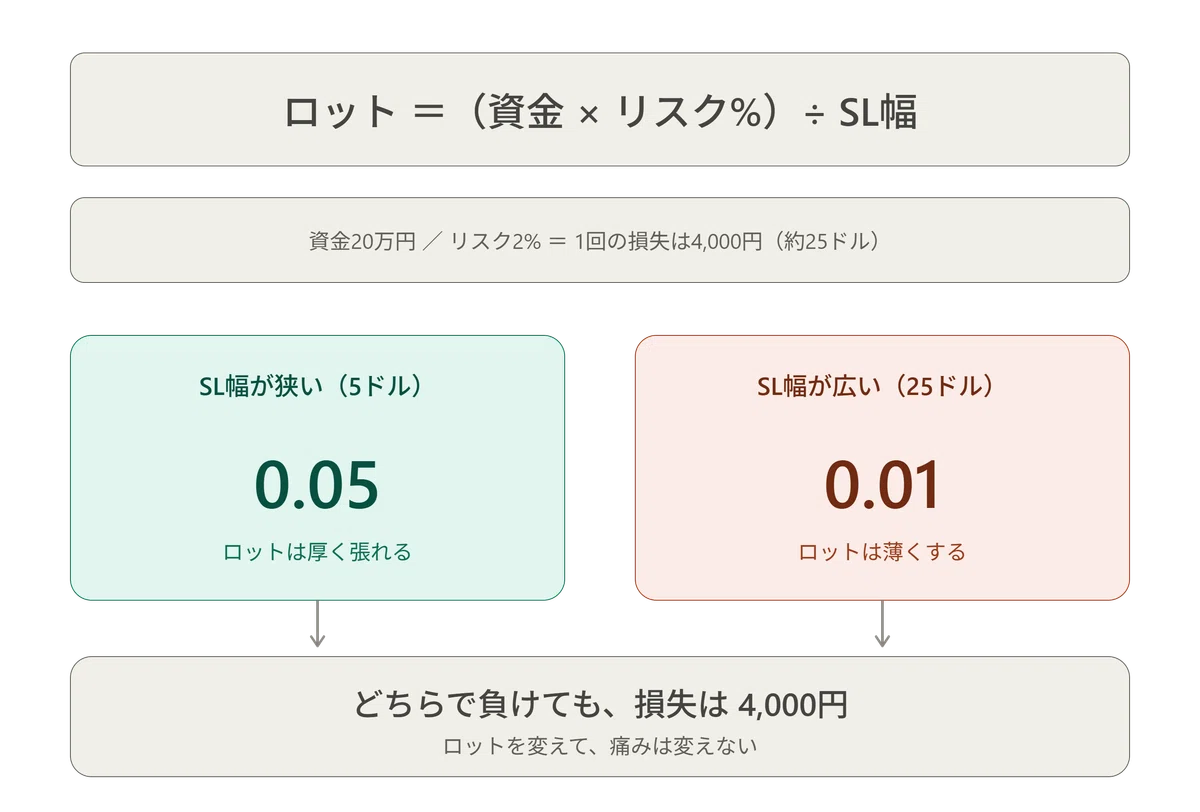
Even with the same 0.05 lots, if the stop loss width differs, the loss amount changes. A trade with a $5 SL vs a $20 SL hits 4 times harder in pain.
Therefore, using a fixed lot size makes the loss amount vary. If you happen to lose on a trade with a wide stop loss, you’ll be hit harder than expected.
The correct approach is this.
Lot = (Capital × Risk%) ÷ SL width of that trade
For a trade with a wide SL, use a thinner lot. For a trade with a narrow SL, use a thicker lot.
In this way, no matter which trade you lose, the loss amount remains constant.
This is the basic form of money management.
What is a reasonable risk%?
Generally, 1–2% of capital per trade is considered a guideline.
With 200,000 yen, a single loss would be 2,000–4,000 yen. Even five consecutive losses would amount to about 10% of your capital.
You may think, “That’s too little.”
But this modest approach is the condition for survival.
Conversely, if you bet 10% of your capital in one shot, five consecutive losses would wipe out half. Five consecutive losses with gold happens fairly often.
Betting big and hitting big once doesn’t sustain you. Betting small and increasing the number of trades will, in the end, keep you alive.
Here’s the real topic. “Always the same” is still not enough
So far, this is what the money management textbook says.
But I think there’s one more step.
Not all entries have the same probability.
A scene where all conditions are perfectly aligned vs. a scene where it just took shape loosely. It’s odd to risk the same lot in both cases.
My indicator assigns a quality rank to signals (S/A/B/★). ★ denotes signatures that appear under especially tight conditions for a small, elite set.
Then you can enter like this.
・When conditions are strong → increase risk% ・When conditions are weak → decrease risk%
Even with the same win rate, entering more in favorable situations changes the total outcome.
The problem is that doing this manually is exhausting.
When the lot size stabilizes, exit decisions also stabilize
And this is another part that is surprisingly under-discussed.
If you can manage the lot size, your trade judgments during the trade become more stable.
Recently I actually encountered such a situation.
There was ample unrealized profit, with a resistance from the prior high and moving average directly ahead. I judged, “It might be better to pull back once rather than extend cleanly,” and I closed the position early, before my take-profit level.
As a result, a decline came right after. Securing early was the correct decision.
That kind of judgment was possible because the lot size was appropriate.
If I had held a too-large lot, my emotions would have swung with the unrealized gains, making it impossible to calmly think, “Here the resistance is near, so secure it.”
You’d be praying or panicking and cutting.
Lot management is also mental management.
Because the size is appropriate, you can watch the market calmly.
The logic is sound, but manual handling won’t last
After reading this, you might think, “What you’re saying is correct. But doing it every time isn’t possible.”
That’s right.
When you actually try it, it becomes this:
・Signal appears ・Measure the SL width ・Apply risk% to the capital ・Divide by SL width ・Round to 0.01 units ・Adjust risk% according to rank ・Place the order
The entry timing is, at most, tens of seconds. With gold, prices move in seconds.
You have to perform these calculations by hand every time.
It won’t last.
And those who can’t continue will eventually return to “Is 0.1 enough?”
The moment they return, we’re back at the beginning.
In other words, money management isn’t a knowledge issue; it’s an execution issue, I think.
So, I automated it
I found the calculations too tedious, so I implemented them into an EA.
What it does is exactly what I described in this article.
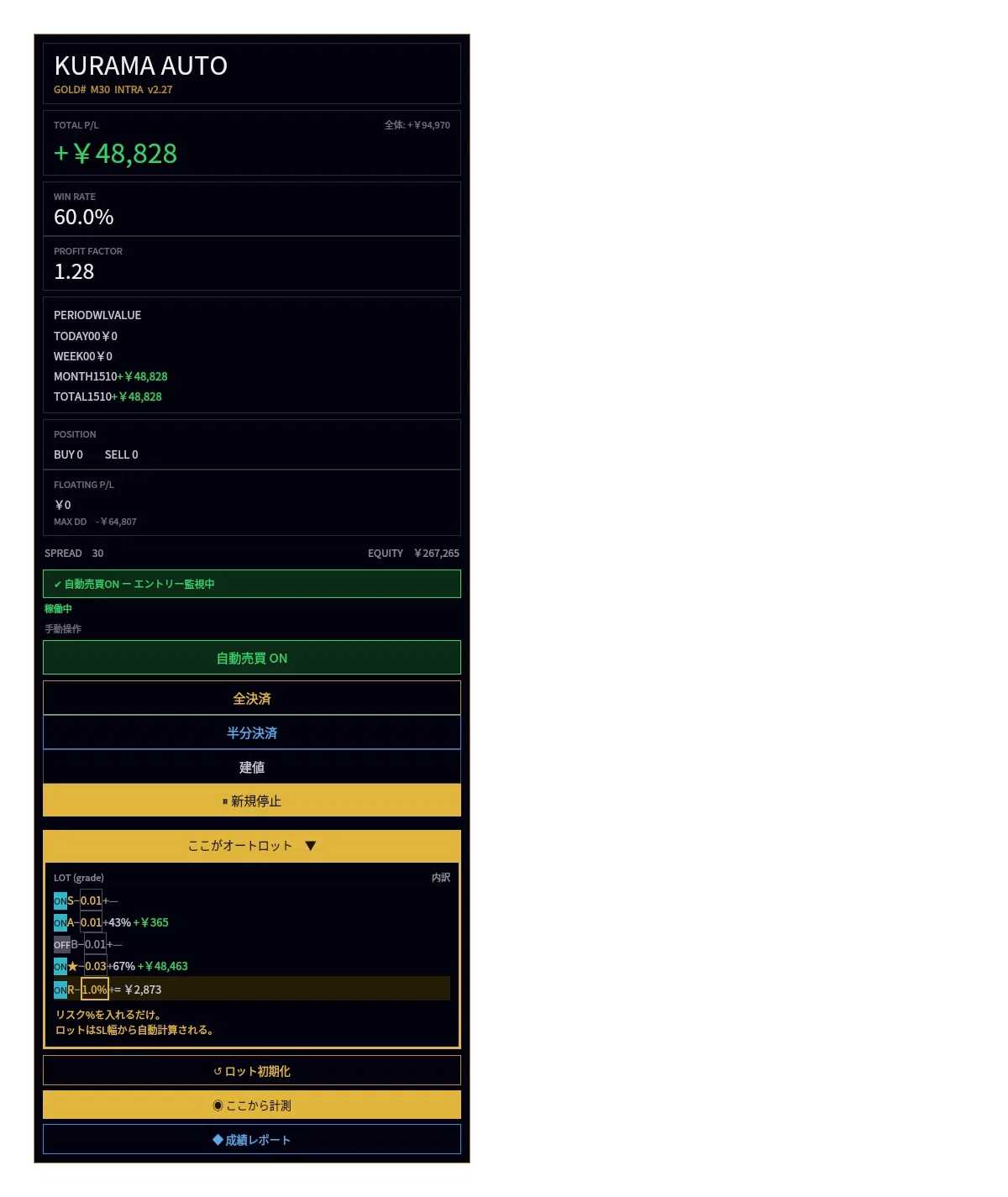
・Just set the risk% and it automatically calculates the appropriate lot from each sign’s SL width
・Adjust the risk% based on the signal rank
・No averaging down or martingale (designed not to increase and recover)
・One-click full exit, half exit, or Break-even from the panel (to enable the early securing without hesitation)
Keep your discretionary judgment, but hand the calculations and orders to the machine.
That’s how it’s built.
Summary
・Most people who blow up on gold die not from the method but from the lot size
・XAUUSD is 100 dollars per 1 dollar per 1 lot. A 0.15 lot move can cause about 48,000 yen loss with a $20 adverse move
・“Margin is sufficient” and “safety” are completely separate issues
・Make the loss amount the same each time (Lot = Capital × Risk% ÷ SL width)
・Risk around 1–2% per trade is a guideline ・If you vary risk% by signal quality, you’ll see even stronger effects
・When the lot is stable, exit judgments become calmer
・Manual calculations won’t last. It must be systematized
Before looking for entries, first determine the lot size.
It’s plain, but it’s the most effective.
Right now, can you answer immediately what percentage of your funds you are risking on a single trade?
If you can’t answer immediately, that is where you should start fixing first.
Purchase here (GogoJungle exclusive)
Due to authentication, this EA is sold exclusively on GogoJungle.
https://www.gogojungle.co.jp/tools/indicators/82015