

Entry logic explanation of the three-currency parity analysis tool "Intervention Aftermath PRO" that captures distortions in the foreign exchange market
Learn the Entry Logic of the Three-Currency Parity Analysis Tool “Intervention Ripple PRO” that Grabs Distortions in the Foreign Exchange Market
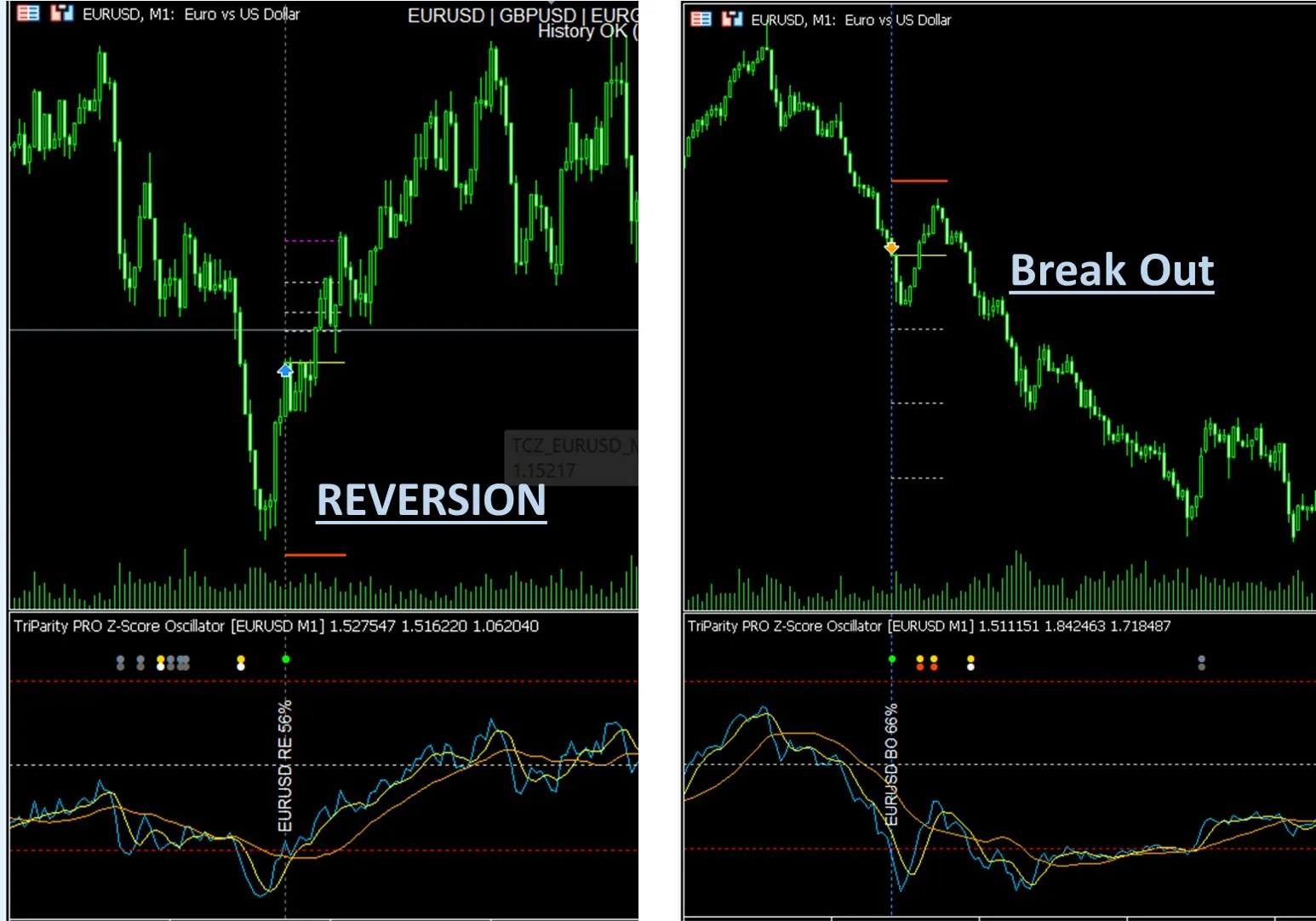
Last time,why three-currency parity analysis can be a weapon for general traderswas written. In this sequel,we will organize how RE and BO signals are generated from the perspective of their underlying ideas. Note that Part 1 in the first half focuses on the details of the logic and is targeted at intermediate to advanced users. Since a more accessible explanation is prepared in Part 2, if you want to grasp the overall picture first, you can start with Part 2.
Detail: How RE and BO are constructed
1. Both RE and BO capture the “distortion among three currencies”!
The starting point of Intervention Ripple PRO is not the price of a two-currency pair, but the distortion among three currencies (composite spread) formed by three currency pairs.
zt= ( St- μt) / σt
What we want to convey is that RE and BO are not inherently different indicators from the start; they read the same distortion Z through different market hypotheses.They interpret the same distortion Z with different market hypotheses.
RE treats this distortion as“the one that will revert”, while BO treats it as“the one that will keep expanding”.
In short, the difference between RE and BO is less about the shape of signals and more abouthow to interpret the current distortion in terms of the phase.
2. RE and BO differ in “which phase they target”
In the phase where the distortion has spread outward to the extremes,the phase when it begins to revert inwardis targeted.
When distortion moves away from the neutral band andthe phase where it is more likely to expand furtheris targeted.
Thus, visually RE appears as the opposite side, BO as the forward side, but the essence is not that; it’s abouthow to interpret the current distortion in terms of whether to expect mean reversion or continuation/expansion.
3. On the RE side, there are effectively three entry points
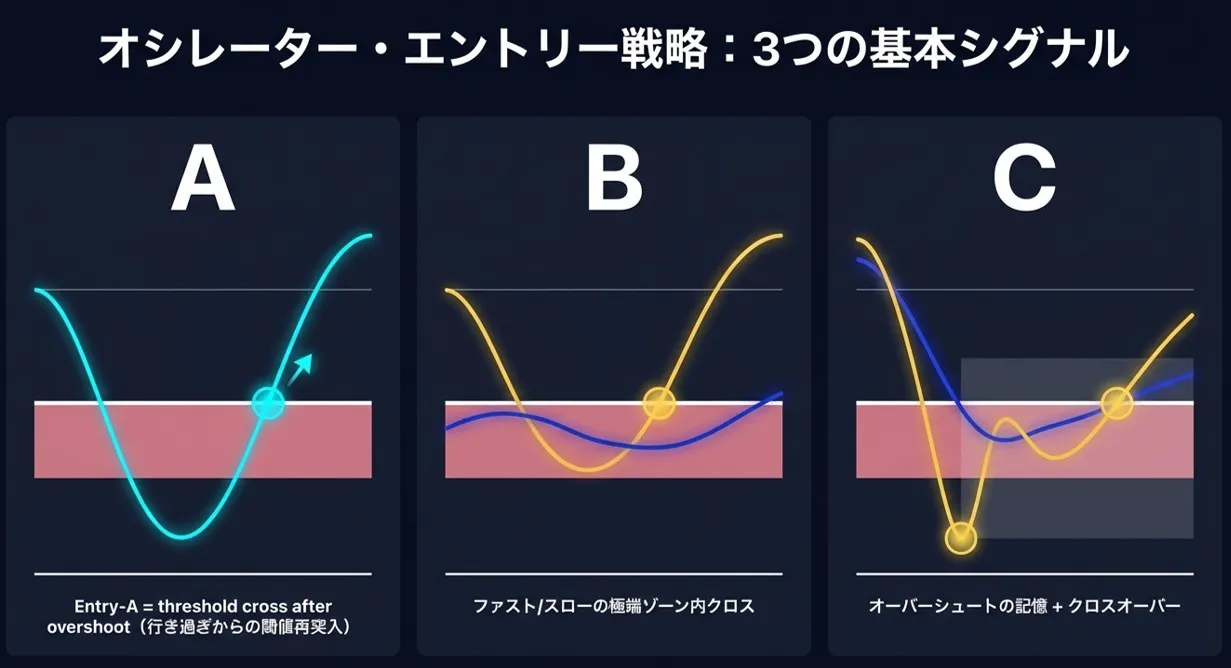
In the settings screen,Entry-A: Threshold Cross,Entry-B: ZMA extreme value cross,Entry-C: ZMA overshoot memory-type cross, all are RE-side entry points.
Entry-A: Threshold Cross (basic)
After the distortion reaches a certain outer extent, the moment it reverts inwardis the RE candidate.
It is the simplest and most intuitive, but since shallow reversals can also be captured, it can be prone to noise when used alone.
Entry-B: ZMA Extreme-Value Cross
Here the ZMA used is not the moving average of price, but themoving average of the distortion Z itself.
While the distortion is still in an extreme range, the fast-side ZMA crossing over the slow side to the reversal direction is checked,watching for a phase shift in the revert.
Entry-C: ZMA Overshoot Memory-Type Cross
Similar to B, using ZMA cross, but additionally assuming that there has been a recent sufficient overshoot.
In other words, C is not just a small reversal, but a “high-quality rebound that appears after a large distortion” entry point that is easier to target.
As an image, A = “reverted”, B = “beginning to revert”, C = “began to revert after a large distortion”.
4. RE does not appear immediately when a trigger occurs
Even if Entry-A / B / C is satisfied, it does not automatically become the final signal.
After an RE candidate appears, several additional checks are performed.
- Whether there was a truly sufficient overshoot
- Whether there is momentum in the reversal
- Whether the Scanner / Nowcast meets the minimum standards
- In the current higher-timeframe regime, whether it is appropriate to pursue mean reversion
In other words, RE is not simply “a reversal-like pattern appeared”;it is issued only when there is a value in pursuing the rebound.
5. The key in RE is whether the market regime allows mean reversion
This is the most important part on the RE side.
RE is a framework that only aggressively trades when the regime permits mean reversion.
On higher timeframes, it comprehensively considers factors such as residual stationarity, half-life, trend or mean-reversion, whether the mean itself is moving, and whether the triangular relationship is intact.
To put it plainly, what is being looked for is
- “Is this distortion likely to revert?”
- “Is the observed rebound genuine?”
- “Is the underlying triangular relationship intact?”
This is what makes RE different from ordinary reversal oscillators. Intervention Ripple PRO does not chase the rebound just because an extreme value is found; it first determineswhether the rebound scenario is likely to be favorable.
6. BO is not merely a band breakout
If you only think of BO as “the RE opposite”, you miss the essence.
Intervention Ripple PRO’s BO is not just a breakout; it is a logic that captures expansion in a market where mean reversion is not permitted, taking the distortion in the direction of the trend.
The BO trigger itself is simple: RE watches from outside to inside, while BO watches from inside to outside.
However, that alone does not guarantee a BO signal.
- Whether the regime prohibits mean reversion
- Whether there is sufficient momentum in the distortion’s slope
- Whether the magnitude of expansion is not too weak
- Whether it does not contradict the direction of the higher timeframe
- Whether the continuation phase is not unnatural
In short, BO is not simply a breakout; it is a signal that looks for the expansion that still has engine power after breaking through.
Thus, even though the visible arrow may look simple, internally it is highly layered.
7. In the end, the arrows on the chart are intersections of conditions
The actual flow can be summarized as
- Create distortion Z from three currencies
- RE or BO triggers in real-time
- Check depth and slope
- See if Scanner / Nowcast meets the minimum standard
- Pass the higher-timeframe regime check
- If BO, pass an additional continuity filter
Therefore, even if charts look similar, a difference arises where today RE appears, doesn’t appear, or only BO appears.
This is not instability; rather, it reflects the context and hence the difference.
Dedicated Tool for Triangle Currency Parity Analysis
“Intervention Ripple PRO Catcher & Scanner”
If you want to incorporate the core RE/BO logic into real discretionary decision-making, see here.
Based on the concept of triangle currency parity, it is a main tool that helps organize the expansion and rebound phases of distortions.
Explanation: In simpler terms for beginners, what does it mean
1. In one sentence
Intervention Ripple PRO distinguishes RE and BO by looking at“Is this distortion likely to revert, or is it still expanding?”.
Ordinary oscillators tend to think, once movement becomes extreme, “it should revert soon.” But in actual markets there aredistortions that truly revert, and there are distortions thatspread further for a while. Intervention Ripple PRO is a tool that tries to organize these differences as much as possible.
2. RE targets the “beginning of the rebound”
It aims for the moment when the rubber is stretched and tries to return to its original position.
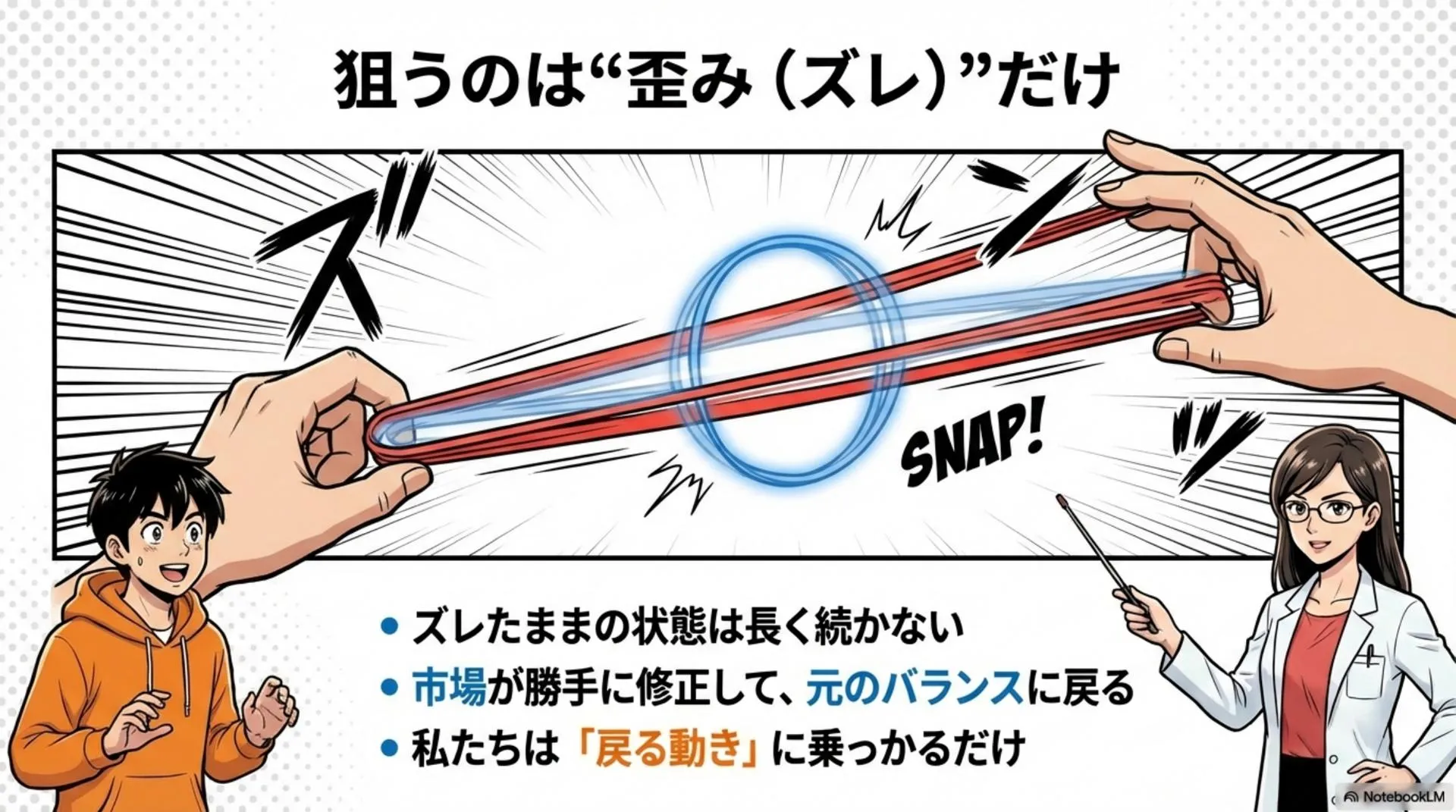
However, it does not issue signals just because the rebound seems likely.
It checks whether the overshoot was excessive, whether the rebound has momentum, and whether the current market conditions areconducive to a rebound.
Therefore RE is not merely a counter-trend signal; it is a rebound signal that occurs in an environment where a rebound is feasible.
This time it is not about excessive movement, but a signal when the market is moving in that direction.
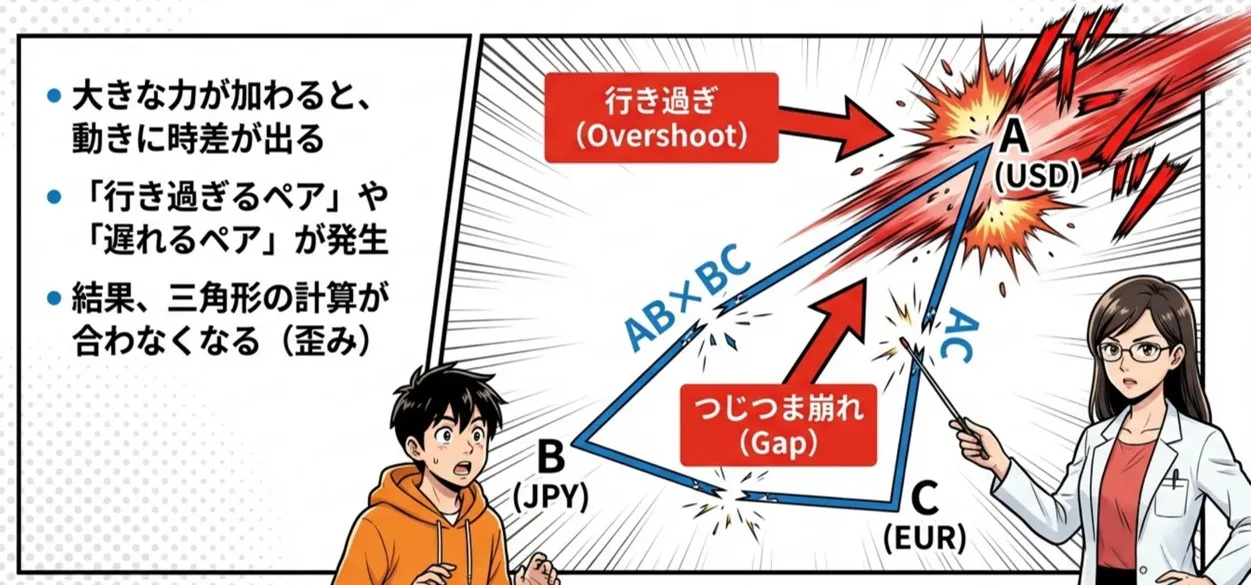
In other words, BO is not a “mean reversion because it’s overdone,” but a signal when it is judged that it will still extend in that direction.
Thus, Intervention Ripple PRO is not only for mean-reversion chasing, but a structure that can look for both rebound and expansion phases.
4. Entry-A / B / C are RE’s differences in how to confirm a rebound
Entry-A: The basic type that confirms the line has returned
Entry-B: Confirms that the rebound momentum has changed direction
Entry-C: A type that picks only high-quality rebounds after a large distortion
A, B, C are less about difficulty and more about differences in the angle of confirming the rebound.It is easy to imagine as basic type, momentum-check type, and selective type after a large distortion.
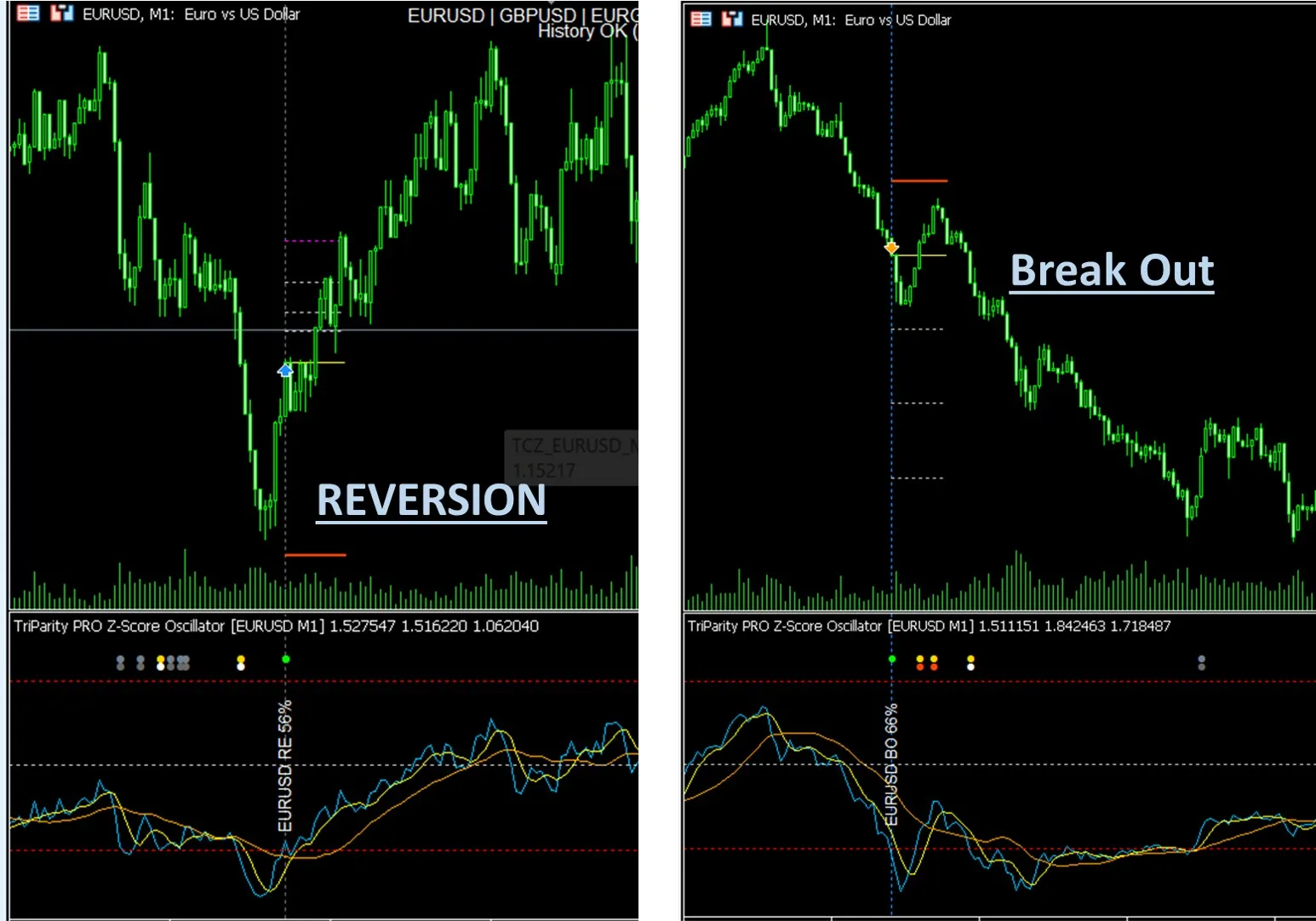
5. Why both RE and BO are necessary
In markets, people who tend to lose are biased toward one side.
- Always expecting reversals and shorting
- Always expecting continuations and jumping in
But in reality, markets have distortions that should revertand distortions that should expand.
Intervention Ripple PRO is based on this premise and deliberately separates the logic for the rebound side (RE) and the expansion side (BO) from the start. (BO was added in version 8.0)
6. Finally, a concise summary
- Measure the distortion from three related instruments
- Decide whether it is a rebound type or expansion type
- If rebound, emit RE; if expansion, emit BO
- Additionally filter out weak or risky setups
Therefore, on the surface it may look like a signal indicator, but in realityit is a tool that distinguishes rebound and expansion by examining the nature of market distortions.
This is what sets apart Intervention Ripple PRO’s RE/BO logic from ordinary oscillators or simple breakout displays.
Intervention Ripple PRO SPIDER
A tool to capture cross-market buy/sell signals across a monitoring net of three-currency parity
If you want to track multiple monitoring targets across the triangle currency parity while leveraging that perspective, SPIDER is also available.
Please also check this to reduce misses and improve monitoring efficiency.
Summary
RE and BO are not signals generated from the appearance of a single chart alone.
Based on the distorted shape created by triangle currency parity,these distortions are evaluated step by step to determine whether they revert or expand, and only then issued.
Because of this, it is easier to justify questions like
“Why isn’t this a contrarian signal but a hold-off?”
“Why is this a BO instead of a rebound?”
and understand the reasoning behind them.
Although they may look similar, the core is quite different.
That is the core of Intervention Ripple PRO’s RE/BO logic.