

I created an SMC Sign Tool that reveals even the “strength” of the basis — Arrow + Score + TP/SL Auto【SMC-Signal】#02
Today, we will introduce the core of the SMC seriesSMC-Signal
In a word,it is an entry support tool with no repaint that shows the convergence of Arrow signs, rationale scores, and TP/SL guidelines at the place where the basis of SMC (Smart Money Concept) overlaps.
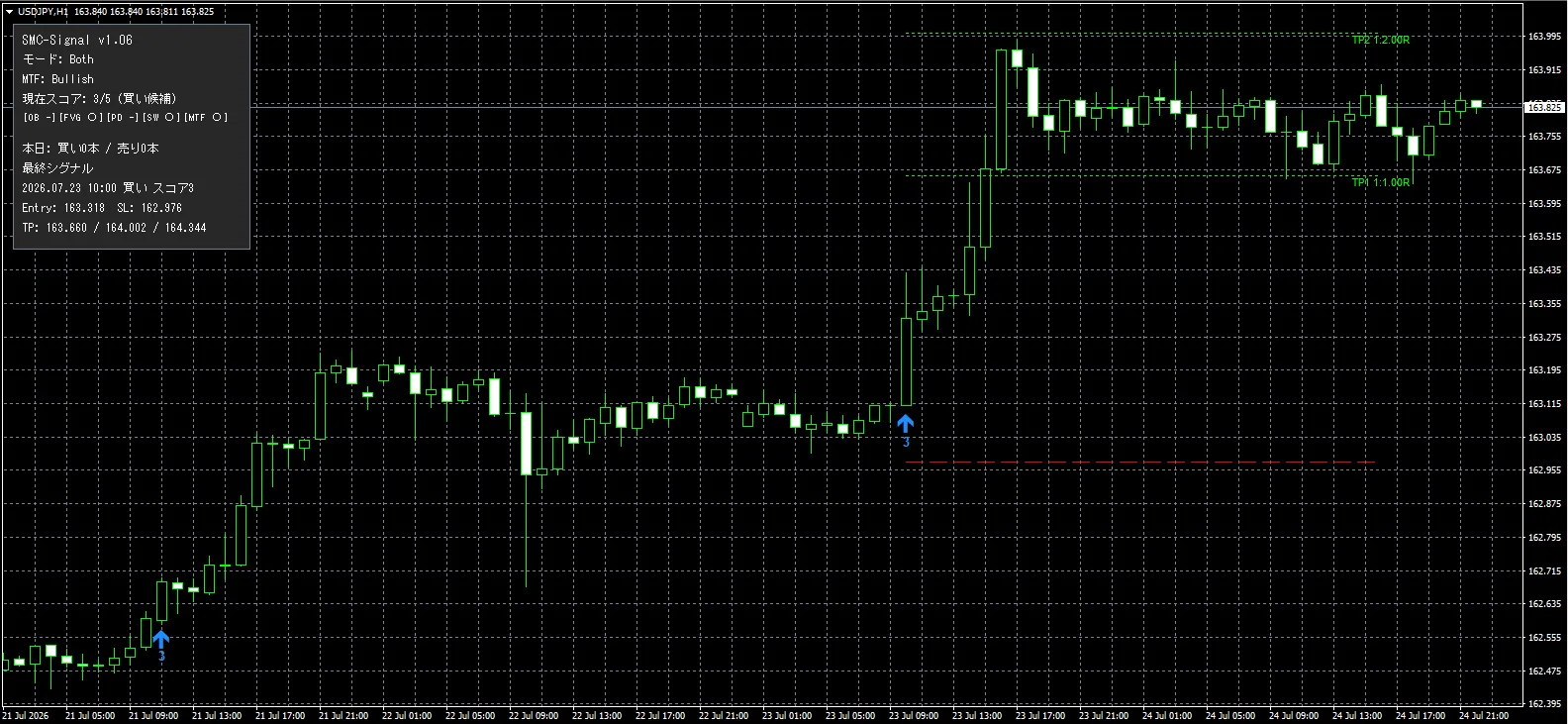
The elements of SMC are “visible.” But you can’t “enter”
After learning SMC, OB and FVG become visible on the chart. Yet aren’t there walls like these?
The elements are visible, butyou still can’t decide where to enterdefinitively
If you enter on a single OB, it goes against you.You can’t distinguish between “strong scenes” and “weak scenes”.
You can enter, butyou’re always unsure where to place TP and SLeach time
You enter a setup in the higher timeframe opposite to the trendand go against the larger flow.
In backtests you win, but in real-timeyour judgment is late and you get left behind
After visibility, what is needed is a presence thatcounts the overlap of bases, converts to scores, and draws lines.
That’s why we created SMC-Signal.
Score five bases and attach to arrows

SMC-Signal evaluates the following five elements for each confirmed bar and shows their overlap count as aConfluence Score (1–5)together with arrows.
Order Block— Reversion to institutional order concentration zone
Fair Value Gap— Reversion to price gaps
Premium / Discount— Overbought/oversold assessment of the latest range
Liquidity Sweep— Occurrence of liquidity hunting
Multi-Time-Frame— Alignment with higher-timeframe trend
A buy is a blue upper arrow, a sell is a red lower arrow. And next to the arrows, scores like “3” or “5” appear.
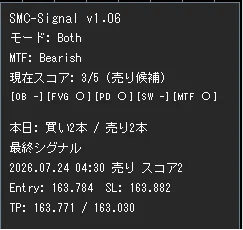
As for how this works in real trading,you can create your own rule like “Ignore score 2, only enter at 4 or higher”.
You don’t need to ride every signal. The ability to select only stronger bases is the biggest difference from single-signal tools.
Auto-calc TP1, TP2, TP3 and SL
When a signal appears, targets for take profit and stop loss are drawn automatically.
TP is three stages(TP1/TP2/TP3). The design for partial profit-taking can stay the same
SL is also automatic. Two calculation methods to choose from
Structure-based: Based on recent swing highs and lows
Fixed RR method: Adjusted to volatility using ATR × multiplier
Each line also showsRisk-Reward ratio.
Not only where to enter, but also where to exit with the same criteria, dramatically improving trade reproducibility.
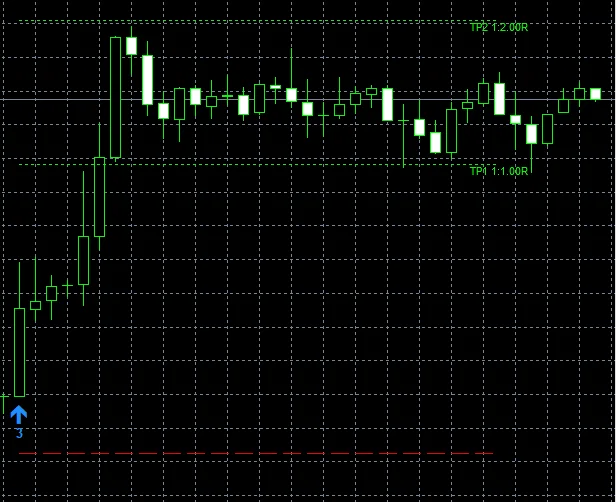
No repaint — signs do not disappear when you switch timeframes
This is the lifeline of this tool, so I will be explicit.
All judgments in SMC-Signal are made using onlyconfirmed bars. Signals are not judged during formation, sothere is no repaint where arrows disappear or move later.
Moreover, past signals are deterministically recalculated from history. Thereforeeven if you switch timeframes or restart MT4, you will see the same signals in the same places. It eliminates the distrust common to signal tools that show that “the arrow you saw yesterday is not there today.”
One method to spot repaint is to speed up in Strategy Tester and look for the moment signals disappear. SMC-Signal is built to withstand that kind of validation.
Alerts to avoid missing opportunities
Notify you of buy/sell signals viapopup / push notification / sound, a three-pronged system
Not only signals, but also alerts for occurrences of OB touch, FVG touch, and other SMC elementscan be set separately.
You can operate without sticking to the chart, receiving “EURUSD M15 buy signal” on your smartphone.
Customization
Minimum score filter (hide weak signals)
TP calculation method and RR adjustment
Upper-timeframe filter ON/OFF
Detection sensitivity for each element and number of analysis bars
Arrow size and color changes
Supported on MetaTrader 4, all currency pairs (GOLD ok), all timeframes, with a recommendation of M15–H4. DLL is not used.
Why we made it
After releasing SMC-Radar (automatic drawing tool), the most common question from purchasers was“And where should I enter?”.
Visibility of elements was solved with Radar. But stacking and prioritizing elements remained in people’s heads. SMC-Signal codifies that.
I turned it into scores becauseI wanted signals to be something you choose rather than something you simply follow. Some aim for score 5, others pick up from score 3 and up. The same tool can be used in ways that suit your style.
Positioning within the SMC series
SMC-Radar: A “visibility” tool that draws six elements. For those who want to see the basis of Signal with their eyes, Radar is the strongest companion
SMC-Signal (this article): A “signalization” tool that scores bases and shows arrows and TP/SL
SMC-Compass: A circular radar to overview all 30 pairs. Use Compass to spot targets and Signal to set up trades
There are also article explanations for each in the magazine.
Sales information
SMC-Signal is sold on GogoJungle.
https://www.gogojungle.co.jp/tools/indicators/80469
Thanks to you, it has become a core part of the SMC series and we are updating it based on questions and requests from users (features like keeping signals after timeframe switching, automatic adjustment of arrow sizes, etc., improvements that came directly from buyers).
Disclaimer
This tool is not investment advice. It may suggest timing or direction of trades, but does not guarantee profits or win rates. The presented information is intended to assist discretionary judgment, and the final trading decisions are your responsibility. Depending on market conditions and broker data, detection results and displays may differ from expectations.
Thank you for reading until the end.
“I want signals to appear, but I don’t want a black box.” — This tool was made for people like that. If you found the article useful, it would be encouraging if you could follow our likes and magazine.
Now, good trading.