
Speaking from the perspective of an EA developer. About grid-style (martingale) EAs
When you hear “Nanpin EA,” what do you imagine?
“It’s the one that buys more when the price goes down, right?” — Yes, that’s correct. However, from the developer’s perspective, “nanpin” is not a single concept; the design philosophy varies greatly. From the quiet, herbivorous type to the carnivorous type that can wipe out an account in one shot. And on a sales page’s performance table, it’s hard to distinguish these differences.
Today, as someone who builds EAs, I’m going to classify the “types” of Nanpin EAs. It’s a bit of an insider topic, but once you know this categorization, your eye for Nanpin EAs will change significantly.
Premise: The Basic Principle of Nanpin
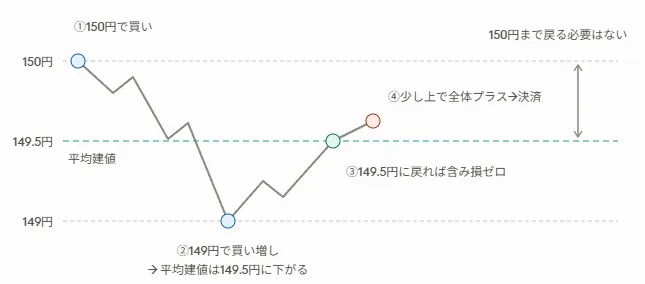
Just a quick recap. Nanpin is a method that increases in the same direction when a position goes against you, in order to improve the average entry price. Buy at 150, and if it drops to 149, buy another unit, making the average 149.5. Instead of waiting for a full rebound, you can be rescued by a small rebound — this is the principle.
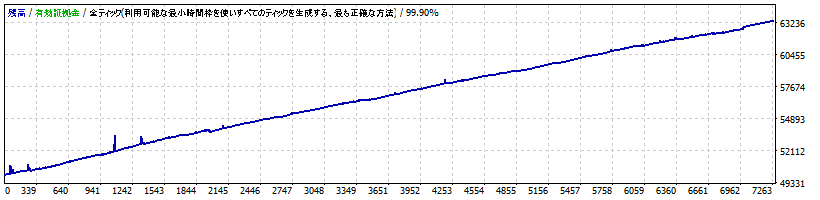
Since the market zigzags, a “slight rebound” occurs with high probability. Therefore Nanpin EAs tend to have a high win rate and a smoother equity curve. This is common to all types so far.
The problem lies in the design of the “how to accumulate” and the “how to fold” that comes next.
↓ Nanpin-type EAs generally produce the following asset curve.
Systematic Classifications of Nanpin EAs
As a developer, I judge Nanpin EAs by the following three design parameters.
- Nanpin Width:How many pips of adverse movement before adding the next position
Lot Multiplier:How many times to multiply the lot each time you add
Maximum Number of Positions:How many positions to add (and what to do after reaching the limit)
No matter how sophisticated the entry logic is, the core risk of a Nanpin EA is almost determined by these three factors. In extreme terms, entries are decorative, the accumulation method is the main body. With this perspective, let’s look at the main families.
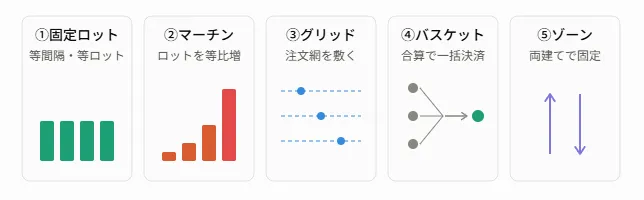
① Fixed Lot, Evenly Spaced Type (Herbivorous)
A type that calmly adds the same lot at fixed intervals. The most conservative design. As the number of positions grows, losses grow linearly, making calculations straightforward. On the downside, improvement of the average entry price is slow, and the ability to rescue from deep drawdowns is weaker. “Among Nanpin,” this is the type with the fewest accidents.
② Martingale Type (Carnivorous)
A type that multiplies the lot by 1.5x or 2x each time you add. The average entry price becomes decisively favorable, so even shallow rebounds can push the overall result into profit. The performance table looks the best.
But here’s a simple math reminder. If you add at a multiplier of 2.0, the 7th lot is 64 times the initial, and total exposure is 127 times. With a multiplier of 1.5, the 7th lot is about 11 times the initial, and total around 32 times. Lots grow geometrically, so the weight of “one more lot” becomes enormous. The collapse of Martingale-type occurs when you lose the tug-of-war between this geometric growth and margin. On sales pages, watch for multiplier figures; the closer to 2.0, the higher the warning level—this is my view.
③ Grid, Repetition Type
A type that barely has a market view, and lays a grid of orders at fixed intervals to harvest zigzags. Technically, it’s sometimes treated as a different category from Nanpin, but the structure “the more the position moves against you, the more you accumulate” is the same. Extremely strong in ranges, weak when driven in one direction. The key design is how wide to place the net and at what price range; once the expected range is broken, hell begins.
④ Basket Recovery Type (Net Settlement)
Do not settle each position individually; settle all positions at once when the total P/L turns positiveType. The exit for the whole is placed as “average entry price + a few pips.” The settlement is a single event, so the trade history is easy to read, and it’s always clear how much rebounding is needed to break free. However, in reverse, it’s a design that bets the entire amount on a shallow rebound.
⑤ Zone Recovery Type (Hedged/Two-way)
If the price moves against you, instead of cutting losses, pile up positions in the opposite directionto fix the loss and aim to recover if one direction breaks out. “Not cutting losses, yet losses are fixed” sounds magical, but the positions will continue to expand in both directions, eating into spreads and swap. When stuck in a range, only the hedged pile remains immobile. Personally, I find this type unrewarding relative to its development difficulty.
Developer’s Honest Opinion: Why Nanpin is Often Chosen
Now, here’s the developer’s inner thoughts.GogoJungle and MQL5 both have many Nanpin-type EAs, right?
I’ll be blunt:
When you publish an EA, forward testing is exposed to public scrutiny. If the forward test starts in the red right away, that’s quite stressful for the developer.
And Nanpin-type by design tends to look good in forward tests. Because losses aren’t locked in, while single-shot EAs visibly lose, Nanpin can appear to be on a winning streak in apparent terms. The performance table can look pristine up until the day before a big drawdown.
In other words, for developers, Nanpin-type is a design that remains attractive because, for a while after release, it tends to look good. I have personally thought many times during development, “If I switched to Nanpin, the numbers would instantly look better.”
A Foothold: Gold and USD/JPY
One more essential perspective is the market environment. In recent years, gold has shown historic rises, and USD/JPY has trended toward a weaker yen over the long term. For these two instruments, buying Nanpin has effectively meant “wait for a rebound and it will usually work.”
Therefore, these two instruments provide fertile ground for buying Nanpin EAs. Not only domestically, but top-selling EAs on overseas sites (MQL5 Market) are overwhelmingly Nanpin-based. Developers around the world are drawn by the same structure and the same tailwinds.
However, if a rising market justified the success, that’s less about the strategy’s power and more about market conditions. If the tide changes, EAs with the same design may hold the same positions but become equally painful.
A little promotion
Actually, I also have Nanpin-type EAs out there...
I’ve designed them to minimize risk as much as possible. Please have a look if you’re interested.