

Only HFT knows the FX “physical laws” - five market truths that individual traders are missing (repost)
Hello!TriParity Labs TokyoのKazです。この記事では、プロの世界では常識とされている、FX市場を支配する5つの真実を解説していきたいと思います。この記事を読めば、きっとあなたのチャート分析は二度と同じものには見えなくなるでしょう。

「監視する通貨ペアが多すぎて、結局チャンスを逃してしまった」
「プロのトレーダーは一体何を見て判断しているのだろう?」
Many individual traders probably have had concerns like these at least once. Facing countless charts and feeling overwhelmed, or regretting after learning of a big move later on, is by no means rare. (That was my experience too...)
However, what ifFXmarket has“laws of physics”that are absolute rules,andprofessionals operate with those rules as the fundamental premise?
In fact,they look not only at the shape of candlesticks we see, but also at theunderlying market “structure”behind them。
1. The true nature of the “physical laws of the market” that govern FX
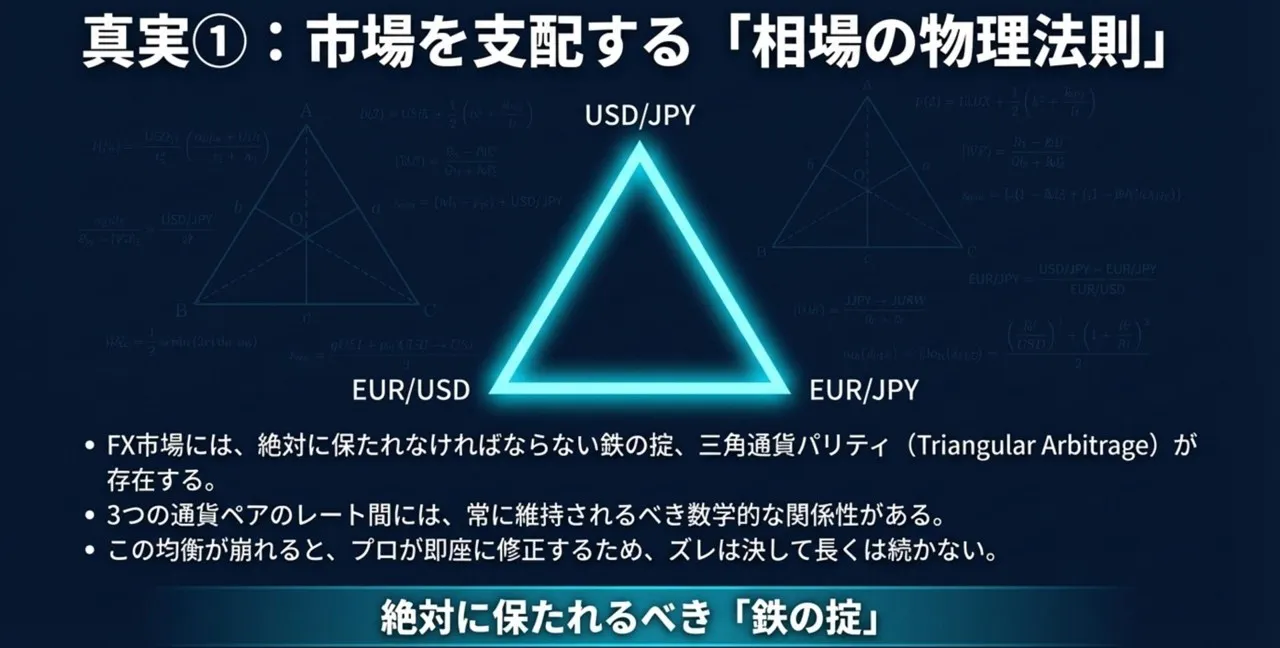
In the FX market, there exists an absolute rule called thetriangular currency parity(Triangular Arbitrage) that must be maintained. This is themathematical relationshipamong rates of three currency pairs.
For example, if you know the rates for “USD/JPY” and “EUR/USD,” you can deduce the theoretical rate for “EUR/JPY.” The actual EUR/JPY rate traded in the market must always match this calculated rate.
If this relationship even slightly breaks down, it implies a potential opportunity to earn profit with no risk. The reason the “physical laws of the market” are not just metaphorical is that, the moment such a misalignment occurs, someone will act to profit, and the misalignment is corrected instantly, so it never lasts long. At that moment, professionals like banks and HFTs will use ultra-fast systems to fix the misalignment immediately..
This ongoing monitoring and correction by professionals is the source that keeps market prices fair and orderly.
“The physical laws of the market”
The existence of this rule is the reason FX rates we usually see stay consistently coherent.
2. Behind the price you see, there is a “millisecond-scale war” going on

Arbitrage opportunities that emerge when the “physical laws of the market” break are, in the professional world,a fierce battleof speed in the millisecond range. This is a speed race on a scale far beyond what individual traders can imagine. A milliseconds (thousandth of a second) raceA milliseconds (thousandth of a second) race, billions of dollars are invested by HFTs and big banks to win this race.
- Co-location: By placing their servers inside the exchange data centers like London LD4 or NY4, firms minimize physical distance and communication delay to the extreme.
- Ultra-low-latency networks: Using microwave links that can take more direct routes than fiber, data transfers between cities can be cut to the sub-millisecond level, sometimes achieving 25–30% faster speeds than fiber.
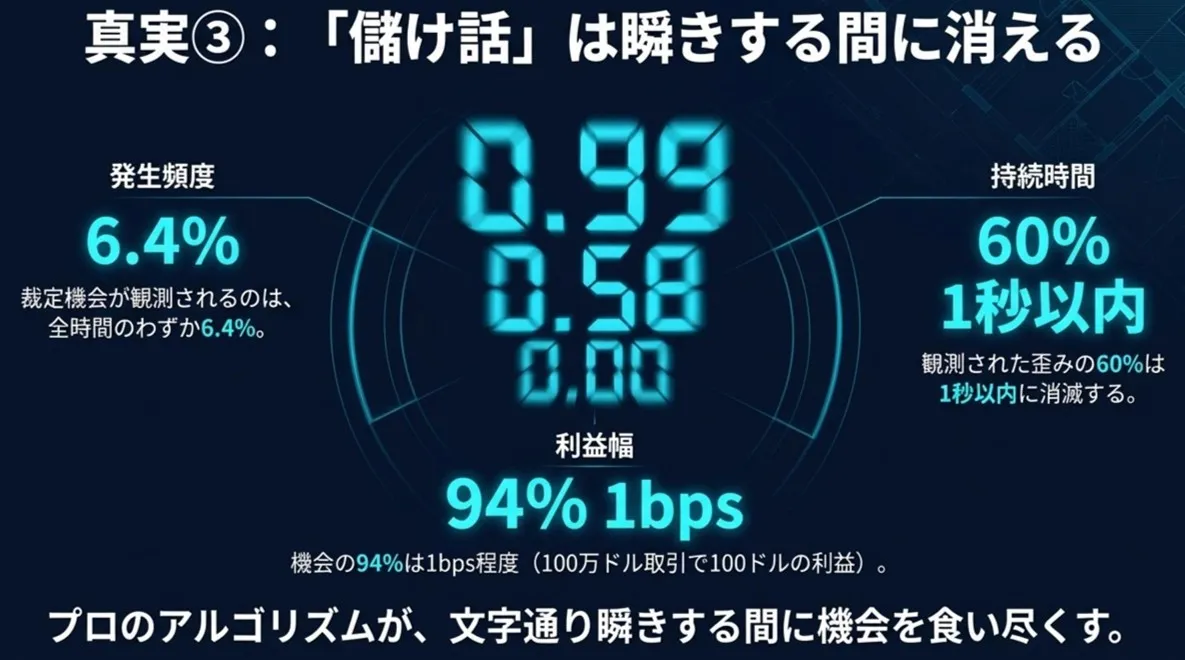
Hearing that it’s “risk-free profit” may sound appealing, but the reality of arbitrage opportunities is far from most people’s expectations. Academic data show that the opportunities are very small and short-lived.This tells how brief and tiny they are.
- Frequency of occurrence: Price distortions that could create arbitrage opportunities are observed in only about6.4% of all time (about 90 minutes per day).
- Duration: Of distortions observed,95% vanish within 5 seconds, and60% vanish within just 1 second.
- Profit margin: For arbitrage opportunities,about 1 basis point (roughly $1,000,000 trades yield $1,000 profit), a very small profit margin.

From what we’ve discussed, it becomes clear that individual traders cannot arbitrage using the same method as professionals.Direct access to the interbank market is difficult for individuals
- .

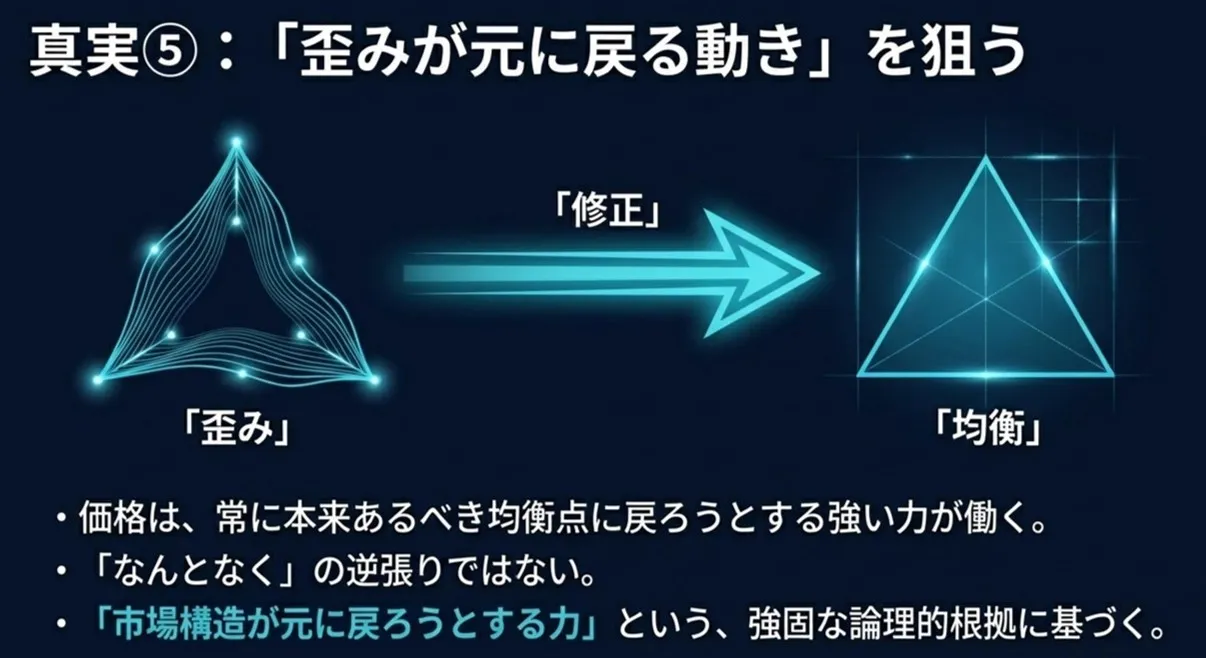
If professionals fix price distortions instantly, viewed differently, it means“Prices tend to revert to their natural balance (parity)”.
You can apply this market structure itself to your own trading strategy.
Suppose a currency pair shows an exaggerated move relative to the other two currencies (i.e., a distortion). Immediately after, professional arbitrage moves to correct that distortion, i.e.,“reversion toward the original equilibrium”is more likely to occur.
This can be applied as an edge for individual traders: contrarian trading that targets distortion-rebalancing toward equilibrium.
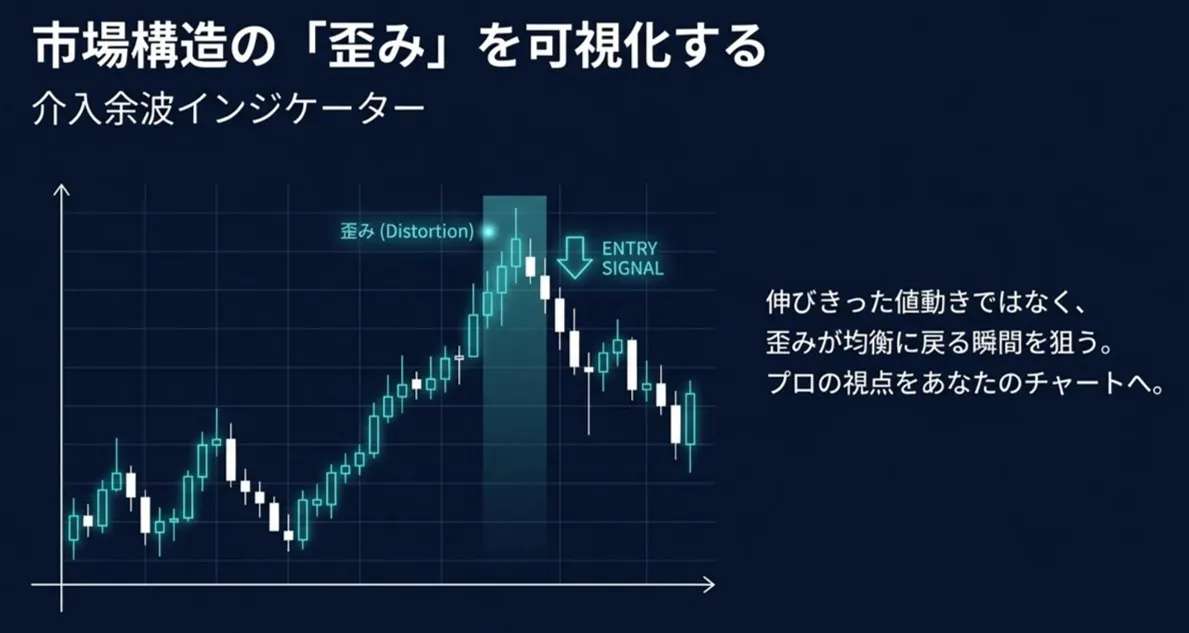
This approach differentiates from conventional, intuitive contrarian trading like “it went up too much, so sell.” The basis is not candlestick shapes but rather the more logical and robust concept of“market structure’s tendency to revert to its original state”,.
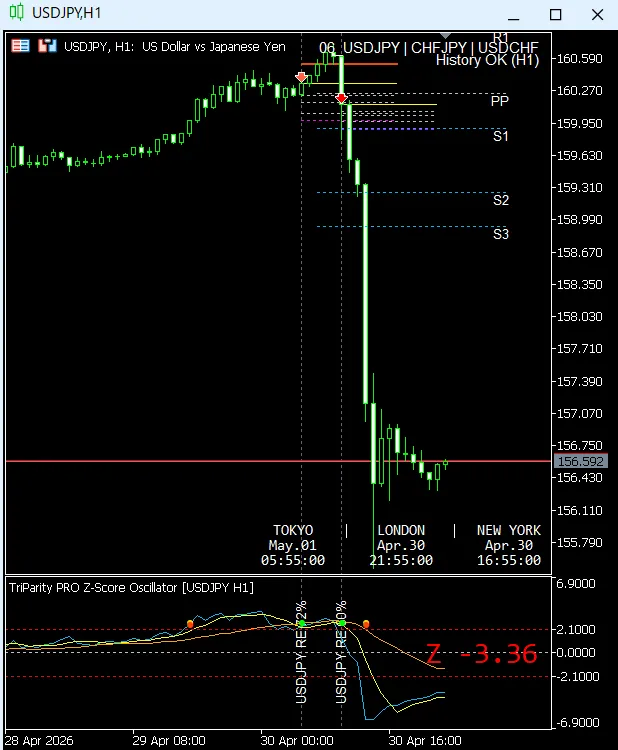
develops「Intervention Ripple MT5 Indicator Series」 is precisely this“visualizing the distortion of the tri-currency parity” to allow individual traders to apply a professional perspective—“don’t chase overextended moves, aim for the move back toward equilibrium from a distorted state”—to their own trading..
【Intervention Ripple Pro】Three-Currency Parity Analysis MT5 Indicator Three-Point Set(Product Link)
Summary: From chart shapes to market structure
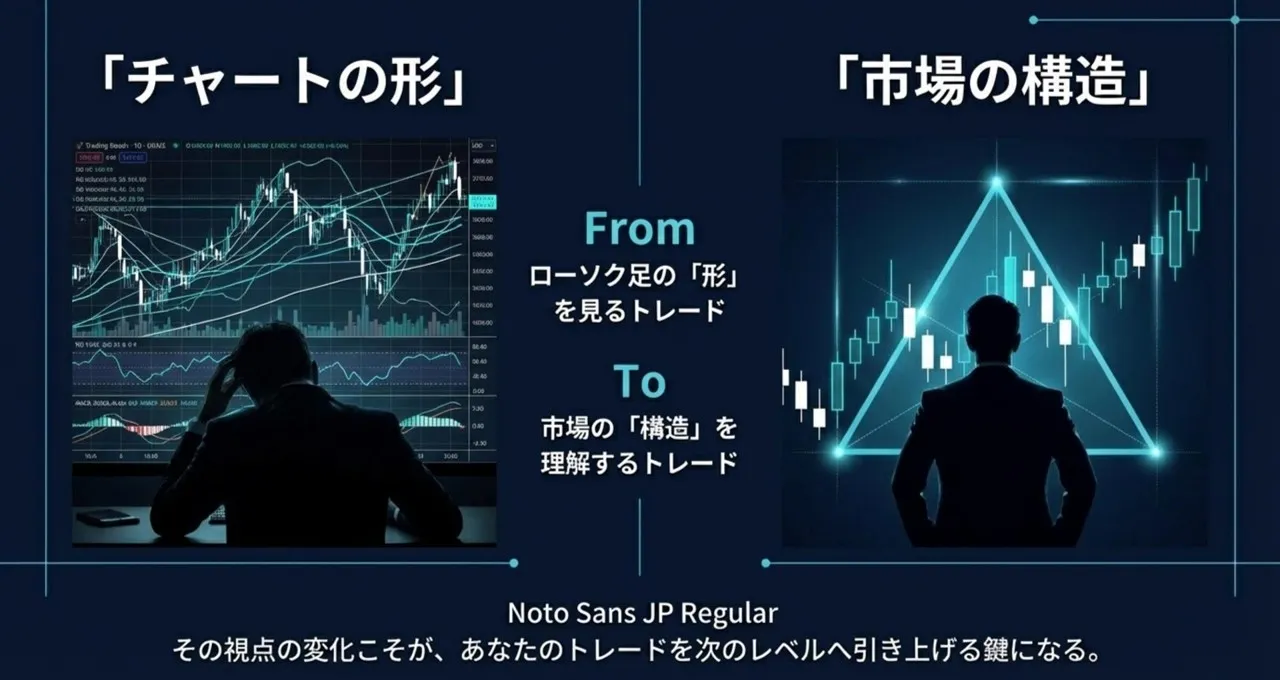
The five truths discussed in this article weave a single narrative.
First, the FX market has an absolute physical law called the“Triangular Currency Parity”. When this law breaks, professionals engage in millisecond-scale technical battles.
As a result, arbitrage opportunities become so short-lived and tiny that individuals cannot directly profit. However, the traces of the motion when professionals correct distortions—the “reversion to the original state”—contain strategic hints that individual traders can apply.
Professionals do not trade by looking only at chart shapes. They constantly consider the market’s underlying structure, i.e., the “physical laws.”If your next trade is based on the market’s distortions and their corrections rather than candle shapes, what would change? That shift in perspective may be the key to elevating your trading to the next level.