

Reason why the yen is not bought even in risk-off scenarios | Trend-following EA struggles to win in this market
If stock prices crash, yen is bought for risk aversion
I think the people who have traded FX for a long time remember this as market common sense.
In the past, when world stock markets fell sharply, dollar/yen and cross-yen often fell as well.
Funds borrowed in the low-interest yen to invest in overseas assets would be withdrawn, triggering a unwind of the yen carry trade.
However, in the market on July 17, 2026, this common sense hardly applied.
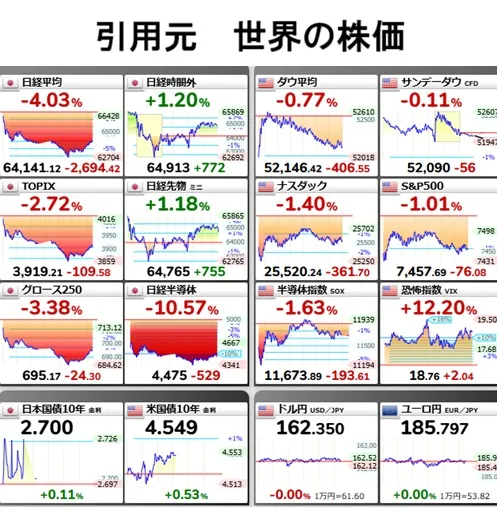
The Nikkei Stock Average closed down 4.03% from the previous day, and at one point fell more than 6%.
Even though there was a clear risk-off market driven by global semiconductor stock losses and the intensifying Middle East tensions, the USD/JPY remained almost flat in the 162-yen range.
The simple market structure based on the assumption of “stock falls lead to yen buying” as the premise of the yen carry trade is coming to an end.
The currency market now moves not only on stock prices and the VIX, but also on multiple factors such as policy rates, government bond yields, fiscal policy, crude oil prices, and intervention in the currency market.
And this change is affecting not only discretionary traders trading USD/JPY but also MT4/MT5 trend-following EAs.
In this article, drawing on six years of EA/indicator development experience and involvement in over 200 developments, I explain what has changed in the yen carry trade and what needs to be reconsidered in future EA automated trading.
July 17, 2026: Stocks plunged, but the yen was not bought
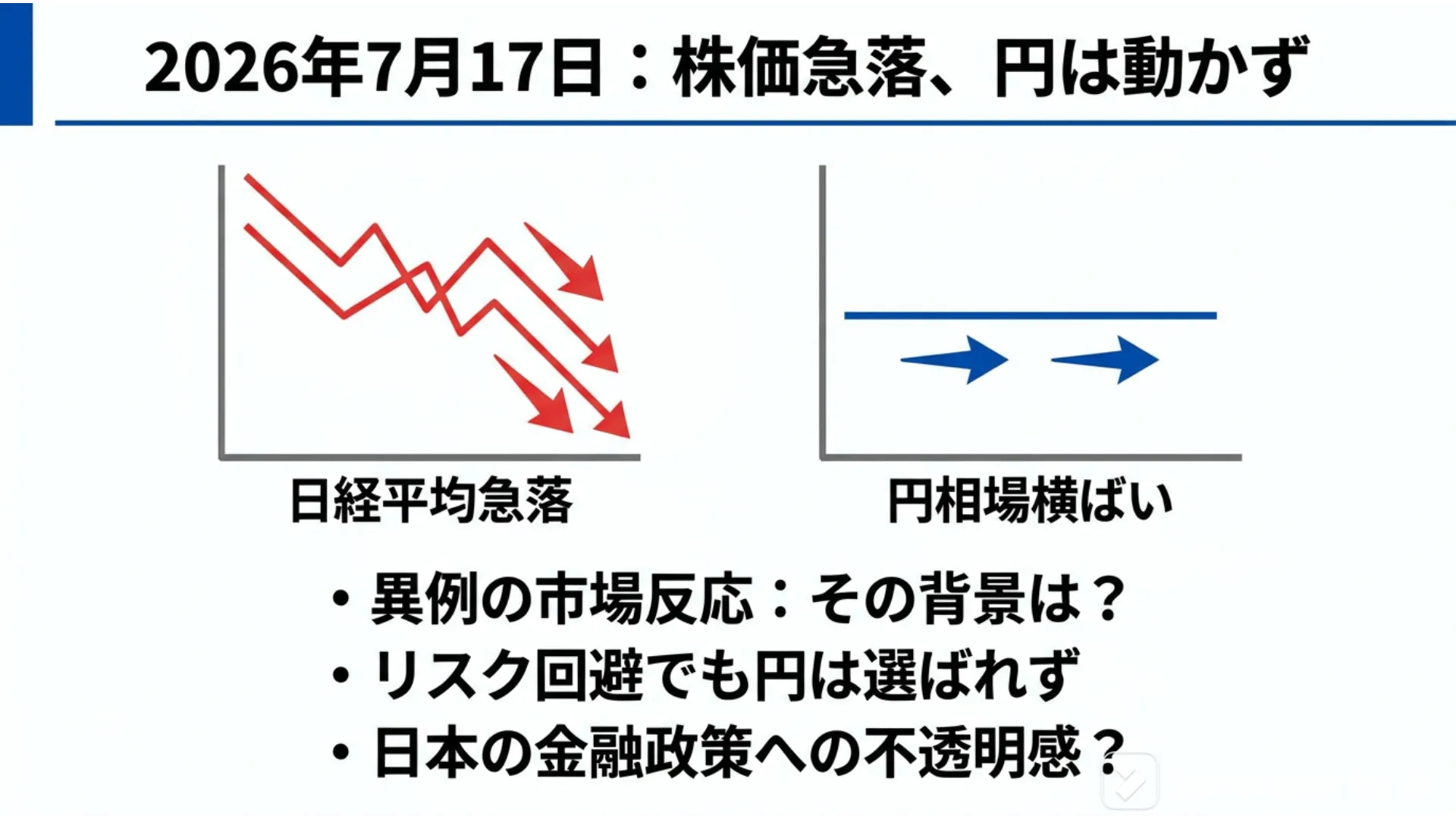
The Nikkei Average finished down 4.03% at 64,141.12 yen, and at one point dropped as much as 6.18%. From the peak on June 25, the decline exceeded 11%, entering a corrective phase according to reports.
The decline was centered on semiconductor-related stocks.
Semiconductor stocks sold off in the United States as well, and tensions in the Middle East and rising oil prices compounded the move. In other words, it was not a risk-on environment where investors actively took on risk, but a risk-off phase where funds were withdrawn from risk assets.
A few years ago, on days like this, it would not be surprising to see the yen buyback.
Nevertheless, USD/JPY hardly moved around the 162-yen range. Euro/yen and pound/yen also did not see sharp yen gains.
This indicates that the traditional “stock down = yen up” relationship has weakened significantly.
What exactly is the yen carry trade?
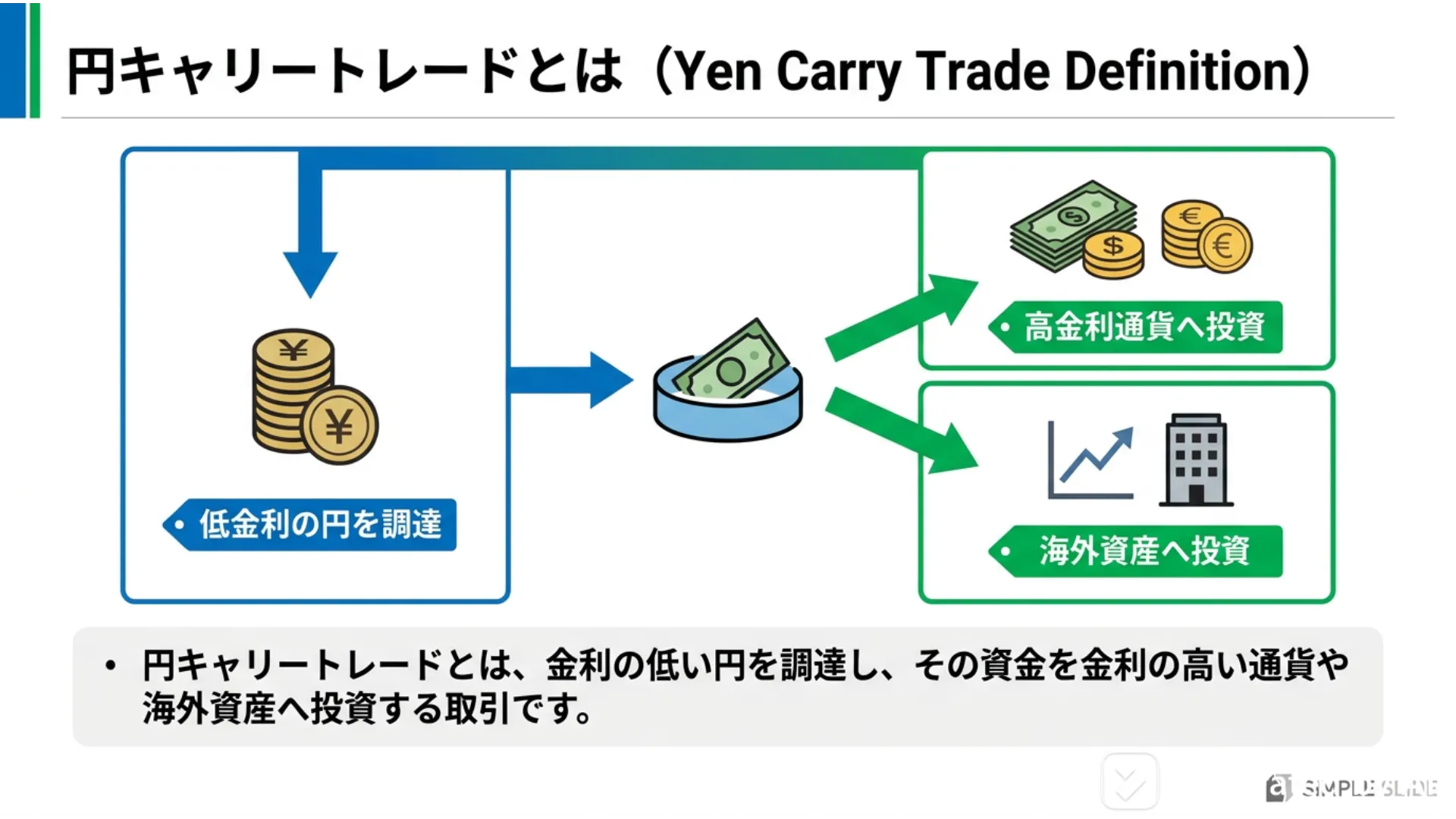
For example, borrow low-interest yen, convert to USD, and buy U.S. Treasuries.
If U.S. interest rates are higher than Japanese rates, the interest rate differential becomes profit. Furthermore, if the yen weakens, you also gain from exchange-rate differences when converting dollars back to yen.
As long as the yen remains weak and overseas asset prices rise, this is a highly compatible trade.
However, when market risk increases, the situation changes.
Investors sell overseas assets and buy yen to repay borrowed yen. This is the unwind of the yen carry trade.
In the past, a typical flow was as follows:
Stock prices fall.
Investors sell overseas assets.
They buy back the borrowed yen.
Yen strengthens, and USD/JPY and cross-yen decline.
This is why people have said that “when risk-off, yen is bought.”
The yen wasn’t simply bought because it is a safe-haven currency. Because global interest rates were low, funds were raised using yen, and when those trades were unwound, they were bought back.
Has the yen carry trade really ended?
In short, the yen carry trade itself has not ended.
As long as Japanese interest rates remain lower than overseas rates and the yen remains relatively stable, there are still merits to borrowing yen to invest in higher-yield currencies or overseas assets.
In fact, a large unwind of yen carry trades occurred in August 2024.
With the Bank of Japan policy changes, concerns about U.S. economic slowdown, and rising volatility, the yen spiked sharply.
In other words, yen carry trades still exist and can unwind rapidly when conditions align.
Then what exactly has ended?
What is ending is,the simple relationship where a fall in stock prices automatically triggers a unwind of yen carry trades.
In the past, there were periods when the stock price and the currency pair moved in a fairly obvious synchronized manner.
But now, even when stock prices fall, the U.S. dollar is bought as well.
Therefore, a straightforward trade like “sell cross-yen when stocks crash” has become difficult to sustain.
Reasons stock prices fall but yen is not bought
In risk-off, the dollar can be bought more than the yen
What stood out in the current market is dollar buying as a safe asset.
When Middle East tensions intensify, investors seek dollars and U.S. Treasuries.
The U.S. dollar is central to global settlement and funding, so it tends to be bought when markets are unstable.
Even if the yen buys modestly in risk-off, if the dollar is bought as well, USD/JPY will not fall.
As a result, looking only at USD/JPY, it seemed like there was a calm market even while both yen and dollar were bought.
FX now prioritizes interest-rate differentials over stock prices
The major factor moving USD/JPY today is the interest rate differential rather than stock prices.
Whether U.S. policy rates will rise or fall, whether the Bank of Japan will raise rates again, and whether the yield gap between U.S. Treasuries and Japanese government bonds will narrow are key concerns.
In this kind of market, the idea that stock prices falling causes USD/JPY to fall does not hold.
The yen itself has become a currency hard to buy
In risk-off, the yen isn’t automatically bought.
There are unique factors in Japan that push the yen in different directions.
The interest-rate gap between Japan and abroad, continued investment in overseas assets, yen selling due to energy imports, and concerns about fiscal policy are among them.
Because there are both reasons to buy and reasons to sell the yen at the same time, a financial panic does not necessarily cause the yen to strengthen.
The yen’s status as a safe asset is not fixed and can change with market conditions.
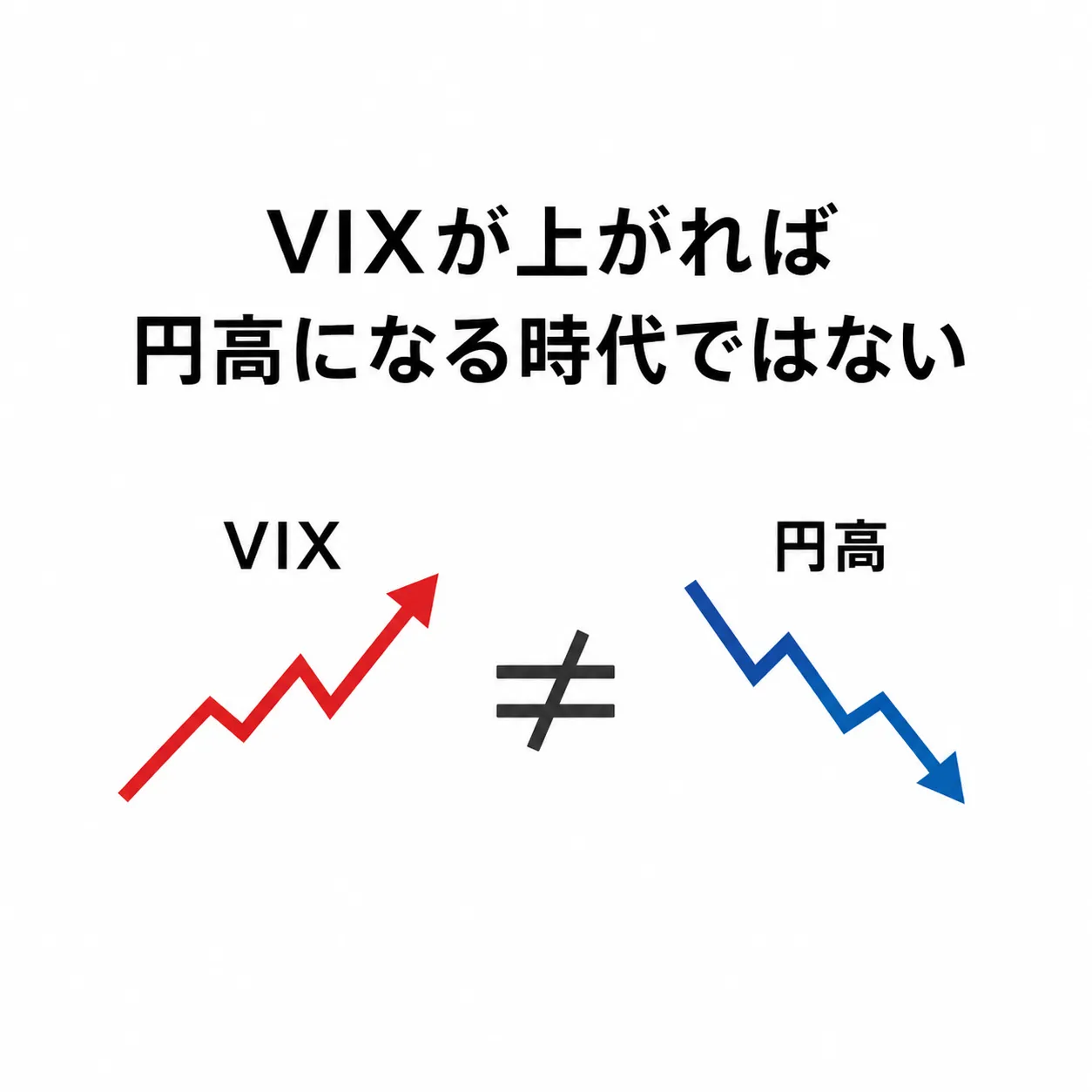
In the past, there was a relatively clear pattern of VIX rising, stock prices falling, yen strengthening, and cross-yen declines.
However, the correlation between VIX and the yen is not fixed.
VIX is the volatility expected by the U.S. stock options market.
Therefore, it is dangerous to trade USD/JPY or cross-yen based on VIX alone.
In today’s exchange market, VIX is only a supplementary tool to gauge risk sentiment.
To think about the direction of USD/JPY, you should also watch U.S. Treasury yields, monetary policy in the U.S. and Japan, the dollar index, and speculative positions, all at once.
USD/JPY has become a market that “rises slowly, then falls suddenly”
Currently, USD/JPY is influenced by both forces pushing for a weaker yen and forces pulling it stronger.
The U.S./Japan rate gap and overseas investment support a weaker yen.
On the other hand, expectations of BOJ rate hikes, U.S. rate-cut expectations, and government currency interventions push toward a stronger yen.
Under normal conditions, USD/JPY gradually rises supported by the rate differential.
However, once the yen weakens beyond a certain point, government intervention becomes a consideration. If the outlook for monetary policy changes, yen-selling positions are unwound en masse.
As a result, the rise can take days, while the fall can occur in minutes to hours, creating an asymmetric market.
In 2026, the Japanese government carried out currency interventions totaling 11.7349 trillion yen during the period April 28 to May 27. The Ministry of Finance’s monthly report confirms large yen-buying interventions during this period.
When such interventions occur, the trends that had persisted are shattered in an instant.
Even if moving averages are turning up or recent highs are being updated, extremely large sell orders can appear beyond what normal technical analysis would anticipate.
In short, even if the USD/JPY is trending higher in the long term, you cannot hold a buy position with confidence.
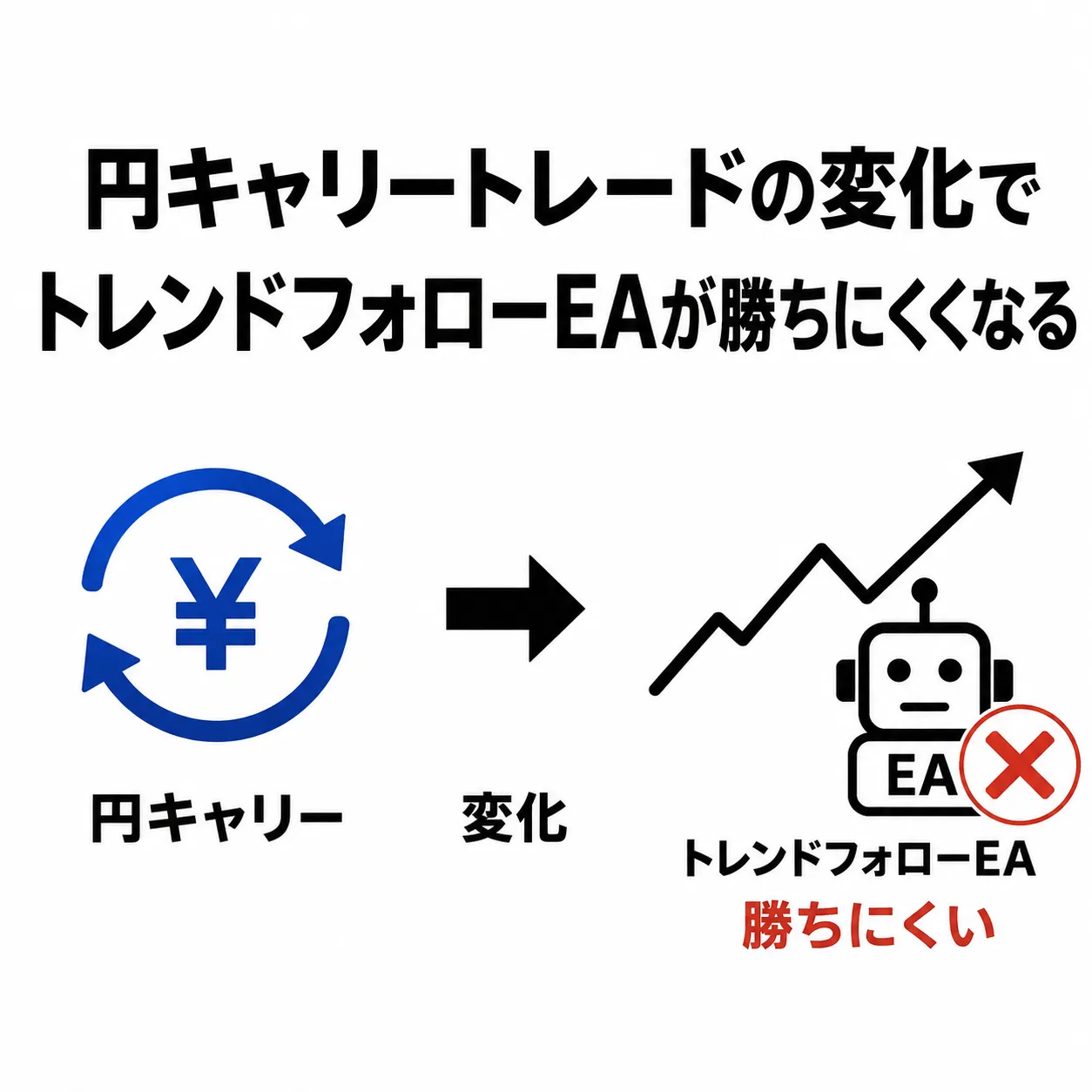
Trend-following EAs profit by capturing price movement in one direction for a period of time.
Especially for swing-type, you hold positions for several days, enduring minor fluctuations while targeting a large trend.
In the past USD/JPY, stock price rises and yen depreciation, or stock falls and yen appreciation were somewhat linked, allowing longer-lasting market directions.
But now, even when stock prices fall, the yen is not bought.
If you keep buying USD/JPY solely on interest-rate differentials, you risk being swept up by sudden interventions or policy changes.
That is, even if you think you are riding an uptrend, a sharp drop can occur at the end.
The most challenging aspect for trend-following EAs is not the absence of movement, but the movement appearing to occur and then disappearing quickly.
Prices can break out and then reverse immediately.
Prices rise to a new high right after breaking out. Profits accumulated over days can be wiped out in an instant by interventions or statements by officials.
As such market conditions increase, the losses of trend-following EAs tend to continue.

For example, in past data, stock price rises might have correlated with yen selling and stock price declines with yen buying.
Trend-following EAs optimized for such environments could be adapted to the historical yen carry trade structure, potentially.
However, today stock prices can fall and yen can still be bought, with USD/JPY remaining in a range.
In the middle of a long yen-weak trend, a sudden large intervention can occur.
In such markets, the parameters that performed well over the past two decades may not work as-is.
Personally, I have developed more than 200 EAs/indicators, and even when long-term backtests look steadily rising, I have seen recent markets where entries and stops are repeatedly triggered.
This does not necessarily mean the EA is broken.
The market dynamics that the EA assumed may have changed.
But that does not mean you should optimize only for the most recent months.
Overfitting to short-term moves leads to poor performance in the future.
What matters is to confirm the long-term fundamental edge of the logic while also checking whether it has worked in the last 2–3 years separately.
If the overall period shows profit but the last two years show consistent losses, the current market structure may not suit the EA.
Also, be cautious with EAs that make most of their profits in a few large trends.
Historical trends of the same scale may not occur again.
What the current USD/JPY needs is adaptation, not prediction
In upcoming EA trading, it is more important to design systems that minimize losses when market conditions change than to perfectly forecast the future.
Rather than running a single EA 24 hours a day, you should identify the timeframes where it performs well and where it does not.
If using trend-following EAs, avoid periods with unclear directional clarity. In phases with heightened intervention risk, reduce position sizes.
Even modestly, this changes the risk of being caught in unexpected abrupt moves.
In today’s USD/JPY market, you do not need an EA that keeps predicting the market.
You need an EA that avoids large losses when it is wrong.
EA automated trading is not something you set and forget for 24 hours
EA automation cannot be left running 24 hours a day just once it is set up.
In particular, USD/JPY moves rapidly with U.S. employment data, CPI, FOMC, remarks by the Fed chair, Bank of Japan policy meetings, etc.
Even trend-following EAs that work under normal conditions can easily hit stops when important indicators are announced and price movements rapidly switch direction.
The same applies to currency interventions.
Just because a trend is continuing does not mean you can keep positions in the same direction forever.
Especially when USD/JPY is at a historic yen-weak level, it can be better to prioritize comments and interventions from governments over traditional technical analysis.
An EA is a tool to automate entries.
You do not need to rely on it for decisions about market conditions or whether to keep running or stop.
In actual operation, you should avoid major indicators, limit lot sizes, and stop after a certain loss threshold.
EA automation is not complete neglect.
You should monitor market structure and update validation periods and operating conditions.
That is the mindset needed to continue EA automation in the new USD/JPY market where the yen carry-trade common sense has collapsed.
Author information
Supervised and written by: Masayan
MT4/MT5 EA and indicator developer. Former Web engineer and programmer.
━━━━━━━━━━━━━━━━━━
Grid Rush series
━━━━━━━━━━━━━━━━━━
MT5 sign indicators
Volatility Rush Indicator
https://www.gogojungle.co.jp/tools/indicators/80364
MT4 sign indicators
Grid Rash_Arrow_Indicator
https://www.gogojungle.co.jp/tools/indicators/55251
MT5 EA trading
Grid Rush MT5
https://www.gogojungle.co.jp/systemtrade/fx/78797
MT4 EA trading
Grid Rash EURUSD
https://www.gogojungle.co.jp/systemtrade/fx/55503