

EA automated trading should not be left unattended 24 hours | A trading method to avoid difficult market conditions in the 2026 USD/JPY market
“EA that used to be profitable, but recently its performance has become unstable”
“Backtests showed an upward slant, but in live trading the number of stop losses has increased.”
When faced with such a situation, you may think the EA’s logic no longer works, or that there is something wrong with the EA itself.
However, in realityit is often not that the EA is broken, but that the current market environment does not match the market the EA is good at.
In 2026, the USD/JPY market is extremely challenging: while there is ongoing pressure for the yen to weaken, there is also a strong sense of caution about currency intervention, which can cause abrupt moves to the yen in the upside. The Ministry of Finance disclosed that it carried out foreign exchange balancing operations totaling 11,734.9 billion yen from late April to May 2026. USD/JPY dropped from the 160s to the 155s on April 30, and subsequent abrupt changes occurred due to intervention expectations.
In such markets, swing-type trend-following EAs that target multi-day to multi-week trends tend to struggle, while scalp-type contrarian EAs that aim for small price moves within a narrow range can function more easily.
However, contrarian EAs cannot operate 24 hours unconditionally, as they would be swept up by currency interventions and rapid market moves.
The important points are threefold:
- What kind of market to operate in
- What time of day to operate
- Around which events to pause
In this article, based on the experience of developing more than 100 MT4/MT5 EAs and indicators, I will explain points to check when performance deteriorates and how to avoid weak markets by adjusting operating times.
Causes for EA performance drop are not limited to logics deteriorating
When EA performance declines, many first suspect the logic’s lifespan.
“Is this EA no longer usable?”
“Has the market’s edge disappeared?”
It’s natural to think this, but there are things to verify before replacing the EA right away.
They are,whether the EA’s logic matches the current market environment.
EAs have their own favorable and unfavorable markets
EA performance is not uniform across all markets.
For example, trend-following EAs excel when prices move in a sustained direction. In ranging markets with no clear direction, they can suffer as prices bounce against positions—buying then selling, or vice versa.
Contrarian EAs perform the opposite.
They excel in range-bound markets where prices oscillate within a certain width, but when a strong one-way trend occurs, averaging down after contrarian entries can magnify losses.
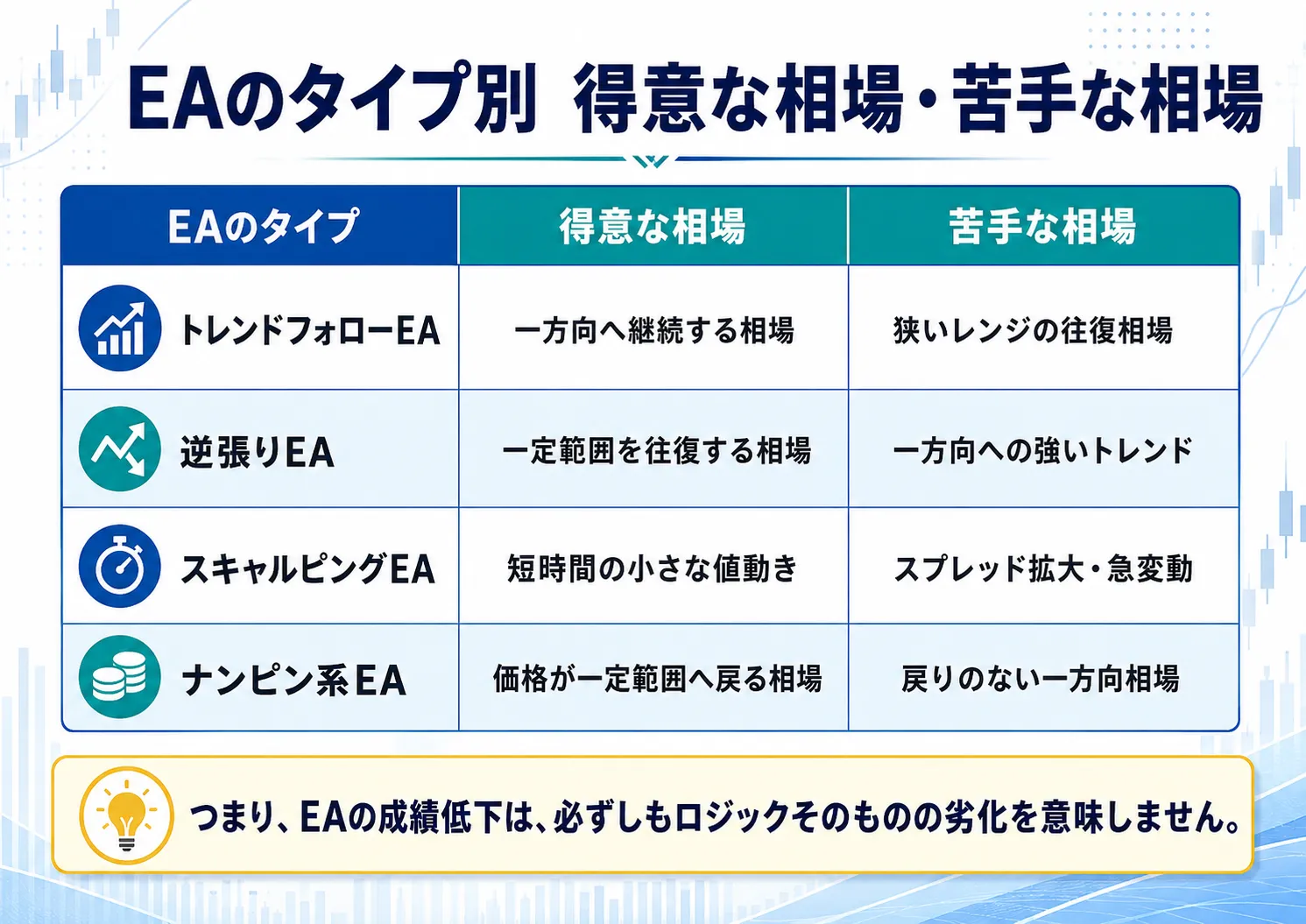
Sometimes the issue is simply that the range the logic expects and the current price movement’s width are mismatched.
Good backtests can still underperform if the market environment changes
Backtests are important, but not all periods experienced the same market conditions.
There were times when trends persisted for long periods and times when narrow ranges persisted. Movements change due to policy, interest rate differentials, geopolitical risk, and interventions.
Since 2020 I have developed MT4/MT5 EAs and indicators—over 100 so far.
From six years of development and operation, I’ve learned that the longer an EA can be used, the more you understand when not to trade.
If you keep optimizing parameters after performance declines, you risk overfitting to the latest market conditions.
What you should check first is not the settings, but the market environment.
Reasons why trend-following EAs are difficult in 2026 USD/JPY markets
In 2026 the USD/JPY market remains predisposed to yen weakness, yet there is extremely strong caution about intervention.
On April 30, 2026, USD/JPY fell from around 160.725 to around 155.50. Later, on May 6, the yen sharply advanced again, fueling expectations of additional intervention. The Ministry of Finance disclosed foreign exchange balancing operations of 11,734.9 billion yen from April 28 to May 27. Subsequently USD/JPY recovered back to the 160s, reaching the 162s by late June 2026. In early July, it briefly reached 162.84, but intervention fears caused sudden yen-strength moves again.
Ayen-weakening trend and intervention fears coexist
The current USD/JPY market is difficult because, in the long term the yen is weak, but in the short term it can suddenly strengthen dramatically.
For a typical trend-following EA, you would buy when a rising trend is recognized.
However, if after a purchase there is intervention or a sudden drop due to intervention expectations, losses can be larger than usual.
Conversely, if you buy during a drop and the impact of intervention fades, the market can reverse and your selling positions can hit stop loss.
In other words, it is not a lack of direction.
There are big yen-weakening trends mixed with extreme sudden yen-strength moves.
Swing-type EAs tend to incur more stop losses in range-bound markets
Swing-type EAs targeting days to weeks of price movement only earn substantial profits when the trend continues.
As of July 2026, prices rise from 160 to 162, return to 160, then rise to 162 again and fall sharply, so a clear trend does not form.
This often leads to the following sequence of actions:
- Identify an uptrend and buy
- Get caught in a sell-off and hit stop loss
- Identify a downtrend and sell
- Bounce toward yen weakness and hit stop loss
- Again get caught in a sharp drop due to intervention
This is not a bug in the EA.
It is the type of price movement that trend-following logics struggle with the most.
What contrarian scalping EAs tend to perform well in range markets
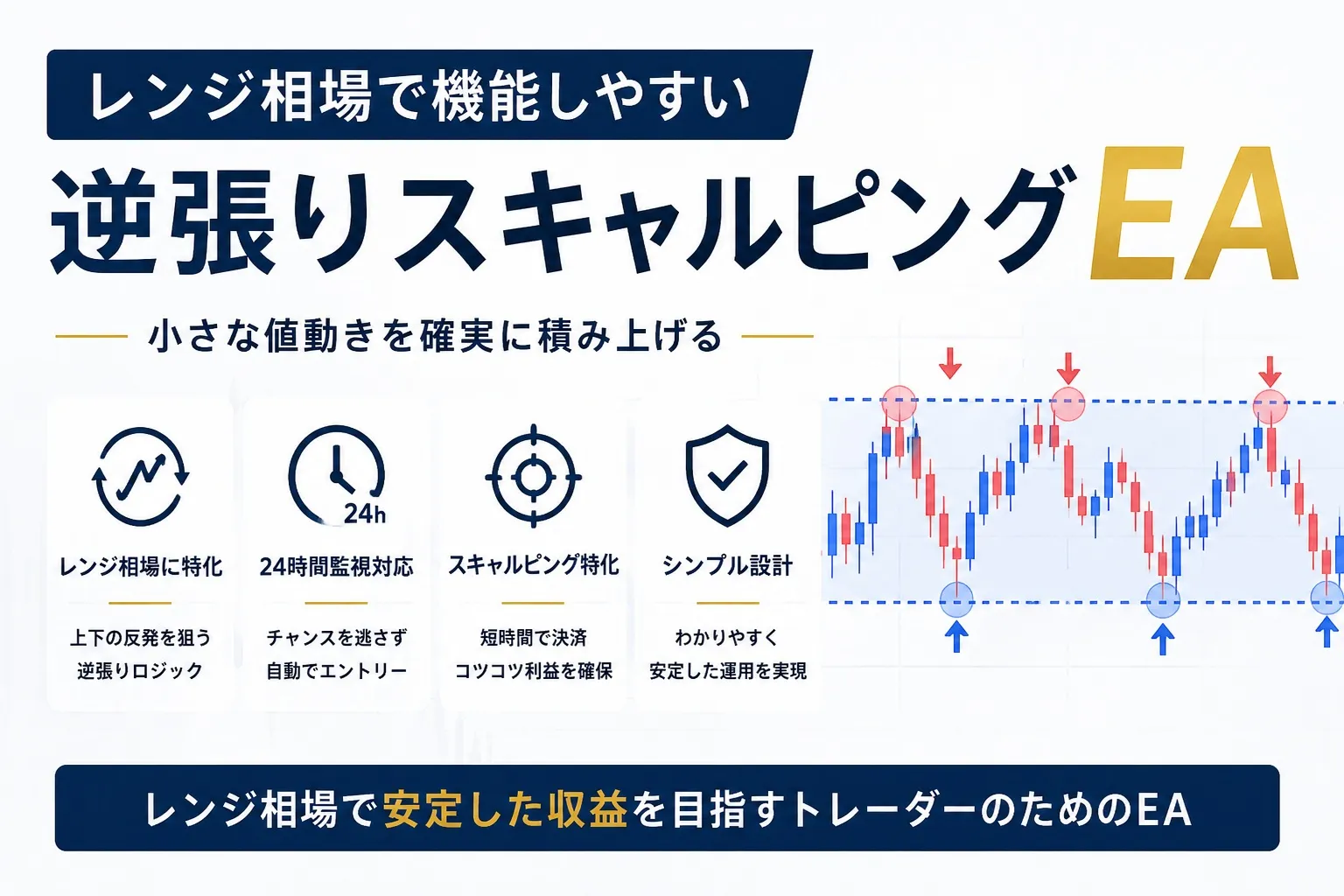
Contrarian means selling at higher prices and buying at lower prices as a counter-trend approach.
Scalping logic that captures multiple narrow ranges
A scalping EA does not aim for a single large move in one trade, but multiple small moves in a short time frame.
For example, if USD/JPY moves back and forth within a range of 161.20 to 161.60 in one day, you can profit by selling near the upper bound and buying near the lower bound.
With day-trading style scalping, you can close within the same day and not carry positions overnight.
This kind of logic tends to perform well when currency pairs are stagnant and clear trends are hard to form.
The idea of not aiming for profits in strong trends
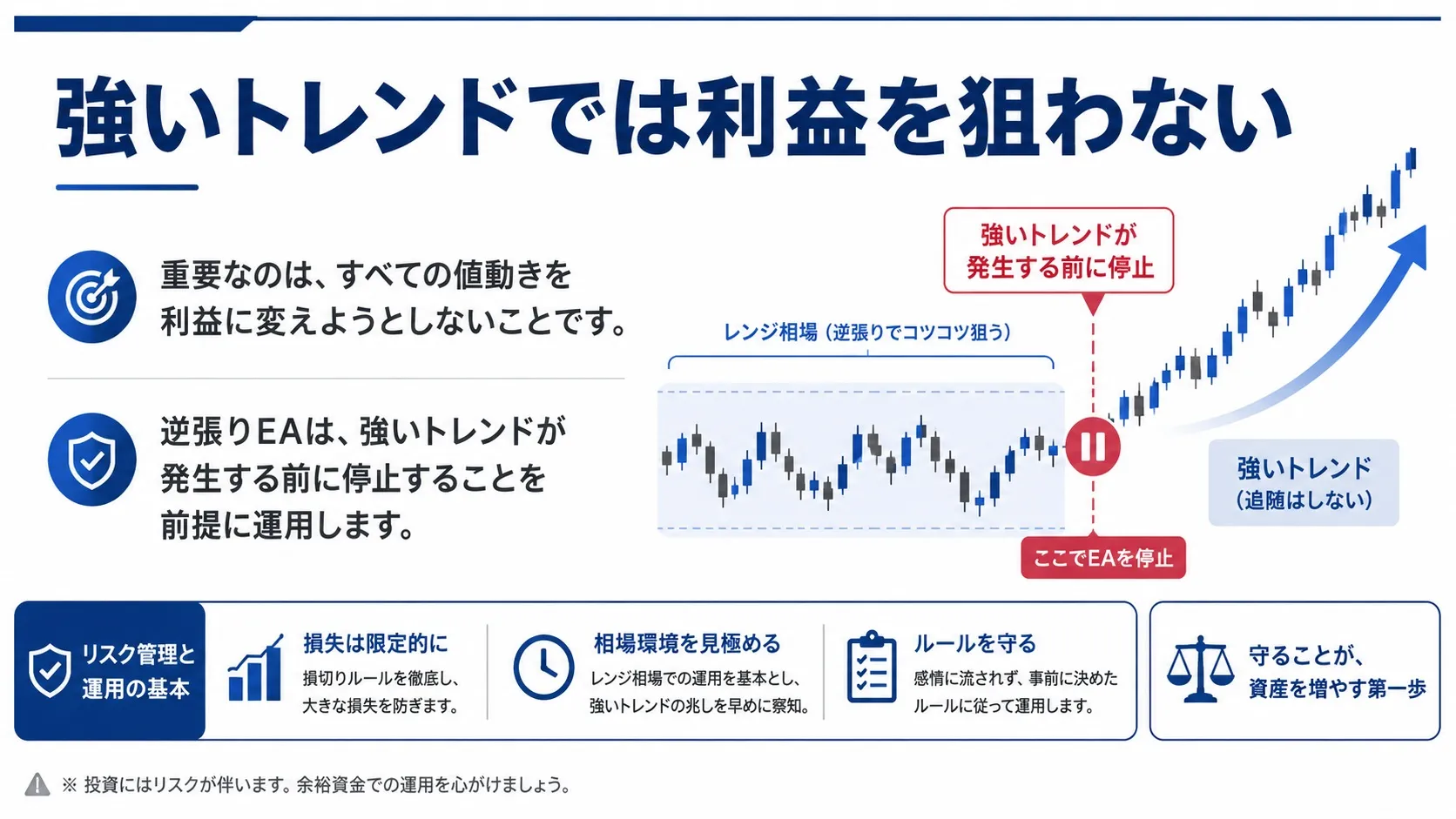
Contrarian EAs operate with the premise of pausing before a strong trend emerges.
This is not a weakness but a design of operation.
Just as trend-following EAs avoid range markets, contrarian EAs avoid strong trending markets.
When choosing an EA, you should think not about “which EA makes the most money” but rather the following:
In the current market, which logic has the relatively smaller loss risk.
Having this perspective helps reduce the risk of forcing EAs that don’t match the market to operate.
The biggest weakness of contrarian EAs is sudden one-way moves
The biggest risk for contrarian scalping EAs is when prices do not revert.
In normal range markets, prices that rise too high will back off, and those that fall too low will bounce back.
But when triggers include currency interventions, economic data, policy rate announcements, or speeches by influential figures, markets can move in one direction for a while.
Difficulties from catching a falling knife
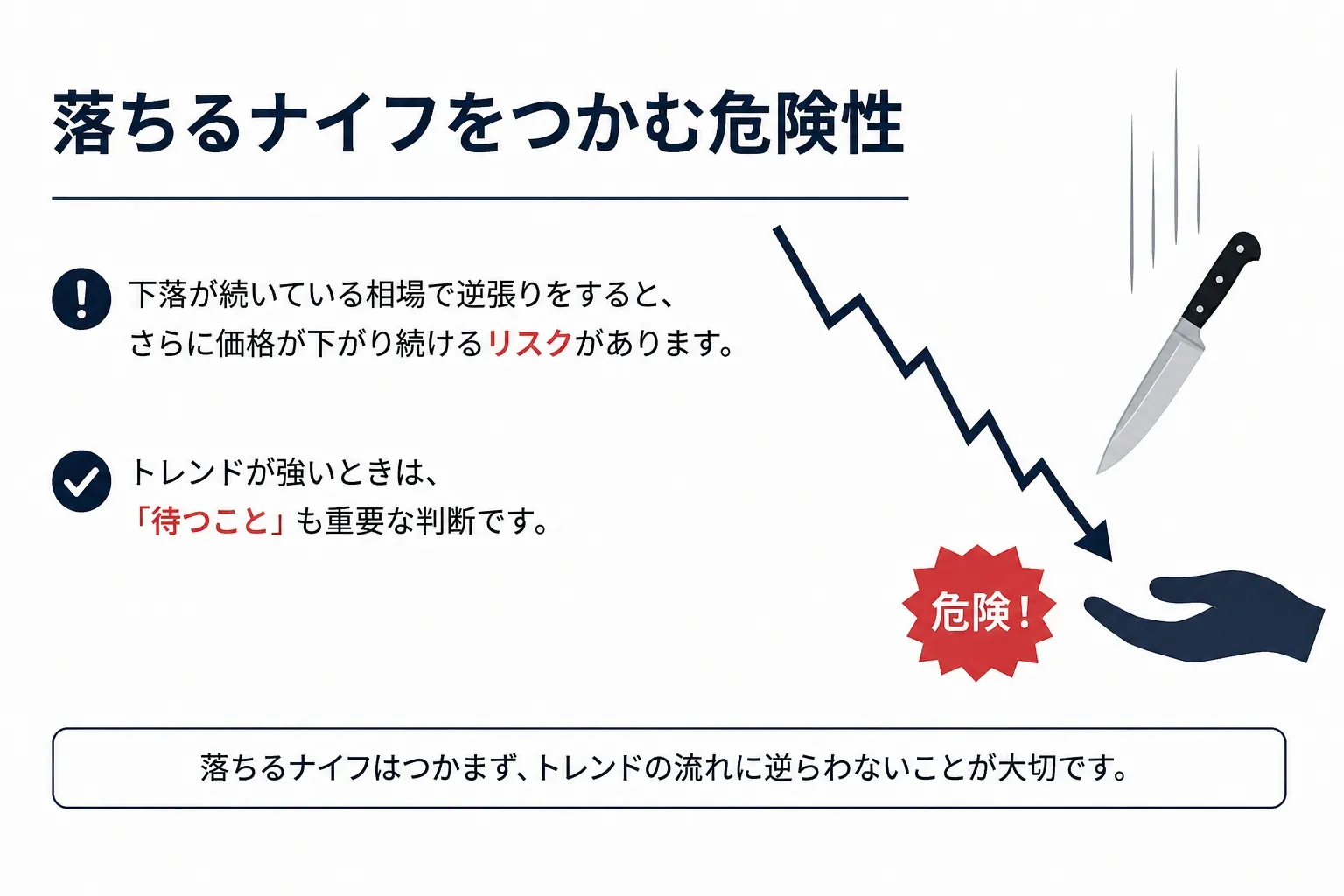
For averaging-down EAs, whenever price rebounds, the average acquisition price lowers, making it easier to realize profits.
On the other hand, if it keeps dropping without rebounds, the number of positions and unrealized losses both increase.
In situations where the market moves several yen in a short time due to interventions, conventional range-based logics may fail to cope.
Cases where averaging-down selling gets squeezed
The same applies to rising markets where more sell positions are added.
Even if you keep selling with the expectation that it will drop soon, if prices rise to 160, 161, 162, unrealized losses expand.
In a yen-weak environment, selling merely because of intervention fears can lead to being squeezed until intervention occurs.
What contrarian EAs need is not the ability to predict interventions.
A mechanism to avoid time periods prone to unpredictable rapid moves.
Times to keep EAs running and times to stop
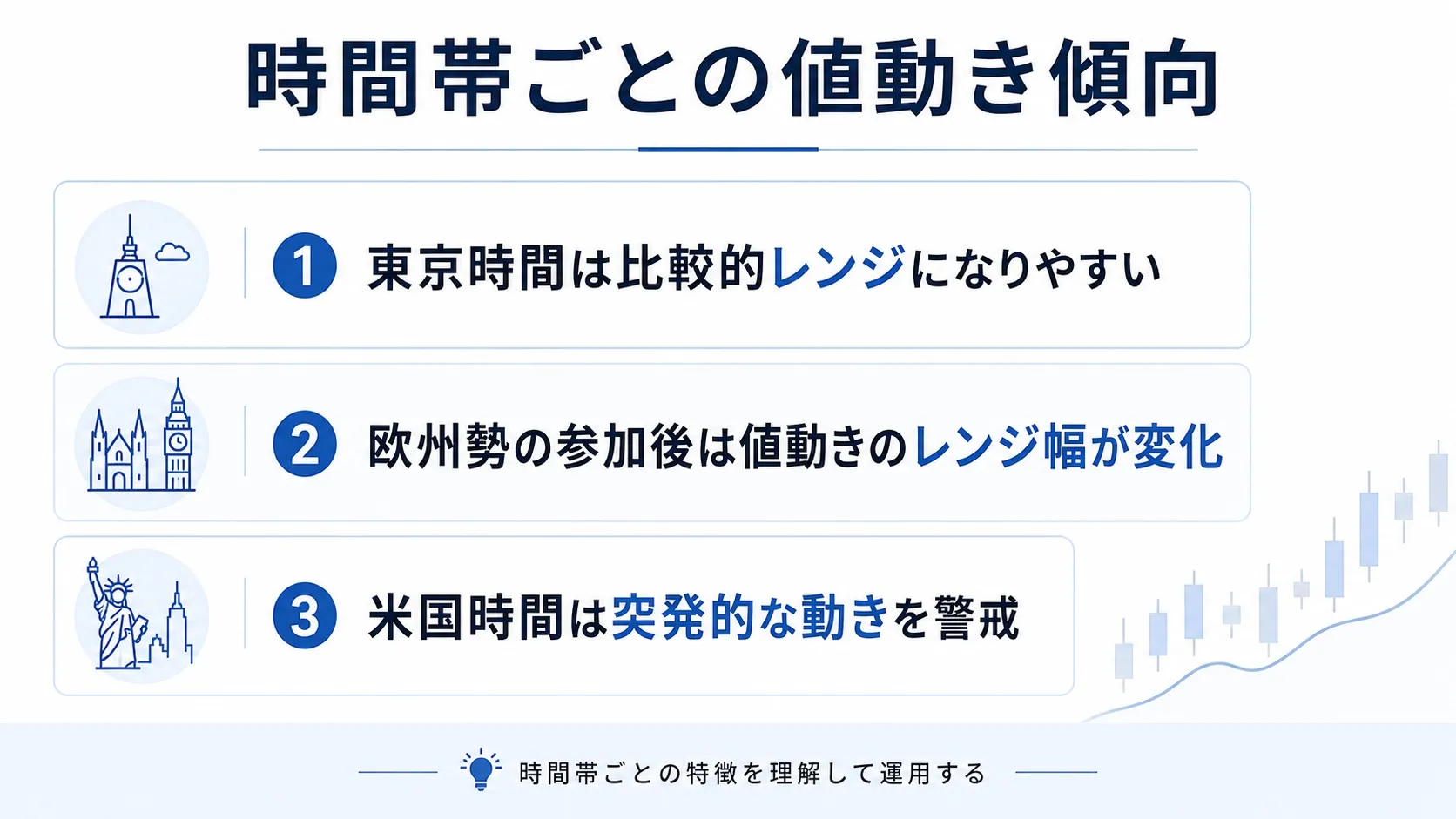
As market participants and economic indicators change, the price action in different time zones varies.
Tokyo time tends to be relatively range-bound
From the morning in Japan until before European participants arrive, contrarian scalping can be more effective.
A general guideline is roughly 9:00 to 15:00–16:00.
Of course, even in Tokyo time, days with Bank of Japan policy announcements, board meetings, or statements by government officials can see significant moves.
“Tokyo time is always safe” is not true.
As long as there are no major events, price movement can be calmer than in European or US time zones.
Watch price action after European participants join
From around 15:00–16:00 Japan time, European market participants begin to appear.
In this period, the price may break out of the Tokyo-range.
In particular, caution is required for EAs targeting the euro and pound.
If CPI, policy rate, or employment data from the UK or euro area are released, spreads and volatility can expand in a short time.
Consequently, contrarian strategies that worked in Tokyo time may suddenly stop working as European time begins.
US time and late-night Japan time require vigilance against sudden moves
Key US economic indicators and figures concentrate in the evening to late night in Japan.
Statements by US Treasury Secretary, the President, the Fed Chair, and other officials can trigger sudden moves in dollar-related currency pairs.
It is not possible to predict the content of statements precisely in advance.
Therefore, when operating MT4/MT5 contrarian EAs, a practical approach is to pause after Japan’s night hours.
Important events when you want to stop the EA

Indicators to watch in relation to the US dollar
When trading USDJPY, EURUSD, GBPUSD, etc., pay attention to the following events:
- US Nonfarm Payrolls
- US CPI (Consumer Price Index)
- US PPI (Producer Price Index)
- FOMC rate decision
- FRB Chair press conference
- US GDP
- Retail sales
- Statements by US President or Treasury Secretary
In particular, employment data, CPI, and FOMC can move in one direction right after release and then reverse sharply.
For contrarian EAs, a one-direction move is dangerous, as is a fast up-down market.
Indicators to watch for the Japanese yen
In USD/JPY and cross yen pairs, check these events:
- Bank of Japan policy rate announcement
- BOJ Governor remarks
- National CPI
- Statements by Japanese government/Ministry of Finance officials
- A rising alert level for currency intervention
Intervention by the currency market cannot be predicted in advance.
There were reports of additional intervention during holidays when liquidity is low, from late April to May 2026.
When USD/JPY is near intervention alert levels, you should reduce lots, shorten operating hours, and decrease the number of open positions.
Indicators to watch for pounds and euros
For GBPJPY, EURUSD, EURJPY, not only US indicators but also UK and euro-area events should be monitored.
- Bank of England policy rate
- UK CPI
- UK employment data
- ECB policy rate
- ECB President remarks
- Euro area CPI
- Major German indicators
Even if you just pause US indicators, if you’re moving GBPJPY around UK rate announcements, you can still be exposed to sudden moves.
It’s important to map out which events in each currency pair influence it.
Steps to verify when EA performance declines
When performance worsens, don’t rely on gut feeling to stop or restart; verify with trading history.
![]() First, check loss-heavy time periods from MT4/MT5 trading history
First, check loss-heavy time periods from MT4/MT5 trading history

For example, classify as follows:
- 9:00–15:00
- 15:00–21:00
- 21:00–1:00
- After 1:00 a.m.
If night losses are extremely high, pause the EA at night before changing its logic.
Classify trending vs. ranging markets
Look at the day of loss and determine whether price moved in one direction or bounced within a range.
If contrarian EAs lose on trending days, that may be an expected weakness.
The issue is not that the weakness exists, but that you keep operating on days when it is likely to appear.
Exclude trading around economic indicators
Next, correlate the loss times with indicator release times.
If you hold a position right before a major indicator and losses occur due to sudden moves afterward, set pause times.
As a guide, pause 30 minutes before and 30 minutes to 1 hour after major indicators.
However, the time to settle varies by event. For FOMC and policy rate announcements, you may need to pause longer, including the press conference.
In EA operation, it is often better to pause during times of unexpected moves than to try to maximize profits by forcing trades during those times.
Why Masayan currently runs scalping series
My current main focus is scalping EAs and sign indicators centered around Grid Rush-style approaches.
The reason is not that scalping is superior.
In markets that repeatedly bounce within a range and experience sudden moves at key price levels, it is easier to profit by targeting smaller movements in shorter times rather than holding positions for a long time.
Do not leave EAs running 24 hours
Current automated trading cannot simply be left running 24 hours unconditionally.
- Operate only during Tokyo time
- Pause before US indicators release
- Pause around major US indicators
- Pause on days of policy rate announcements for the target currency
- Lower lot sizes on days with high intervention risk
- If price starts moving in one direction, manually stop
Rather than aiming for complete automation, a semi-automatic approach that stops only during dangerous times is more practical.
Use EAs and sign indicators complementarily
For people who cannot constantly monitor charts, automated EA trading is suitable.
For those who want to review market conditions and time entries, sign indicators offer an option.
With sign indicators, you can skip signals just before economic indicators or during clear trend formations.
It is not a matter of one being superior to the other.
Choose based on your lifestyle and how much discretionary judgment you want to apply.
★ Scalping Series ★
We offer MT4/MT5 compatible EAs and sign indicators for those considering short-term trading, available on Gogojungle.
MT5 Sign Indicator
① Volatility Rush Indicator
An MT5 sign indicator that captures price moves and supports scalping entry decisions.
https://www.gogojungle.co.jp/tools/indicators/80364
MT4 Sign Indicator
② Grid Rash_Arrow_Indicator
Displays buy/sell signals on the chart for visual entry points (MT4 indicator).
https://www.gogojungle.co.jp/tools/indicators/55251
MT5 EA Auto-Trading
③ Grid Rush MT5
An MT5-compatible EA that automates scalping logic.
https://www.gogojungle.co.jp/systemtrade/fx/78797
④ Trend Rush MT5
An MT5-compatible scalping EA that trades while judging market flow.
https://www.gogojungle.co.jp/systemtrade/fx/80062
MT4 EA Auto-Trading
⑤ Grid Rash EURUSD
An MT4-compatible scalping EA that trades EURUSD.
https://www.gogojungle.co.jp/systemtrade/fx/55503
Summary — When EA performance drops, review operating hours before the logic
A decline in performance does not immediately require changing the EA or re-optimizing parameters.
What to check first is whether the current market matches the EA’s logic.
Trend-following EAs tend to perform better in trending markets, but in range markets they incur more stop losses.
Contrarian scalping EAs can handle narrow ranges but struggle with currency interventions and major economic data that cause one-direction moves.
Therefore, in currencies like USD/JPY in 2026 where there is strong intervention caution, the following operations are important:
- Pause the EA around major economic indicators
- Reassess operating hours for US time and late-night Japan time
- Limit operations to relatively stable times such as Tokyo time
- Lower lot sizes on days expected to have abrupt moves
- Do not run when the market and EA are mismatched
Automated trading is not a system to be left completely alone after deployment.
Both operating to generate profits and stopping to avoid losses are part of EA management.
If your EA performance is currently poor, do not immediately change settings on the next trading day. Instead, first collect and analyze your past 1–3 months of trading history by time of day.
Then exclude trading around major indicators and Japan’s late-night hours to observe how performance changes.
If you are considering contrarian scalping EAs, do not assume 24-hour operation—avoid major indicators, start forward testing with small lots, and gradually extend as appropriate.
EAs and indicators do not guarantee profits simply by being installed. It is essential to tailor settings to your funds and trading environment, including operating times, lots, maximum positions, stop losses, and indicator avoidance.