

How does the USD/JPY move when the "fear index" rises? Reading market sentiment from the VIX index
“Fear Index” If It Rises, How Does USD/JPY Move? Reading Market Sentiment from the VIX Index
In FX market news,
“The VIX index has surged.”
“The market is in risk-off mood.”
You may sometimes come across these phrases.
However,
“What is the VIX index?”
“Why is it related to USD/JPY?”
and many people wonder about it, don’t you think?
The VIX index is one of the indicators that forecasts future price movements in the US stock market and is generally referred to in the market as the “fear index.”
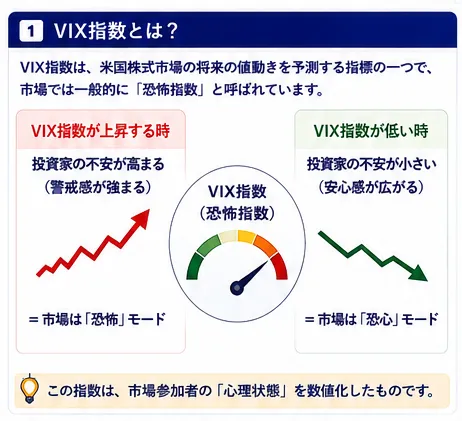
The higher investors feel substantial anxiety about the market's future, the more this index tends to rise.
Conversely, when the market is calm and optimistic, the VIX index stays at a low level.
In other words, this index can be seen as a numerical representation of the market participants’ “psychological state.”
So why does the VIX index affect USD/JPY?
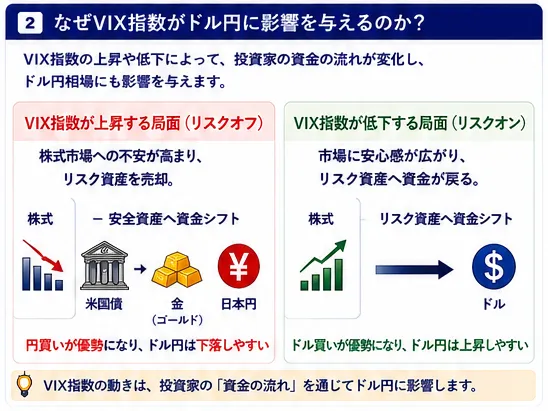
The reason lies in the flow of funds among investors.
When the VIX index rises, concerns about the stock market grow, and many investors sell risk assets.
As a result, there is a stronger tendency to move funds into safe assets such as US Treasuries and gold, and also into the Japanese yen.
Consequently, yen buying dominates in USD/JPY, and the price may fall.
On the other hand, in phases where the VIX index is declining, a sense of security spreads across the market, and funds tend to flow back into the stock market.
Investors start taking on more risk, creating an environment where USD/JPY can rise more easily.
Of course, the forex market is not determined by the VIX index alone.
However, there is no doubt that it is a very important indicator for understanding what kind of psychology investors around the world are in.
In the current USD/JPY market, market psychology changes daily due to factors such as geopolitical risk, monetary policy, and inflation trends.
The VIX index is what reflects those changes most quickly.
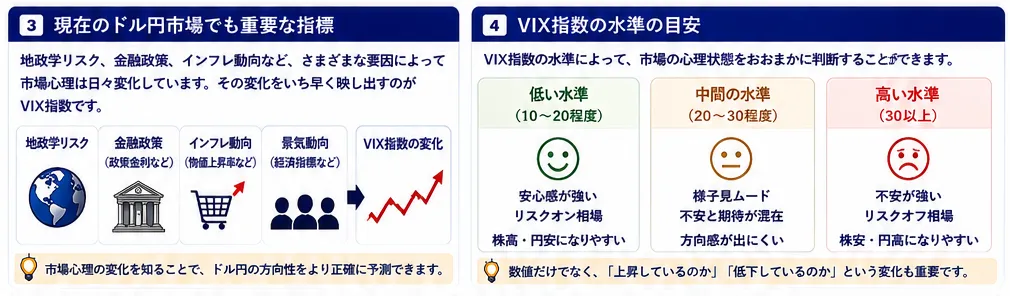
In fundamental analysis, it is important not only to look at economic indicators and policy rates but also to analyze the psychological aspect of whether market participants are “comfortable” or “on guard.”
Behind the numbers are always investors’ emotions.
And those emotions generate capital flows and move the exchange market.
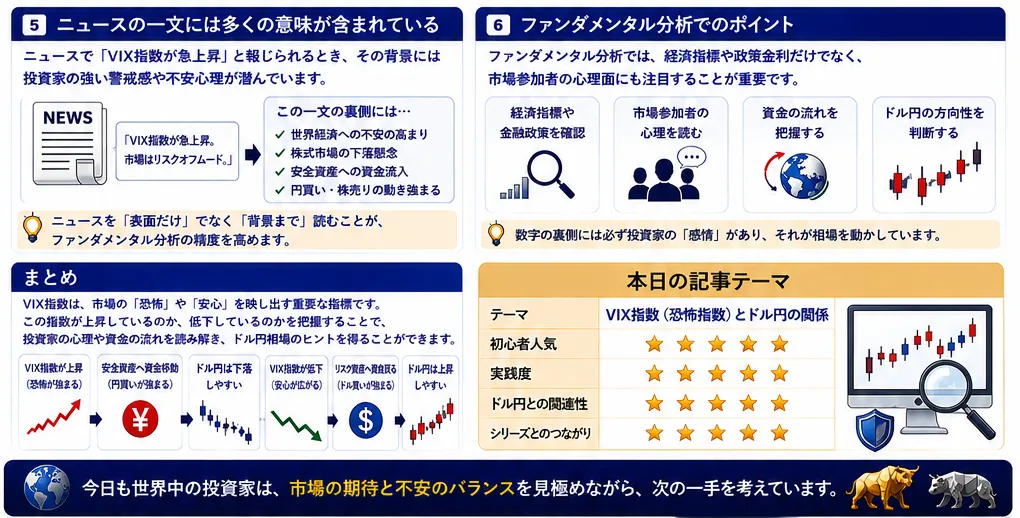
When looking at the USD/JPY market in the future, please also pay attention to the VIX index.
When you see in the news a sentence like “the fear index is rising,” you will be able to read the underlying market psychology, expanding your perspective on the market.
Today as well, investors around the world are considering the next move while assessing the balance between market expectations and anxieties.
★ Our URL:https://www.gogojungle.co.jp/users/186761?via=indicators_detail_users