
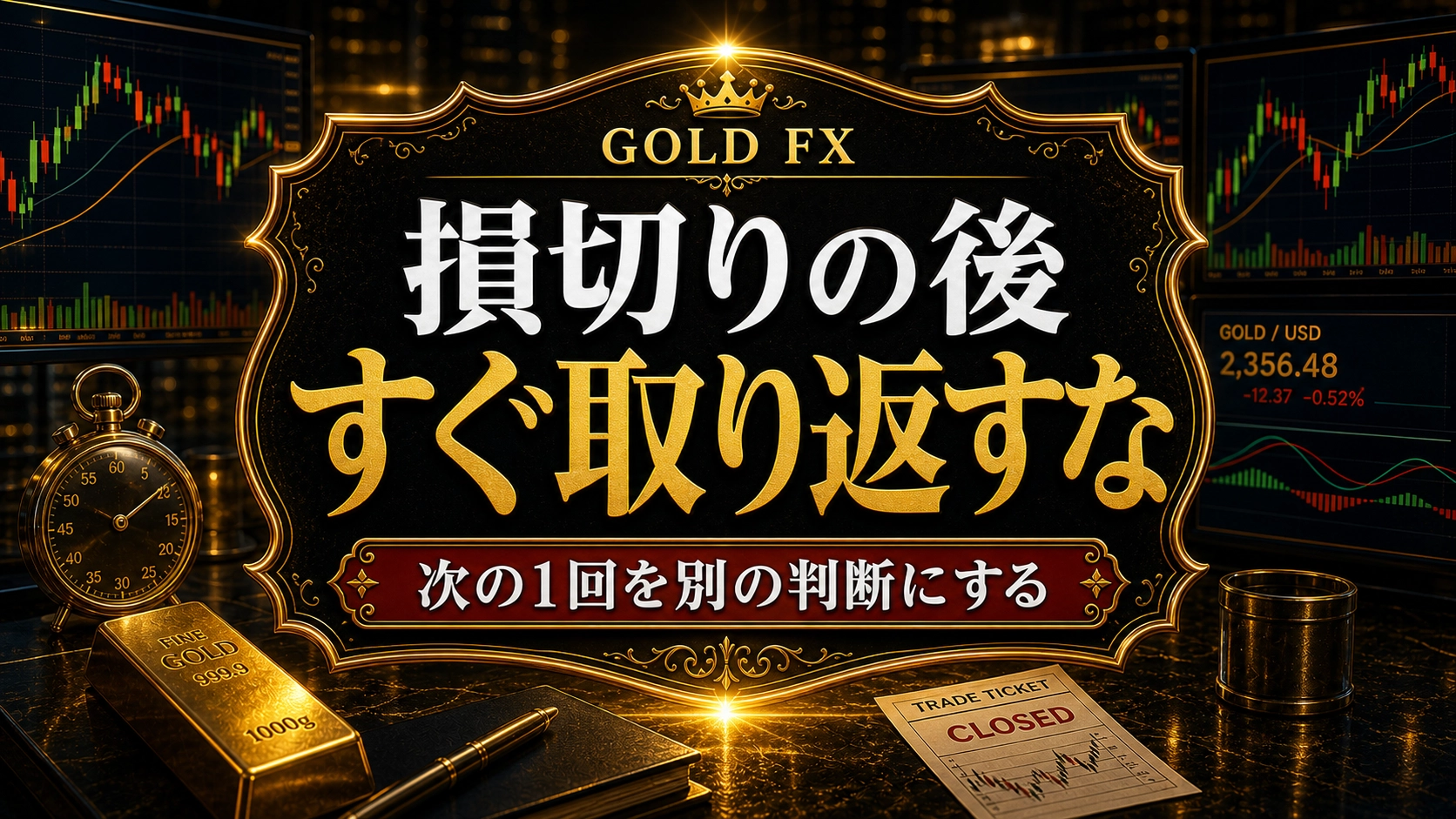
Do not immediately recoup after a loss — make the next one a different entity
Good evening!
I’m Masashi^^
Right after a stop loss, the urge to recover profits moves faster than the eye can see, before you even look at the market.
So to protect the next move, you need a procedure that separates the previous trade from the current chart, not just patience.
The next move after a stop loss is a different trade judged by new conditions, not an order to erase the previous loss.
? After a stop loss, opportunities seem to form quickly
Immediately after a stop loss, even small pullbacks that you would usually pass up start to look like opportunities.
The market hasn’t suddenly become easier to understand.
The urge to erase the previous loss quickly means you’re cherry-picking only favorable candles.
What’s tricky here is that you think you’re staying calm.
You can justify with reasons like “the shape is better than before” or “the barrier is closer now,” so you don’t feel you’re acting on emotion.
However, if you skip the verification order, the number of reasons can increase while the quality of your judgment does not return.
I shrink the chart to a higher time frame just after a stop loss and review it again.
If you leave only a few bars magnified in front of you, the rebound looks stronger than it actually is.
Just by restoring your perspective, you’ll reduce the tendency to continue the previous position considerably.
First, ask not whether the current shape is good, but whether you’re looking at it with the same perspective as before the stop loss.
If this is the same, you’re operating under the same reasoning as the previous loss, not a new order.
The quicker you spot a chance immediately after a stop loss, the more you should doubt it for a moment.
? Key point: Look at whether the confirmation order has returned to the same sequence rather than the shape’s quality
? First, 3 minutes, create a time where you cannot place orders
Just telling yourself to “calm down” after a loss leaves the screen and the order button as-is.
So I decide in advance to not place orders for at least 3 minutes.
Not to take a long break, but to drop out of the pace of the previous trade for a short interval.
There isn’t much to do in these 3 minutes.
Close the trade history, leave one screenshot, take a sip of water, and return the chart to a higher time frame.
There’s no need to hold a reflection meeting. If you start reflecting, you’ll start looking for a correct re-entry next time.
The purpose of cutting time isn’t to erase your emotions completely.
Even if frustration remains, it’s enough to create some distance before placing the next order.
Emotions themselves aren’t as dangerous as emotions directly driving orders.
If you still want to enter in the same place after 3 minutes, rewrite the conditions from scratch in the next chapter.
If you can’t rewrite them, that moment hasn’t become a new trade yet.
This isn’t a break time; it’s a time to cut the previous order and the next judgment apart.
? Key point: Close the settlement history, save a screenshot, and return to higher time frames
? Divide stop losses into three types
If you end all stop losses as “my prediction was wrong,” your next action becomes fuzzy.
In reality, stop losses due to a broken premise, stop losses due to entering too early, and stop losses due to inappropriate lot size or stop distance are different things.
If the premise is broken, there’s no reason to immediately target the same direction.
If the timing was early, it isn’t enough that the price has retraced—you need the waiting reaction to appear as well.
If it’s a problem of lot or width, even if the direction is correct, you shouldn’t re-enter with the same size.
Entering again with “just one more try” without differentiating these causes will increase orders without addressing the mistakes.
Right after a stop loss, state the cause of failure in as few words as possible, not the direction.
If it were me, I’d mark one of “premise,” “timing,” or “size” in the records.
A shorter reflection note is easier to change the next move than a long critique.
If you don’t separate the cause of the stop loss, you’ll repeat the same failure for different reasons.
? Key point: classify which of premise, timing, or size came first
? Write the next move from scratch with four conditions
If you enter next, write them anew: location, reaction, stop loss position, and time frame to watch.
Return to conditions that can be explained by looking only at the current chart, not “it’s a little better than before.”
- Location: which wall or zone you will wait at.
- Reaction: what confirms you as a candidate beyond a single wick.
- Stop loss position: where crossing breaks the premise.
- Time frame: which candle you wait for to confirm.
When these four align, you can see the path to placing an order.
Conversely, if even one is “probably,” “since there was a reaction earlier,” you’re using the previous trade as the basis.
Previous gains/losses aren’t a basis for the next trade. Even if you just had a loss, if the current conditions are weak, you should pass.
It may seem tedious to write, but it only takes tens of seconds.
Wasting those tens of seconds by slamming entries later will leave you feeling unsettled for hours.
Explain location, reaction, stop loss position, and time frame using only the present chart.
? Key point: Do not bring in prior outcomes or prior reactions as the basis for the next move
⚖️ Do not reflect and re-enter at the same time
If you draw lines on the chart after a stop loss while seeking the next entry, you’re actually creating a reason to re-enter under the guise of reflection.
Conducting verification and live decision on the same screen and at the same time makes both too lenient.
Reflection can wait until the market settles.
On the spot, only confirm whether the premise was broken and whether the next conditions align anew.
More detailed verification can wait for weekend records, which reduces the chance of misinterpreting current orders.
I used to redraw lines right after a stop loss and re-enter thinking, “The real wall was here.”
But the wall didn’t move; I merely shifted the grounds to fit my convenience.
This extra step reduces post hoc justification.
Drawing lines immediately after a stop loss tends to become a post-hoc entry rather than reflection.
? Key point: Verification comes after; during trading, only look at premise and new conditions
?️ Do not increase the next lot
When you want to restore the same amount in one go after a stop loss, you’ll subconsciously want to raise your lot size.
When conditions look favorable, you’re tempted to think “a bit larger is fine,” but that judgment blends in the amount of the previous loss.
If you truly want to make the next move a different thing, separate the lot from the previous profit/loss. Do not increase it. If you still hesitate, halve it.
Lowering size isn’t weakness; it’s space to verify that your judgment has returned.
Smaller lots do not mean you should enter with any amount.
However, reducing the risk pressure makes it easier to cut losses when the conditions collapse.
When the goal is to recover, fixing the size becomes the last brake.
Even the Golden Line Sniper AI’s safety display does not command you to fix the lot size.
Use it as final material to confirm you are not beyond your acceptable range.
Stop-loss Lot size is decided from the current acceptable loss, not the prior loss amount.
? Key point: Do not increase at a minimum; if still unsure, halve it
? Leave one line and return the screen
Recordings during live trades don’t have to be long.
Write in one line what differs from the previous loss.
- The location is different
- The time frame is confirmed
- The stop loss position is clear
If the difference is concrete, you’re starting to return to a new judgment.
If the words you can utter are only “this time for sure” or “stronger than before,” you’re writing expectations, not conditions.
If so, you’ll pass. Even if the market moves after you pass, that’s not a failure. It’s a record that you followed the conditions.
This one line isn’t a magic to win. It’s a marker to identify where you’re most likely to break down after a loss.
When you line up several weeks, you can see you’re repeatedly uttering the same words in a row.
After recording, return to the overall chart. Don’t place orders immediately just because you wrote something to feel safe.
Finally, review the location and time frame before making a decision.
If you cannot explain in one line how it differs from the previous loss, wait.
? Key point: write differences in place, confirmation, and stop loss position, not expectations
➡️ Next is to stop the collapse after a win
It isn’t only after a loss that things are risky.
Even after taking profit, the market can look easy and the checks become brief.
After a stop loss you want to recover; after a profit you want to take more.
Even if the direction differs, the act of carrying previous gains or losses into the next trade is the same.
This time the rule was to separate the previous trade from the next judgment.
Next time, after a win, narrow the conditions further and organize a practical view to avoid chasing extended moves.
In the third section, finish the week not only with wins and losses, but with records that carry over to the next week.
A flow that records not daily feelings but repeated conditions.
First today, try the 3 minutes after a stop loss and one line only.
Rather than changing everything at once, it’s practical to have one place to revert just before the collapse.
This week’s common theme is not carrying the previous loss into the next decision.
? Key point: Next time move toward a condition that stops chasing after profit
? 30-second check when unsure
Finally, here is a 30-second check for when you again feel like entering after a stop loss.
- First, is there at least a 3-minute gap since the previous stop loss?
- Next, which of premise, timing, or size was the cause?
- Finally, can you explain with the current chart only the location, reaction, stop loss position, and time frame?
Even if you can answer all three, you will not increase the lot. If you can’t answer even one item, you should pass.
The check is not to prove a chance; it’s to ensure the previous loss isn’t left as judgment for the next trade.
Using this procedure, there are times the market moves even after you pass on the trade.
But compare that missed one move with stopping the chain of recoveries you would have chased.
What you want to keep is the ability to return to a decision when the price collapses, not the chance you just got lucky.
Until you’re used to it, write it on paper and place it beside your monitor.
It works better to keep it where you can see it than to memorize it in your head.
If you cannot answer any one of the three confirmations, skip the next move.
? Key point: verify in 30 seconds that 3 minutes, cause classification, 4 conditions, and fixed lot size are met
↓ An exclusive GOLD special feature has been organized^^
If you want to organize the basis of your judgment, please also check this out.
? Summary
The next move after a stop loss is a different trade judged by new conditions, not an order to erase the previous loss.
Golden Line Sniper AI is here.
https://www.gogojungle.co.jp/tools/indicators/80000

Thank you as always for reading^^