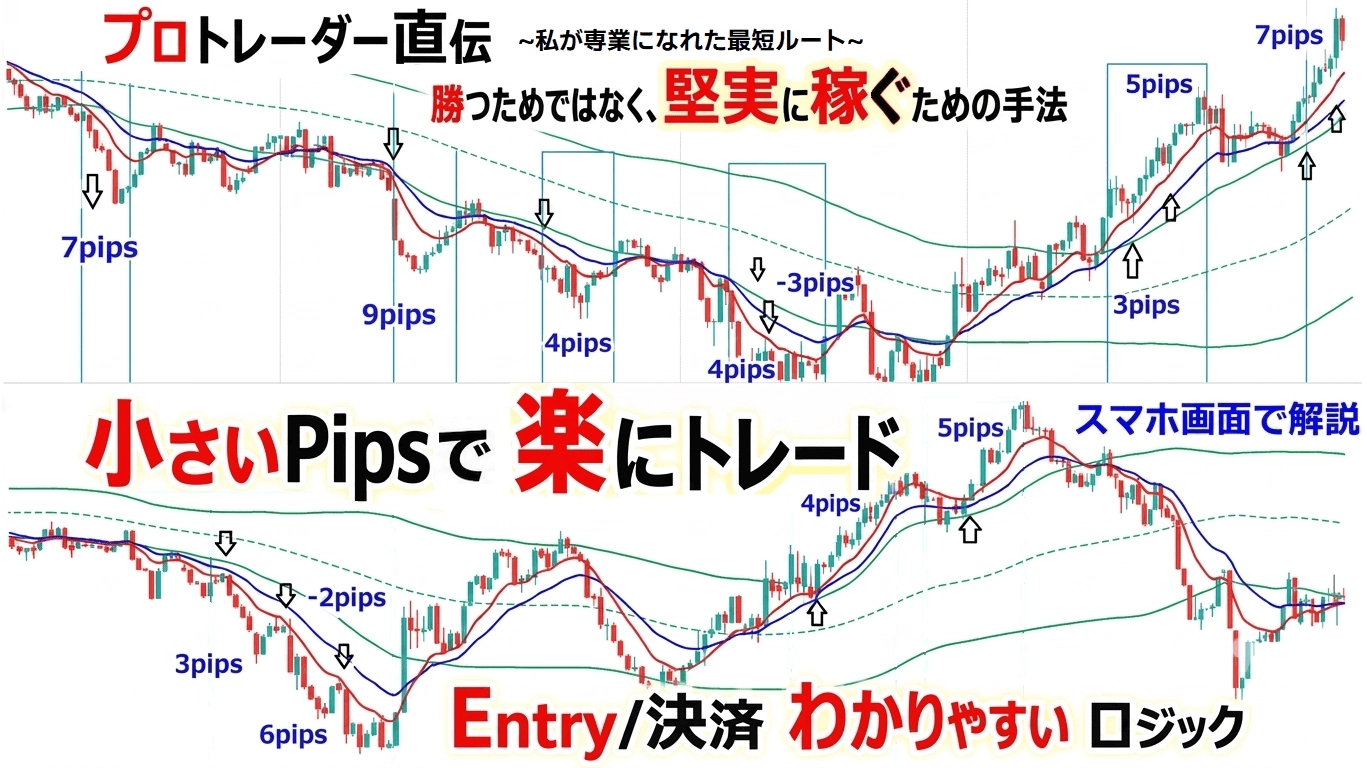
【Method Logic Details ⑤】 Entry and settlement are clear! The professional logic to earn money is here!
【Details of Method Logic ⑤】 Clear entry and settlement! Here lies the professional logic to earn profits
This article focuses on the following
【Details of Method Logic ⑤】 How to take entry points and settlement points
This content focuses on that. For other indicators, please see other articles
■ Overview of the entire method
We focus on the “upswing rate (expectation)” rather than the “win rate”
1-minute chart scalping trading method by minutes
Even in scalping,
follow the medium-term trend (higher time frame direction),
capture the short-term momentum
as the method
Also, avoid areas with low volatility
do not go against the higher-time-frame trend, ride the momentum at the moment
Where there is momentum
where the price tends to rise quickly after entry (or fall quickly)
trade only where there is expectancy, and accumulate profit overall
■ Combination of excellent logics
We combine several logics that can independently perform trades
■ What each indicator decides
※ Each blog will explain one by one
【Detailed Logic of the Method①~⑤】
[○○] means an indicator
【Detailed Logic①】[Bollinger Bands]
【Detailed Logic②】[MACD (short-term)]
【Detailed Logic③】[Two EMA lines]
【Detailed Logic④】[MACD (mid-term)]
【Detailed Logic⑤】 How to take entry and settlement points
【Detailed Logic⑥】 Presence of volatility
Now, below, about 【Detailed Logic⑤】 How to take entry points and settlement points
We will write
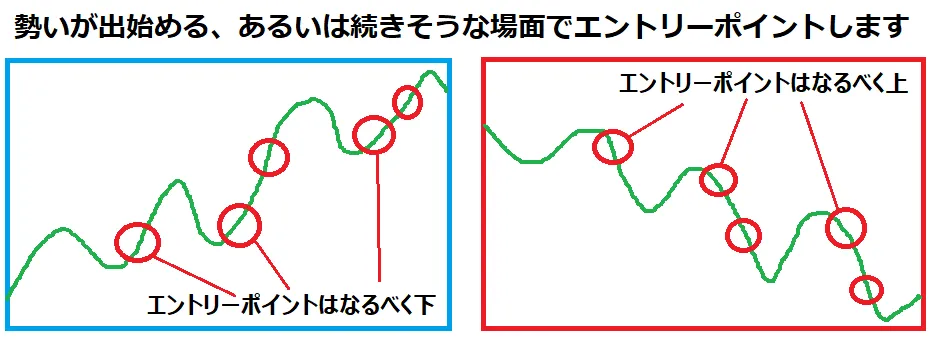
=== Entry Point Explanation ===
If long, it is advantageous to enter as low as possible
If short, it is advantageous to enter as high as possible
This is the concept behind it
Also
“Where momentum is starting to build”
“Where momentum is building”
This is the logic to enter
Points with momentum tend to rise immediately after entry,
points that can be quantified into a logic
This is a logic that quantifies that momentum
■ Entry point judgment method using [MACD(short-term)]
Decision is made by the slope of the [MACD(short-term)] line
When the line begins to slope, ⇒ “momentum is starting to appear”
When the line becomes more sloped, ⇒ “momentum is appearing”
Thus
If the momentum shows signs of fading, do not enter
The [MACD(short-term)]
When the line’s slope fades
When the line tilts opposite direction
In such cases, it is judged as a point where momentum is fading, and you do not enter
(Alternatively, if you had entered, you can consider it a point to exit)
■ Entry point judgment method using [EMA2]
The basic idea is to enter as close as possible to the EMA
If long, it is advantageous to enter as low as possible
If short, it is advantageous to enter as high as possible
This “as close as possible” criterion is based on EMA
Also, it is advantageous for the entry point to be as close as possible
in proximity
If the candle closes far from the EMA (in FX terms, called “divergence”), the potential profit tends to be smaller (not universal; it can continue to move) so you enter when the candle is around the EMA, or slightly detached but not too far, and the candle length is short
Specifically, as a guideline, if the candle close is within 5 pips of the EMA, enter
If detached by more than 5 pips, skip entry
Because momentum exists, even if detached by more than 5 pips, if momentum is strong, it can keep rising, so you may ride the momentum
Therefore, you can ignore the 5-pip rule in discretionary handling
=== Explanation of the exit point ===
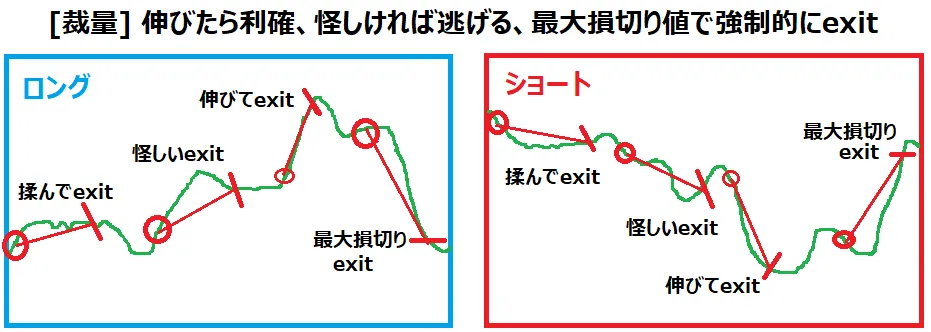
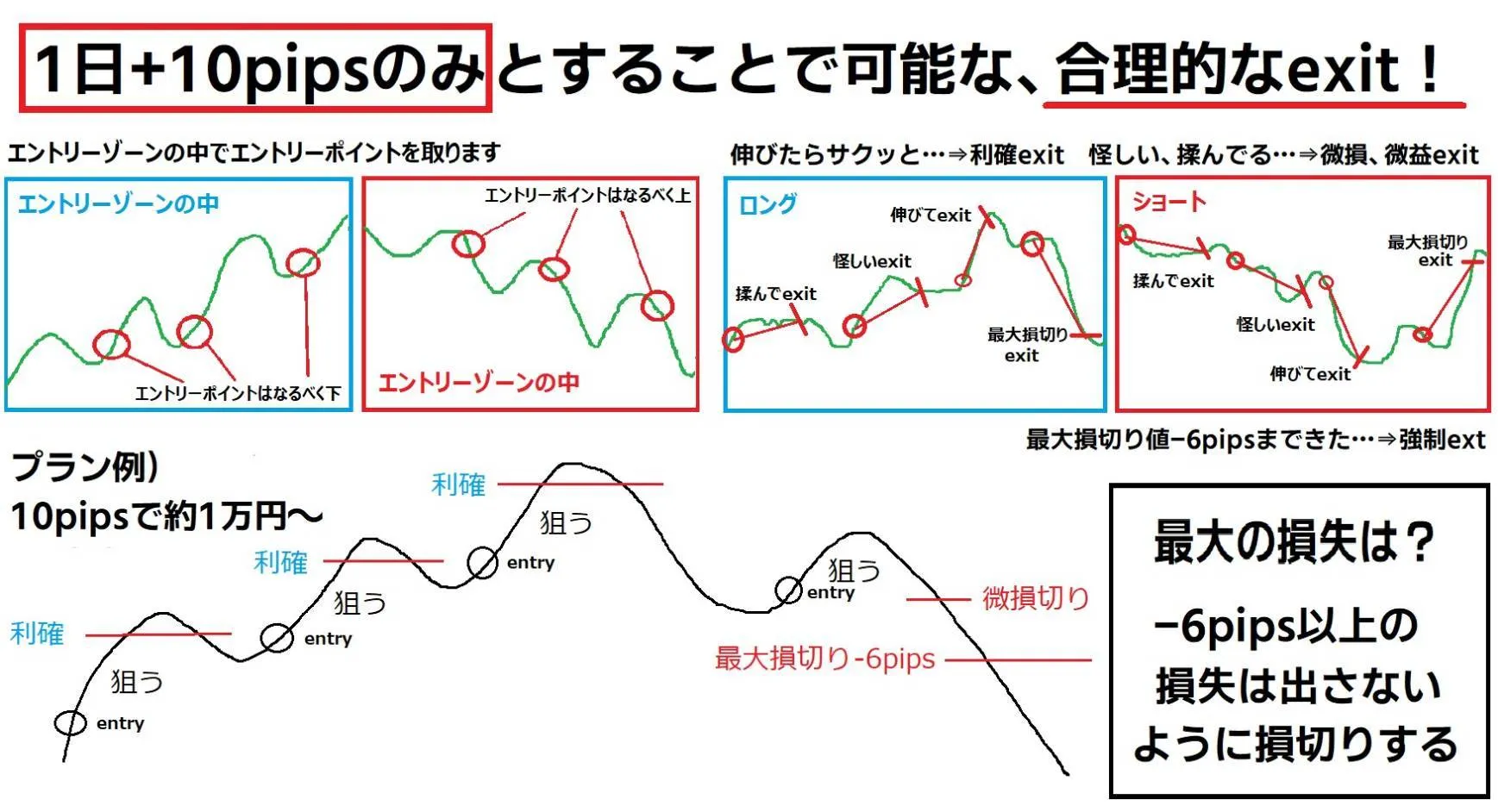
The plan for exits (egresses) in this method is summarized as follows
・Take profit when it moves in your favor
・If suspicious, take a small loss or small gain and exit
・Limit losses with a maximum stop loss value (max -6 pips)
In multiple trades, prioritize a plan of total +10 pips or more, and decide each time according to the plan
■ Take profit when it moves in your favor
As the name suggests, take profit when it moves in your favor
Realize profits typically around +1 to +15 pips
Most often, profits are realized around +2 to +7 pips
■ If suspicious, take a small loss or small gain and exit
We say exit with a small loss or small gain, but there are cases with reasonable profit peculiarities
This is when price action stagnates, so consider exiting
In such situations, you can decide exits not just by feeling but by indicator conditions
Using indicator logic
If the logic satisfied at entry is no longer satisfied after entry, you exit
For example, if the [MACD(short-term)] line turns against the trend or turns flat and the angle becomes unstable, exit.
However, a line turning in the opposite direction does not always mean an immediate reversal
It often flattens a bit, so if it moves against you or stagnates, exit
■ Max stop loss value set (−6 pips)
Sometimes it moves against you rapidly, so do not move the maximum stop; exit there (placing a stop order in advance is good)
【A plan to total +10 pips】
is prioritized, and decisions are made according to the plan
■ Low mental load advantages trading
Exiting without being bound by indicator rules is advantageous for keeping profits, and is easier mentally than forcing an exit via indicators, which lowers daily difficulty toward the +10 pips plan
For example,
● With enforced rules (higher mental load)
When there are unrealized gains, prices may come back
But with enforced rules, you cannot exit
Eventually you may end up negative
● No enforced rules (lower mental load)
With unrealized gains, you can exit easily by not being bound by rules
As shown below,
you adjust your exit policy according to the number of pips gained at that time
Since it’s the first trade,
avoid taking large losses as much as possible
so even a short move may be taken
If one candle grows by one, you may take profit
Example ② Gain of about +1 pips
If at that point you have around +1 pips, you are not yet in a comfortable state, so the next trade is conducted with the same sense as Example ①
Example ③ Gain of +1–6 pips
If you gain about +1 to +6 pips, you may exit once it moves a bit, and use as a forerunner to later trades
For example, if you can lock in +3 pips, your next trade becomes mentally easier because you can tolerate up to -3 pips
Example ④ Gain +7 pips or more
If you already have +7 pips after several trades, if the next trade heads into negative territory and looks suspicious, cut loss around -2 pips and accumulate the remaining 5 pips in later trades
If the next trade yields +3 pips, you may exit there (total +10 pips)
Example ⑤ Gain +12 pips or more
If you already have +10 pips or more, you may let it run, tolerating up to -2 pips, raise the reserved stop loss position if it continues to move (trail) to some extent
If it moves further, you may chase more and shift the reserved stop loss position further
Shift the reserved stop loss position (max stop loss −6 pips) to break even and keep chasing for profit
There is also a plan to push the reserved stop loss position further, without taking profits yet
Move the reserved stop loss position to break even, and continue chasing profits
Don’t rush; gradually reduce the loss and exit steadily
Stop trading for that day, or pause for a few hours and trade only when a trend appears
■ The worst thing is trying to “make up for it” with trades
Bad days happen to any pro trader
If you force yourself to “make up for it,” you may end up increasing losses
【Is discretionary exit difficult? Can you learn to do it?】
When you first start using the method, you may feel exits are too early or too late
Chickens often take profits reluctantly
However, overall, if you trust that this approach can make you positive in total,
you will come to feel exits are easier
Keeping rules is important, but for exits, the emphasis should be placed on the plan of +10 pips per day rather than on indicators or other technical analyses
toward that image, it is not sloppy but deliberate
If you review with backtests or demos and look at charts with the logic in mind, the image will become clearer
If you test the method and gain trust,
in practice, with the logic and the +10 pips plan in mind, you will naturally be able to make such exit methods
【Forced Exit (Settlement) Logic】
Up to here, I have written exit logic based on discretionary decisions, but
You often hear requests like, “I want non-discretionary exit logic”
For such people, I present two exit plans based on indicators
Of course, these are not arbitrary logics; I also use them as guidelines
Usually you exit before these forced exit conditions, but there are two logics where you exit almost automatically when they occur
① Exit when you move away from the Bollinger Bands logic
② Exit when candle close breaks below the two EMA lines in the opposite direction to your entry
In the method explanation, these entry and exit points are explained more concretely
There are chart image explanations as well
Please regard this as an overview
The method I am currently practicing is here
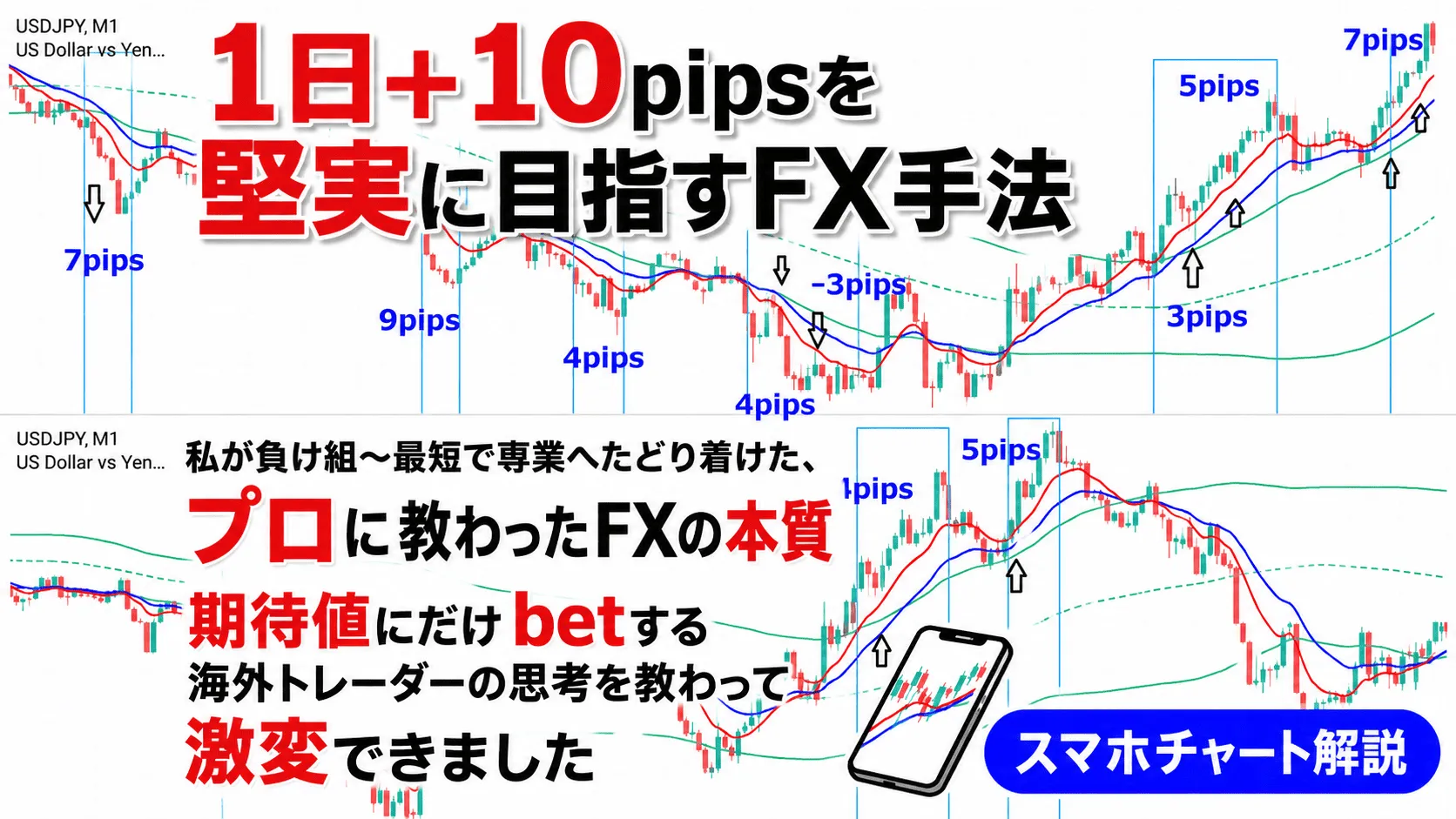
【Steadily +10 pips per day】
A 1-minute FX method learned from a pro trader that helped me escape the losing group (about 2–5 hours per day)
Explained with smartphone chart images
Easy-to-understand logic for entry points and settlement points
■ Thinking of international professional traders (legendary investors Buffett and Soros)
Trade not to “win” but to “earn”
Trade based on expectancy of long positions where the win rate is not the focus
↓
https://www.gogojungle.co.jp/tools/ebooks/76385
#DollarYen #EuroDollar #FXMethod #FXBeginner #FXLegend #FXWinningMethod #RealTrade #Scalping #Indicator #ProTrader #FXTrade #DayTrading #DayTrader #DayTrading #WantoBeTraders
#Investment #SelfInvestment #InvestingLife #WantToBeAnInvestor #Freelance #WantToBecomeFreelance #FreedomOfWork #DesireFreedom #SecondCareer #StockActivity #JobChangeInProgress #HomeWork
#AssetFormation #FundRaising #AssetManagement #IndependenceStartUp #SoleProprietor #WantToBeSoleProprietor #Entrepreneurship #WantToEarn #HowToEarn #WantToStartBusiness #LeaveSalaryWork #SideBusiness #SideBusinessDesire #HousewifeSideBusiness #EntrepreneurWoman #MomEntrepreneur