

Do you look at “changes” rather than numbers in the market? What are the true criteria that move the dollar-yen pair
Do you look at "change" rather than numbers when judging the market? The real criteria moving USD/JPY
In the FX market, economic indicators are released almost daily.
U.S. Consumer Price Index (CPI).
Employment statistics.
GDP growth rate.
And central banks' policy rate announcements, among many other pieces of information that reach the market.
Yet when you actually look at the market,
you sometimes see,
"It was a good number, but USD/JPY fell."
"It was worse than expected, yet it rose."
Why does this happen?
The reason is,
the market places emphasis on change rather than the numbers themselves.
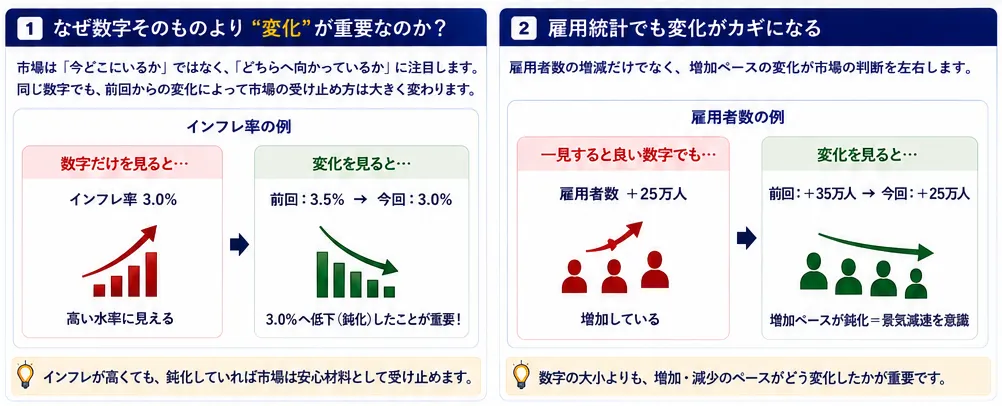
For example, suppose the inflation rate is 3%.
If you only look at this number, it might feel high.
However, the market focuses on the change,
"Last time it was 3.5%."
"This time it fell to 3.0%."
and pays attention to that change.
In other words,
even if inflation remains high,
the fact that it is cooling becomes important.
The same applies to employment statistics.
Even if the number of employed persons is rising,
if the pace of increase is gradually slowing, the market starts to price in a slower economy.
Conversely,
even if the numbers themselves are still low,
as long as the improvement trend continues,
the market begins to price in an economic recovery.
In short, the market looks at
"where we are now" rather than "where we are headed."
This line of thinking is very important in the current USD/JPY market.
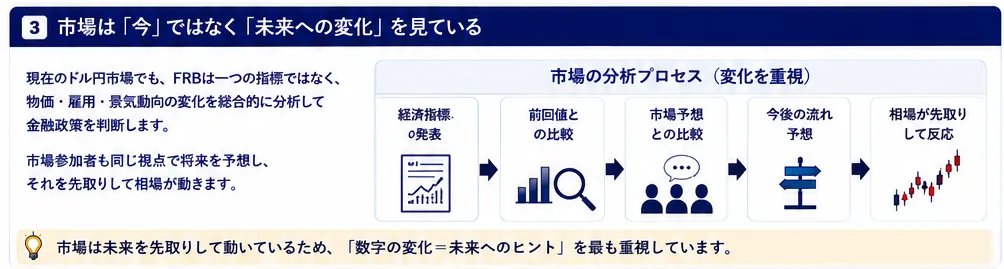
Even when the Fed is assessing monetary policy,
not by a single economic indicator alone,
but by comprehensively analyzing changes in prices, employment, and economic trends.
Market participants are forecasting the future from the same perspective.
That is why,
instead of looking at the numbers alone,
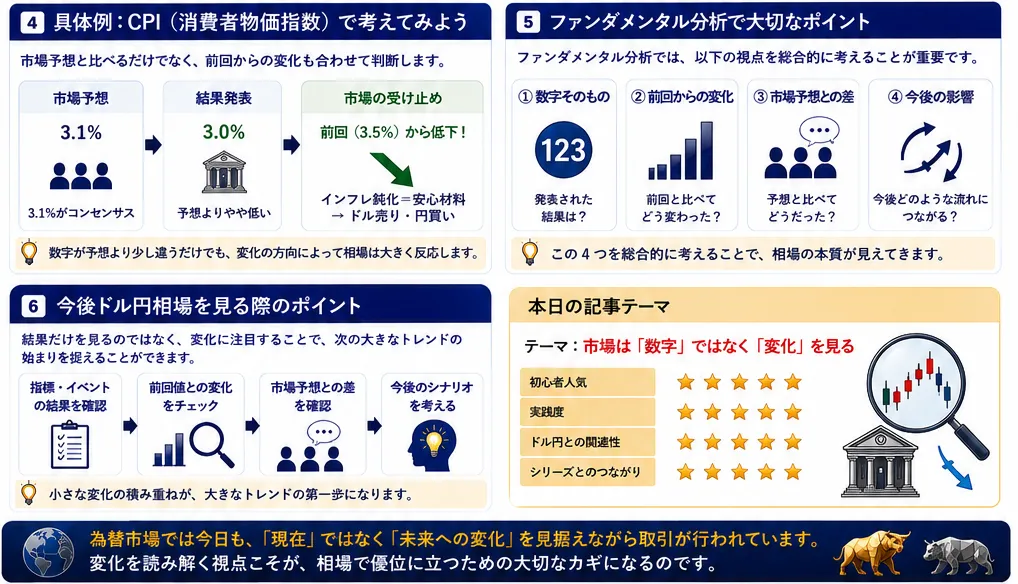
you should consider how those numbers have changed from the previous reading.
How did they compare with market expectations?
And what kind of trend might this lead to in the future?
All of this is considered comprehensively when making trading decisions.
In fundamental analysis,
you should not rely on a single result to make judgments;
reading the direction of change is extremely important
The market moves by anticipating the future.
That future is not built from numbers alone,
but from the accumulation of changes.
Going forward, when watching the USD/JPY market,
not only should you pay attention to the released numbers themselves,
but also how those numbers have changed compared with the last time.
That small change can be the first step in generating the next big trend.
In the foreign exchange market, many investors continue trading while focusing on "changes toward the future," not on the "present today."
★ Our URL:https://www.gogojungle.co.jp/users/186761?via=indicators_detail_users