
Please quit already
Last Friday the US markets were closed, and on Thursday there was the employment data,
so the market has had days where traders held back.
We are approaching a season where a summer lull in the market is becoming noticeable, but
with gold, volatility is likely to continue.
Now, this time I’d like to share a very common question we receive.
“How can I trade without getting caught in a range-bound market?”
That is the question.
We receive this kind of question very often.
And to answer it concisely,
“There is absolutely no need to avoid it.”
That is my answer.
I will explain the reasons from here.
First of all, a range-bound market
is defined differently by different people,
and even if someone determines it as range-bound based on some criterion,
that is only the market state up to this moment from the past,
and there is no guarantee that such a market will continue in the future.
If you think the market is range-bound,
it is common for a trend to suddenly emerge.
Therefore, based on the history from the past to the present,
saying “it’s range-bound” or trying to avoid it
is basically impossible.
Even if you stop trading just because you think it’s range-bound,
if a big trend then forms later,
you’ll miss those profits.
Many people acquire some logic or signal tools,
and then think they can trade more efficiently.
They end up trying to avoid ranges and only target times when a trend is occurring.
However, predicting this in advance is impossible.
When exactly a trend will begin,
how long the range will continue,
and so on—predicting these accurately is impossible.
Nevertheless, many people still try to avoid ranges by applying various filters,
and end up making inefficient trades overall.
There are a lot of such cases.
What is crucial here is
to use a logic that profits even in range-bound markets.
A logic that does not profit in range-bound markets
will require trading both in ranges and in trends,
and still aim to accumulate overall profit.
The reason I say you do not need to avoid range markets is that I use a logic that profits in range markets as well.
So, does it actually profit in range markets? Let’s take a look.
This is“Tenka FX Logic”traded according to the rules.
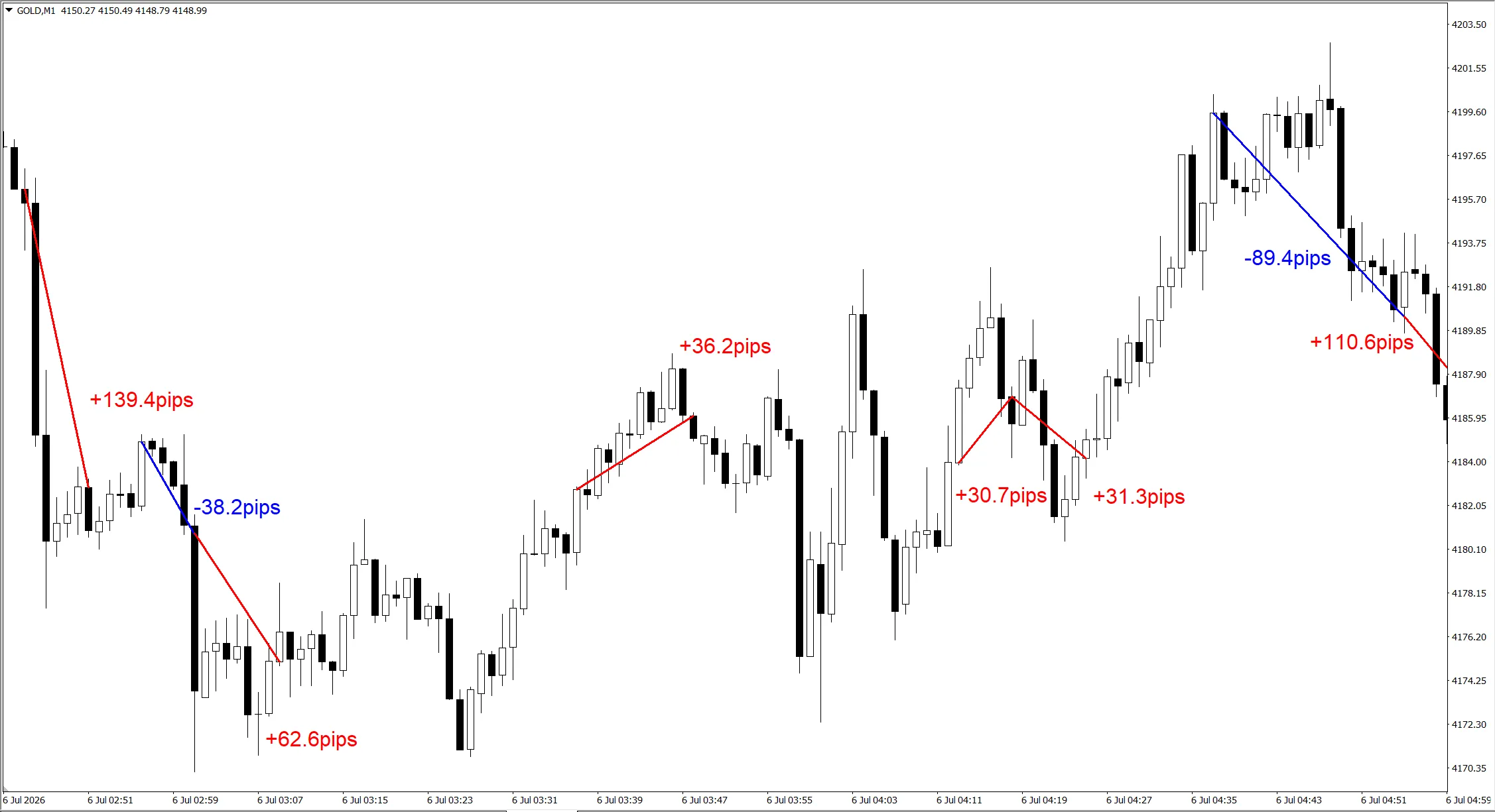
This is today’s morning session as well,
and I think many would classify the market as range-bound.
We lost twice,
but overall,
the total profit is approximately300 pips.
This is“Tenka FX Logic”trading purely by the rules, without discretion,
so even beginners and anyone can achieve similar profits.
And even in such a range-bound market,
we can clearly leave profits,
so we tell you
“There is no need to avoid range markets.”
Therefore, when using my logic,
do not apply filters unwisely,
do not add discretion to try to avoid ranges,
as that will cause you to miss out on profits,
so please stop doing that.
Anyway, trading mechanically, without thinking, yields profits in the end.
So, even beginners,
anyone can achieve similar profits with this logic.
Also, this time the logic uses
entriesonly on 3 candles,
and exitson 2 candles, traded without any other knowledge or techniques or discretion.
Completelydiscretion-free and mechanically tradable.
Recently gold has been somewhat less volatile than last year,
yet it still yields consistent profits.
Several months since its launch,
it is still profitable.
This is not a temporary logic;
it uses human instincts,
so it remains valid going forward.
Because of these factors, even after launch,
even as the market changes, profits have continued smoothly.
And because this is such a logic,
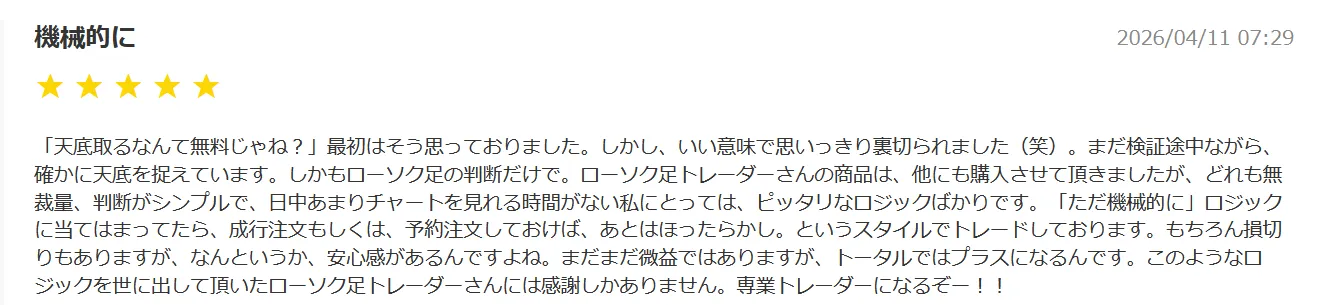
“Tenka FX Logic”has received comments and reviews from those who have already purchased it.
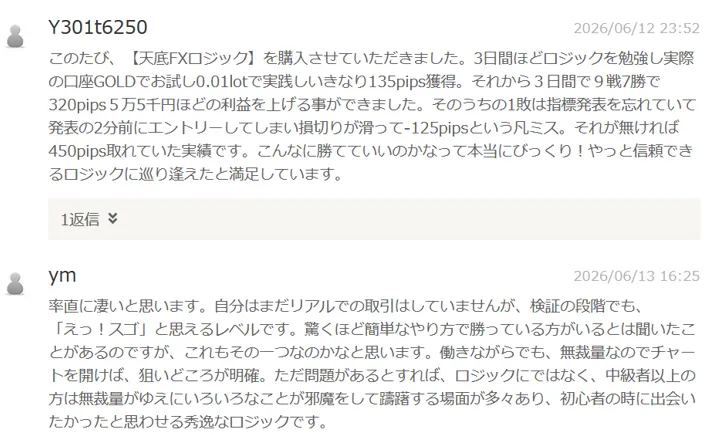
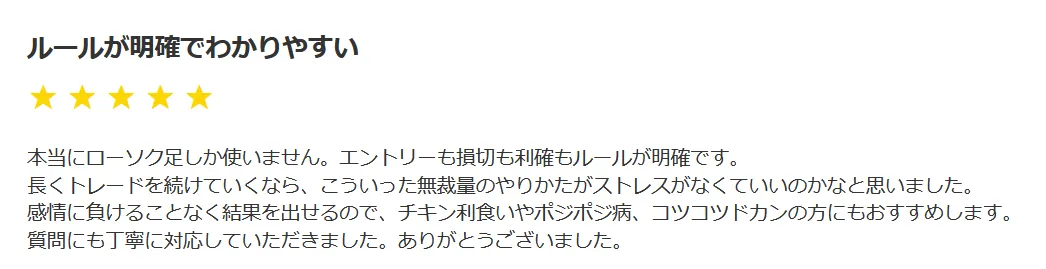
“Is it really okay to win this much?”We received such a joyful comment!
“Mechanically”was the title of the comment.
As this person said,
“Of course there are losses too.”
But, “it provides peace of mind.”
Exactly right,“Tenka FX Logic”is
a logic that follows the market participants,
in other words, a logic that uses human instincts.
So, even if the market changes in the future,
it will still be applicable in any market conditions.
As the person mentioned,
the logic used in this case iscandlesticks only.
Therefore, the learning curve is probably about an hour—very simple indeed.
So, this time I discussed that in my logic there is no need for filters purposely avoiding ranges or any discretionary elements.
If you want to trade mechanically to aim for profits,
please take a look here.