
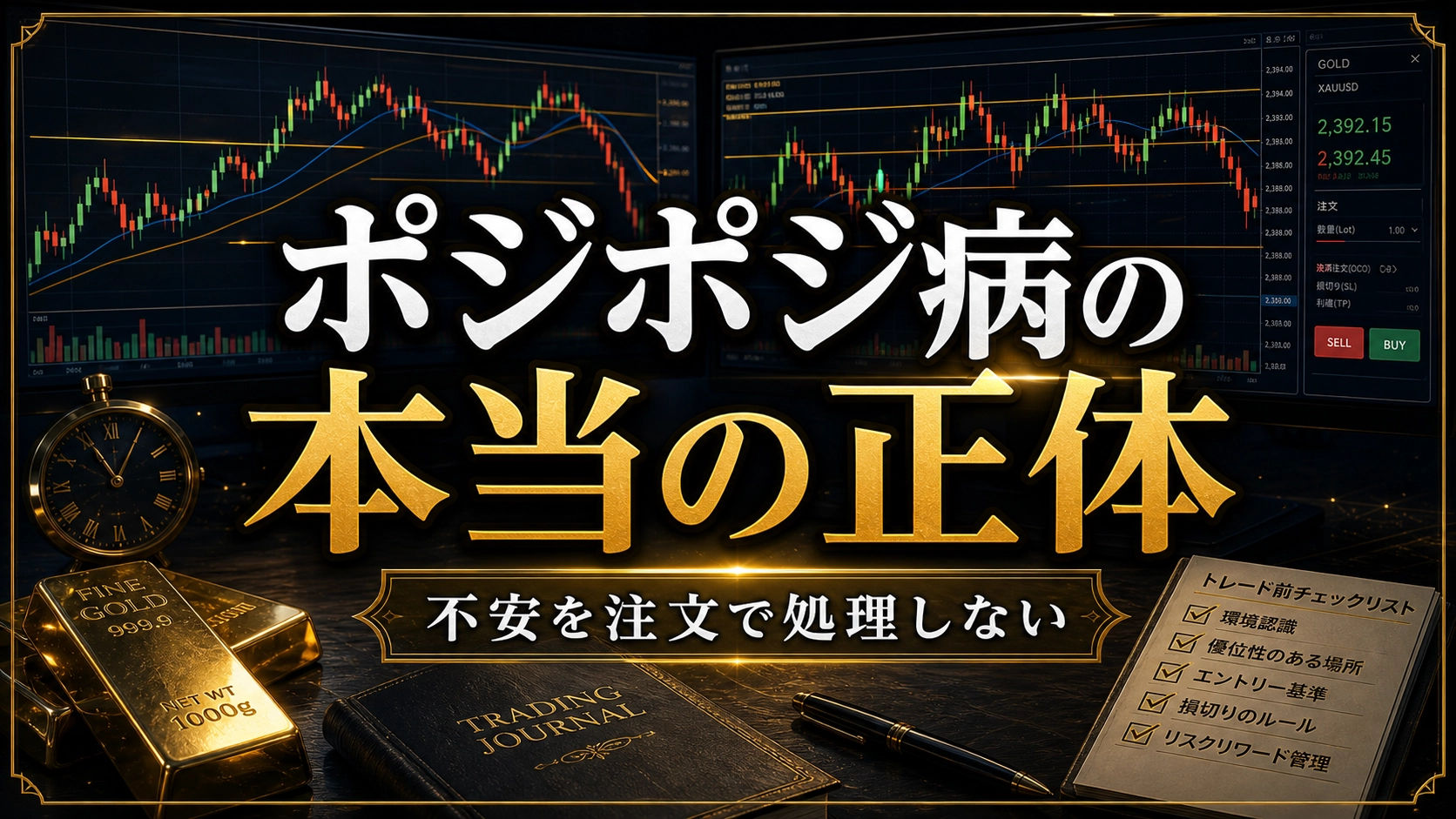
The Real Identity of the Posiposi Disease: Do Not Process Anxiety with Orders
【ポジポジ病の本当の正体】不安を注文で処理しない
Good evening!
This is Masashi ^^
↓A GOLD special feature has been organized ^^
Please join while you can.
This time, I will write about “the true identity of positional anxiety.”
In the past, I believed I was watching the market properly, but when I reached the right edge, my judgments would suddenly become reckless.
Last time I wrote about the reasons I hesitated as I increased the number of screens.
Continuing from that, I will write about “the true identity of positional anxiety.”
When people hear about positional anxiety, they tend to think it’s because of weak will, inability to endure, or failure to follow the rules.
Of course, there are such aspects.
But I believe the root of positional anxiety lies somewhere else.
It’s because we try to erase anxiety by placing orders.
Positional anxiety is not a disease of having too many opportunities; it’s a habit of trying to erase anxiety with orders.
? Reasons you can’t endure the waiting time
When watching GOLD, there are times you can do nothing.
The direction is a little visible. But the entry point is bad. Reactions are present, but stop loss is far. It seems like a chance, but I can’t explain it fully yet.
? The time when you aren’t doing anything is scary
? It feels like you’ll be left behind
⚠️ If you fill that anxiety with orders, your judgments will collapse
In such times, people who can wait and those who cannot wait diverge.
People who can’t wait give in to the anxiety of missing a chance and enter.
But actually, what’s scary is not so much missing a chance, but “the self who isn’t doing anything.”
If you’re watching the chart but doing nothing, you feel left behind. So you press orders to feel like you’re taking action.
This is the entry point of positional anxiety.
Waiting time is also trading. Merely pressing an order is not the only form of trading.
Rather, as you start to win, the quality of the waiting time becomes important.
What to check while waiting. When to enter. When to pass.
Those who have this decision set tend not to find waiting time painful.
Conversely, if there is no reason to wait, simply watching the chart becomes stressful.
Therefore, you want to press orders quickly to escape that stress.
When you can’t endure the waiting time, people try to buy peace rather than a good chance.
⚠️ You feel at ease only when you place an order
When you hold a position, you feel at ease for an instant.
Because at least you can escape the anxiety of doing nothing.
❌ You feel at ease for a moment when you place an order
❌ If the market moves against you, another anxiety arises
✅ You use orders not for reassurance, but only when the rationale is solid
Bought. Sold. This is how you participated in the market. You did something.
But that sense of ease doesn’t last long.
The moment there is a slight retracement, another anxiety appears.
“Maybe I was too early,” “Where should I place the stop loss?” “Would it come back?”
In other words, the anxiety you thought you erased by pressing a trade returns bigger.
If you repeat this many times, trading becomes emotion management rather than judgment.
When you hold a position, the way you view the chart changes. What you previously saw as a wall to break through becomes “a place you want it to break through.”
A level that was a stop-loss candidate becomes “a place I want to endure a little longer.”
Therefore, the decision before you hold the position is the most important.
Even if you try to calm yourself after entering a position, your profit/loss is already on you, making it hard to view objectively.
Orders are not tools to erase anxiety. They are actions used only when the evidence aligns.
? The real problem is wanting to fill the gaps in judgment
Positional anxiety isn’t that people are too good at finding chances.
It’s that they’re not good at tolerating gaps in judgment.
? I don’t know yet
? Don’t enter here
⏳ Wait a little longer
? How to hold this gap is crucial
“I don’t know yet,” “I won’t enter here,” “Wait a bit longer”
I can’t endure this gap.
So before conditions are met, I create some reason to enter.
As written in the previous article, increasing screens and hesitating also connects to this. If the criteria are vague, the reasons not to enter become vague.
If reasons not to enter are vague, anxiety wins and you press orders.
Therefore, to fix positional anxiety, you need not only mental discipline but also pre-commitment of non-entry conditions.
Non-entry conditions should be concrete to be effective. “If I feel vague anxiety, I won’t enter” is weak.
When the market moves, you ignore that anxiety.
For example, “I won’t enter when the distance to the wall is short,” “I won’t enter when the stop loss is too wide,” “If I can’t write a reason in one line, I won’t enter.” Being this specific helps you stop when hesitating.
Trying to fix positional anxiety with sheer will doesn’t last. You need to set stopping conditions in advance.
To stop positional anxiety, you should verbalize non-entry conditions before entry, more than entry criteria.
? Stop rules when anxiety arises
So, how should you actually stop?
What I recommend is to create stop rules for when anxiety arises.
? If you can’t write a reason in one line, don’t enter
? Do not place an order before deciding the stop loss
? Don’t enter unless you’ve looked at the wall and the margins
For example, “If you can’t write a one-line reason, don’t enter” is quite effective.
Another is “Don’t place an order before deciding the stop loss.” This is important too.
Furthermore, “Don’t enter unless you’ve looked at the upper-side wall and margins” can significantly reduce momentum-driven impulsive entries.
The point is not to try to stop with sheer will.
It’s hard to stop when anxiety is present. Therefore, stop in advance with rules.
Not because you’re weak, but because you set up such a mechanism.
Stop rules exist not to win, but to prevent rough losses.
If you don’t enter, you won’t gain, but you also won’t incur unnecessary losses.
The most wasteful thing in trading isn’t a loss with solid reasoning, but a hasty entry with weak reasoning that drains your funds and mentality.
Continued losses like this make you afraid even in genuinely good moments.
Therefore, stop rules are defensive rules and also preparation to calmly view the next opportunity.
When you’re anxious, don’t leave it to your mood; entrust it to stop rules.
✍️ Leave a pre-trade note
Finally, the dull but effective thing in fixing positional anxiety is this.
Please leave a memo before trading.
✍️ Where would it break down if it changes
✍️ Are there any remaining reasons not to enter
There are only three things to write.
First, where you are reacting. Second, where it would break down if it changes. Third, are there any remaining reasons not to enter.
Just write these three and then enter; you’ll reduce a lot of unnecessary orders.
Because when you’re trying to enter out of anxiety, you’ll realize the reasons are weak if you put them into words.
Conversely, when there are solid reasons, you can explain them in one line.
The first step to fixing positional anxiety is to externalize your reasons before entering.
Notes aren’t for neatness. They’re to make your judgments verifiable later.
If you lose and think, “Why did I enter?” it’s usually because the words before entry aren’t left behind.
If words aren’t left, you won’t know whether you entered by emotion or by reason.
On the contrary, if you have notes, even in a loss you’ll have learning. Was the rationale right but timing early? Was the location wrong?
Was the stop loss too far? You’ll know where to fix next.
A one-line pre-entry memo is a brake to separate anxiety from reasoning.
? Finally
Positional anxiety doesn’t come from having too many opportunities.
It arises from trying to handle anxiety by placing orders.
I can relate to the feeling of not wanting to endure the time you’re not doing anything. To fill the blank in judgment. To avoid being left behind.
I understand those feelings.
But pressing orders to erase anxiety won’t help the market.
Therefore, decide non-entry conditions before entry. If you can’t explain in one line, don’t enter. Don’t place orders before stop loss is determined.
This modest rule will ultimately protect you the most.
This week’s three articles connect reducing confirmation steps, deciding criteria before increasing screens, and not processing anxiety with orders.
GOLD Line Sniper AI provides lines and signals to organize where to enter and where to wait on the chart.
Waiting is not doing nothing. It is the time to protect capital until the conditions are met.
There’s no need to blame positional anxiety. Instead, build a mechanism to stop. That’s far more realistic.
If you connect this week’s three pieces, it becomes quite simple. On days you can’t read, reduce the confirmation steps. Decide criteria before increasing screens.
And even when anxiety arises, don’t process it with orders.
These three may seem like separate topics, but their root is the same.
In tougher markets, return to your own confirmation order rather than external information or momentum.
Positional anxiety ultimately circles back here. What to confirm before entering. What are non-entry conditions. At what point will your assessment break down.
If you decide these in advance, it’s harder to run to orders when anxiety arises.
If you could do only one thing this week, start with a one-line pre-entry memo. If you can write it, use it as a candidate to enter. If you can’t, pass.
It’s simple but just continuing this will significantly change the quality of your trading.
And even if the market moves in the direction you expected after you pass, please don’t blame yourself right away.
If the justification isn’t there, it’s better to evaluate not having taken a trade than the fact you didn’t take it when you could have.
As this feeling develops, the time you’re not in a position gradually becomes less scary.
Not doing nothing, but waiting for the conditions to be met.
To stop yourself from rushing into entries, reduce bad entries before increasing good entries.
✅ Look at the location. ⚖️ Check the conditions. ✍️ Leave a reason.
? When you’re unsure, reduce the confirmation order. This is enough ^^
? GOLD Line Sniper AI is here.
If you want to organize where to look and why to enter before increasing orders due to anxiety, check this out.
https://www.gogojungle.co.jp/tools/indicators/80000
Thank you as always ^^