

Do central banks move the market with "words"? What messages are more important than monetary policy
Will central banks move the market with their "words"? What messages are more important than monetary policy
In the FX market, the announcements of policy interest rates and monetary policy meetings attract great attention.
But in reality, there are things that move the market even more than the policy itself.
That is the
“messages” emitted by central banks.
In the news,
you may see headlines such as
“Dollar buys on the back of the Fed chair’s remarks”
“Yen selling following the BOJ governor’s press conference”
Even when policy rates are left unchanged, there are many times when the market moves significantly.
So, why do markets pay so much attention to central bank words?
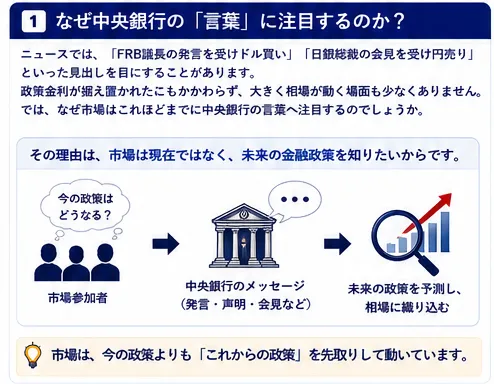
The reason is,
the market wants to know about future monetary policy, not the present.
For example, even if interest rates are held steady at this meeting,
during the press conference
if there is a statement implying that
“future rate hikes will be options depending on inflation,”
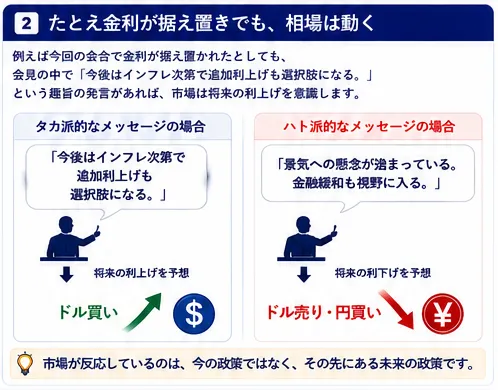
the market will start to price in rate hikes in the future.
Conversely,
if there are remarks such as “concerns about the economy are intensifying,”
“easing of policy is also in view,”
the market may begin to expect rate cuts.
As a result, there are times when dollar selling or yen buying intensifies.
In other words, what the market reacts to is
not current policy, but the future policy beyond it.
This way of thinking is also very important in the current dollar/yen market.
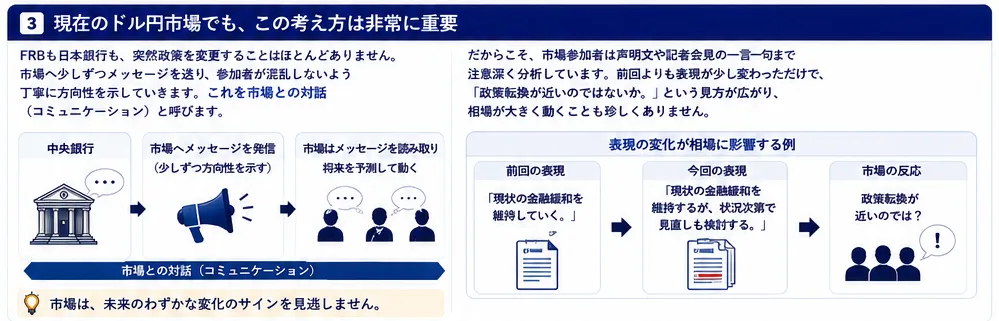
Both the Fed and the Bank of Japan rarely change policy abruptly.
They send messages to the market gradually and carefully indicate the direction so that participants are not confused.
This is called a dialogue (communication) with the market.
That is why market participants analyze every word in the statement and press conference.
Even if the wording changes slightly from the previous time,
the view that “a policy shift is near” spreads, and the market moves significantly, which is not uncommon.
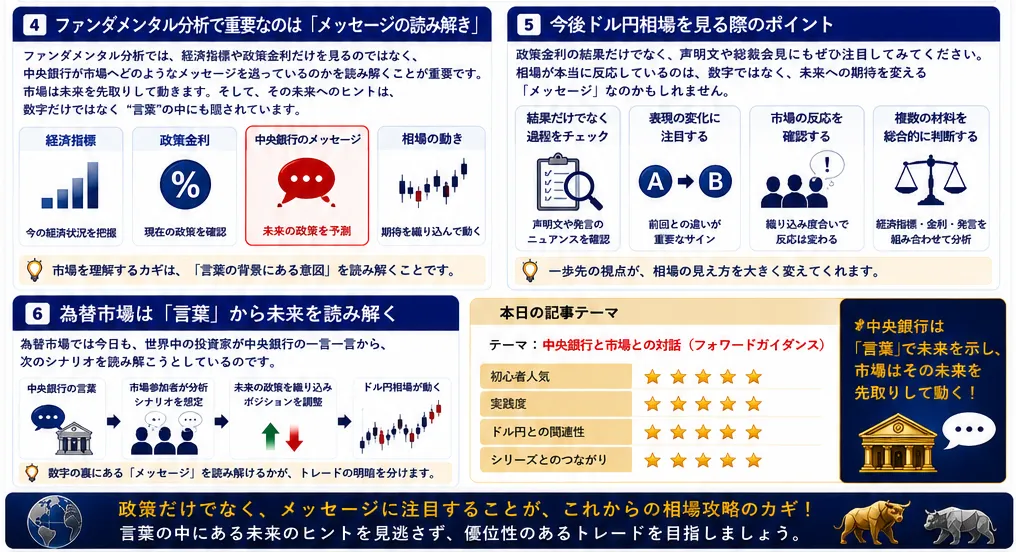
In fundamental analysis, it is important not only to look at economic indicators and policy rates, but also to read
what kind of messages the central bank is sending to the market
and interpret them.
The market moves ahead of the future.
And clues about that future are hidden not only in numbers, but also in words.
When looking at the dollar/yen in the future,
pay attention not only to the policy rate results,
but also to the statements and the governor’s press conference.
What the market truly reacts to may be
not the numbers, but
the “messages” that change expectations for the future.
In the foreign exchange market today as well, investors around the world are trying to read the next scenario from every word spoken by central banks.
★ Source URL:https://www.gogojungle.co.jp/users/186761?via=indicators_detail_users